The 2026 Lead Gen Landing Page Stack: Server-Side Tagging + Consent Mode + CRM Events Without Breaking Attribution
Lead gen tracking used to be mostly tactical. Add a few pixels, fire a thank-you-page conversion, pass UTMs into the CRM, and move on.
That no longer holds up. Browser restrictions, blocked scripts, consent enforcement, shorter identifier persistence in some environments, and platform-side modeling have changed the baseline. A client-side-only setup can still work, but it often undercounts in ways that are easy to miss and expensive to ignore.
Many teams respond by adding more tracking. Usually the better move is the opposite: define fewer events, make them cleaner, route them more reliably, and connect them to CRM truth. The goal is not perfect attribution. It is measurement you trust enough to make budget decisions.
Why lead gen measurement got harder
Browser restrictions, shorter cookie windows, and blocked scripts changed the baseline
A browser-only measurement stack depends on a lot going right. The page has to load cleanly. Scripts have to execute. The user cannot block trackers. Identifiers have to persist long enough to connect the session to the conversion. Cross-domain handoffs have to work.
In 2026, that chain breaks often enough that relying on it alone is risky.
Common examples:
- A user clicks an ad, lands on a page, and submits a form before tracking scripts finish loading.
- A consent banner suppresses ad or analytics storage until the user makes a choice.
- A thank-you page fails to load, reloads, or gets bypassed by AJAX form logic.
- An ad blocker stops platform tags but not the form itself.
- A long sales cycle leaves the CRM with a clearer history than the ad platform.
None of this is unusual. It is normal operating reality.
Consent requirements reduced observable user journeys
Consent changes what can be stored, sent, and used. That affects compliance, but it also changes measurement design. Consent Mode helps tags respond to consent state, but it does not turn a denied user into a fully observable one.[^1]
That matters because reporting conversations still blur three different things:
- observed conversions
- modeled conversions
- CRM-verified business outcomes
All three are useful. They are not interchangeable.
Platform modeling fills gaps, but only if the inputs are good
Google and Meta both rely on partial signals and modeling in privacy-constrained environments.[^2][^3] That can improve directional reporting and bidding, but the output is only as good as the inputs.
If your stack sends noisy button_click events, misses actual submissions, and never tells the platform which leads became qualified opportunities, the model is learning from weak evidence.
The real risk: optimizing on bad conversions
This is where the problem shows up in budget reviews.
If campaigns optimize to raw form fills, but half those leads never become real sales conversations, the platform may get better at finding cheap bad leads. Reporting looks busy. ROI gets worse.
Measurement problems rarely fail loudly. More often, they make weak decisions look justified.
The thesis: not more tracking, better measurement
A trustworthy stack does four things well:
- Defines conversion stages clearly
- Collects and routes signals reliably
- Respects consent state
- Feeds lead quality back into optimization
That is a better target than tracking everything.
What a trustworthy stack gives you
Not perfect numbers. Useful ones.
You should be able to answer questions like:
- Which campaigns generate real leads, not just form fills?
- Where is attribution weak because of technical loss versus sales-process delay?
- Which conversion signal should bidding optimize toward?
- Are platform reports directionally consistent with CRM reality?
What it still cannot do
Even a strong stack will not recover every lost journey.
Server-side tagging improves control and resilience, especially when using a first-party endpoint through server-side Google Tag Manager or a similar routing layer.[^4] But it does not remove consent requirements, browser limits, or platform matching constraints.
Modeled conversions can also be useful. They are still estimates, not business truth.
Why client-side-only setups quietly undercount
Most undercounting comes from one or more of these:
- tracking form button clicks instead of successful submissions
- relying only on thank-you-page logic
- consent-denied states reducing observable signals
- blocked or failed browser tags
- missing click IDs or UTMs in CRM records
- no qualified lead or sale feedback loop back to platforms
That is why this is now an architecture problem, not just a tag problem.
A practical 2026 stack for lead gen landing pages
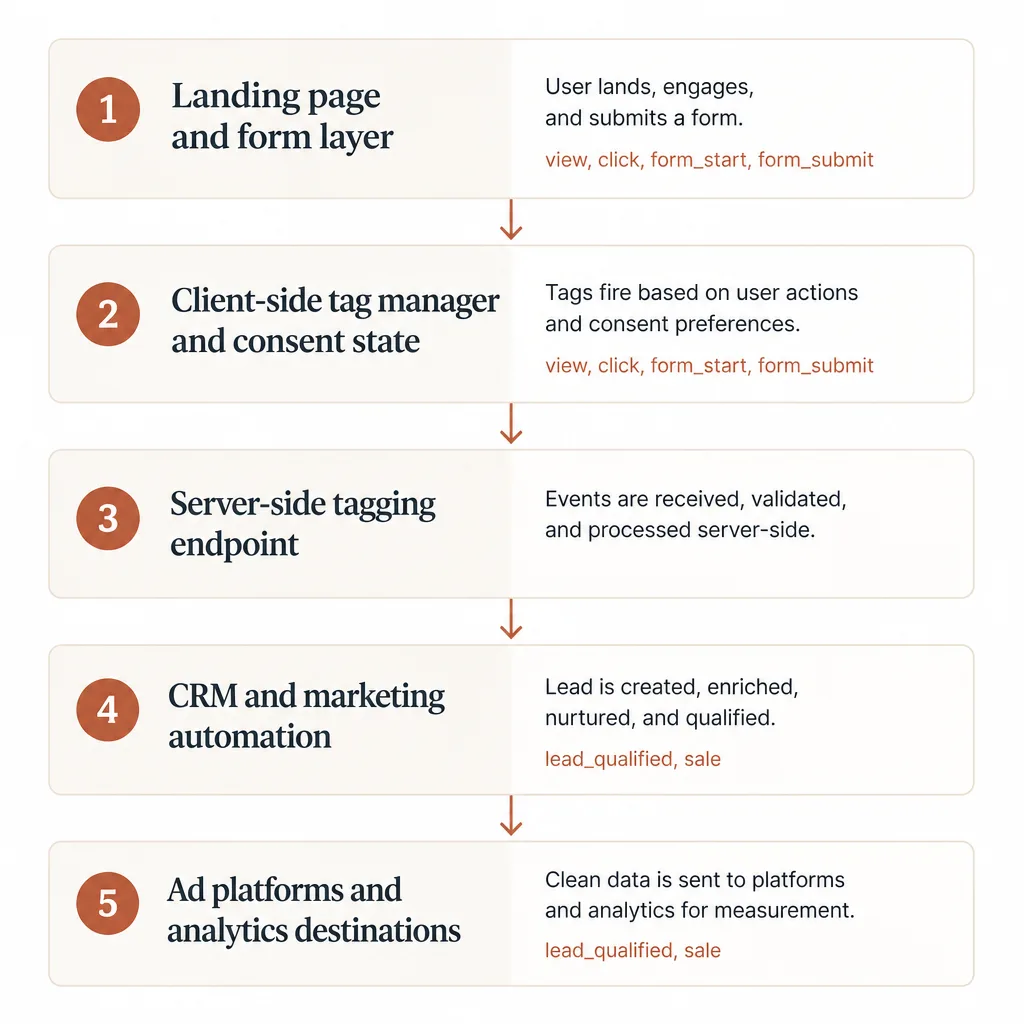
Think in layers. Each layer should have one clear job. Problems start when the same job is spread across three systems.
Landing page and form layer: clean triggers, durable identifiers
This layer should do less than many teams ask of it.
Its job is to capture page context, form interactions, and lead creation metadata cleanly. That usually means:
- storing UTMs and landing-page parameters in hidden form fields
- capturing available click IDs such as
gclid,gbraid, andwbraid - generating a stable event ID for submission-related events
- confirming actual form success, not just button intent
For a local service business with a simple quote form, capturing source, campaign, page URL, timestamp, and click IDs directly into the lead record often fixes more attribution loss than another reporting dashboard ever will.
Client-side tag manager: collect intent and consent signals
The browser layer still matters because it sees interactions first.
Use it to collect:
view- meaningful CTA
click form_start- consent state
- page and session context
Do not treat it as the final source of truth for bottom-funnel outcomes.
Server-side tagging endpoint: route first-party events to the right destinations
A server endpoint gives you routing control. You can normalize payloads, enrich metadata, and forward events to tools such as Google Analytics 4, Google Ads enhanced conversions for leads, offline conversion imports, or Meta Conversions API.[^5][^6][^7][^8]
What it improves:
- less dependence on browser execution for downstream delivery
- stronger control over what gets sent where
- better event formatting and deduplication
- more resilient first-party delivery patterns where allowed
What it does not fix by itself:
- bad event definitions
- poor CRM hygiene
- missing consent logic
- weak lead qualification rules
Consent Mode: traffic control, not recovery magic
Consent Mode is best understood as traffic control.
When consent is granted, tags can operate more fully within the approved categories. When consent is denied, behavior changes, and some ecosystems may use limited signals and modeling instead.[^1]
That can preserve some measurement utility. It does not recreate a complete user-level trail.
CRM and marketing automation: the source of truth for lead quality
For lead gen, this is the layer that matters most to ROI.
A form fill is not a business outcome. A qualified lead is closer. A sales-accepted lead, attended consultation, created opportunity, or closed sale is closer still.
If your CRM can distinguish between spam, unqualified inquiries, and real pipeline, it should drive your conversion feedback strategy.
Offline and enhanced conversion feedback: send quality signals back to platforms
This is where measurement starts becoming useful for optimization.
Google Ads supports offline conversion import and enhanced conversions for leads under specific matching conditions.[^6][^7] Meta supports server-side event delivery and matching through Conversions API workflows.[^8]
In practice, that means sending back events such as:
lead_qualifiedsale- sometimes a midpoint event like
opportunity_createdorconsultation_attended
The best optimization target is often not the last event. Closed sale can be too slow. Raw lead can be too noisy. The middle ground is usually a qualified milestone that happens early enough for learning and late enough to reflect business value.
A practical event taxonomy from click to revenue
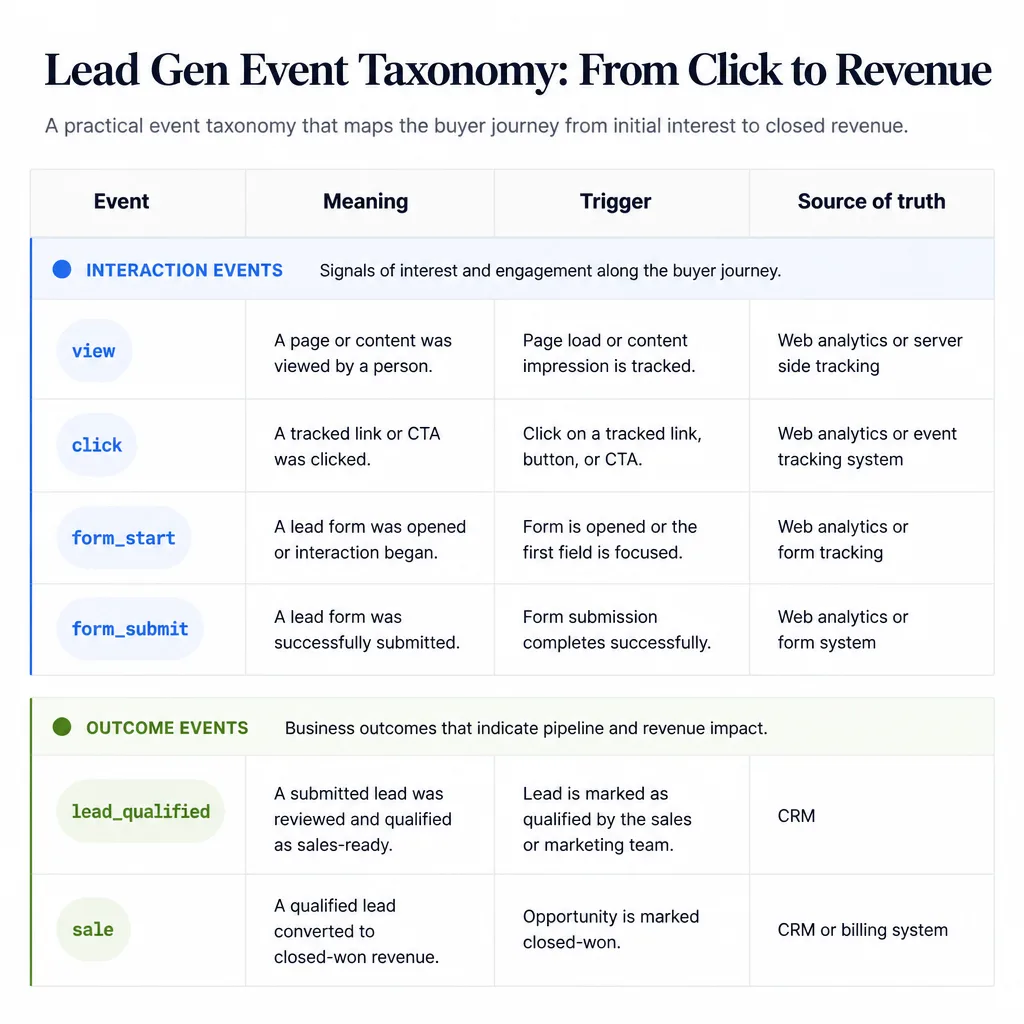
Taxonomy is really about governance. Each event should mean one thing.
| Event | Business meaning | Trigger | Source of truth | Typical destinations |
|---|---|---|---|---|
view |
Landing page loaded and usable | Page ready | Browser | Analytics, ad platforms |
click |
Meaningful CTA intent | Primary CTA click only | Browser | Analytics |
form_start |
First real form engagement | First field interaction | Browser | Analytics |
form_submit |
Successful lead creation | Confirmed form success | Form handler / backend | Analytics, server endpoint, CRM |
lead_qualified |
Lead passed quality threshold | CRM stage or score rule | CRM | Google Ads, Meta, reporting |
sale |
Revenue recognized | Closed-won / booked sale | CRM | Google Ads, Meta, BI/reporting |
view
Use this as a baseline exposure signal. Keep it simple.
click
Track meaningful CTA clicks, not every button on the page. Broad click tracking creates noise fast.
form_start
This is useful when you want to diagnose drop-off between intent and completion. Trigger it on first field engagement, not page load.
form_submit
This is where many stacks go wrong.
A button click is not a lead. A validated success state, backend confirmation, or confirmed form-handler success is the cleaner trigger.
lead_qualified
The exact definition depends on the business:
- B2B SaaS: sales accepted lead
- Local service: appointment booked and confirmed
- High-ticket education: application reviewed and approved
The important part is consistency.
sale
This should tie back to the original lead identity through captured identifiers and contact matching data where supported. Long sales cycles make this harder, which is exactly why metadata at lead creation matters so much.
How to pass identity without creating duplicate counts
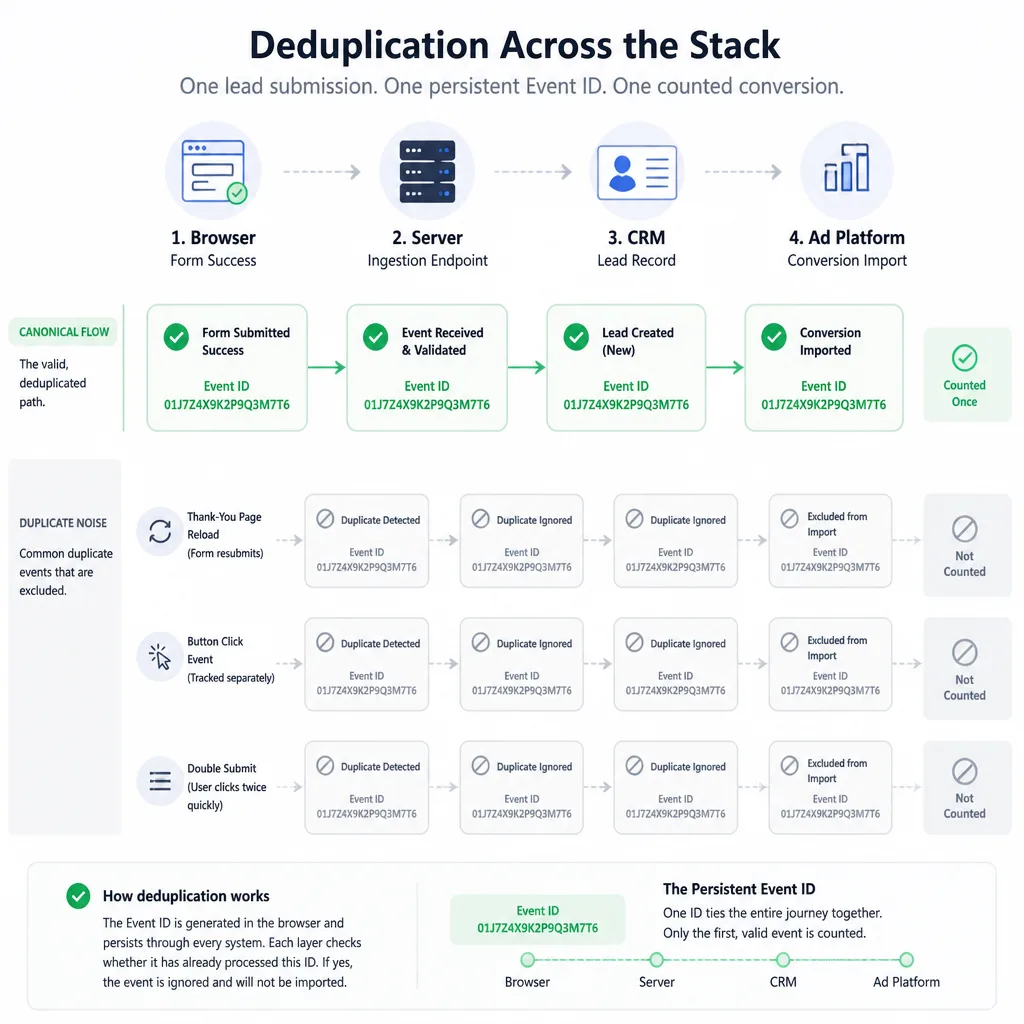
Most attribution damage is not caused by one missing tag. It comes from inconsistent identity across systems.
Use consistent event IDs across client, server, and CRM
A stable event ID is the backbone of deduplication. Generate it once for the lead-creation event and preserve it through server processing and CRM storage wherever possible.
Separate interaction events from outcome events
click and form_start are interaction signals.
form_submit, lead_qualified, and sale are outcome signals.
Do not let the same system treat a CTA click and a qualified lead as equivalent conversions.
Deduplicate form submissions and thank-you-page reloads
If your stack fires on:
- button click
- AJAX success
- thank-you page load
- CRM workflow
you are one reload away from counting the same lead two or three times.
Pick one primary source for form_submit. Usually that should be the form handler or backend-confirmed success event.
Match CRM events back using captured identifiers
At lead creation, store as much lawful and useful attribution context as your process supports:
- UTM parameters
- landing page URL
gclidgbraidwbraid- timestamp
- hashed email or phone where supported by platform workflows[^5][^8]
If you do not capture these at creation time, you usually do not get another chance later.
Keep one source of truth for each conversion stage
This rule prevents a lot of confusion:
- browser owns interaction events
- form or backend owns submission success
- CRM owns qualification and sale
Simple. Durable. Easier to audit.
How the data should flow
Step 1: user lands, consent state is set, identifiers are stored where allowed
The page loads, the CMP sets consent state, and the browser captures available attribution metadata. If consent allows storage and use, first-party identifiers can help preserve continuity.[^1]
Step 2: high-intent actions move through client and server layers
view, CTA click, and form_start fire in the browser. Relevant payloads pass to the server endpoint for normalization and forwarding.
Step 3: form submission creates a lead record with attribution metadata
On successful submit, the form handler creates a lead in the CRM with:
- event ID
- original timestamp
- source and campaign fields
- click IDs
- page context
- contact details needed for lawful matching workflows
Step 4: CRM status changes trigger qualified lead and sale events
When the lead advances, the CRM emits lifecycle events based on real business rules, not marketing guesswork.
Step 5: ad platforms receive downstream conversion feedback
Google Ads and Meta receive the conversion stages that matter for bidding and reporting, using supported matching methods and deduplication logic.[^6][^7][^8]
QA the full funnel before trusting the numbers
If one dashboard looks about right, that is not QA. It is hope.
Browser-level QA: consent states, cookie behavior, network requests
Check:
- consent-granted and consent-denied flows
- regional banner behavior
- request firing in browser dev tools
- hidden field population in forms
- SPA or AJAX form behavior, if applicable
Tag QA: event naming, parameters, trigger conditions
Check:
- exact event names
- parameter consistency
- trigger scope
- whether
form_submitrequires real success confirmation - whether CTA clicks are filtered to meaningful actions
Server QA: payload integrity, destination mapping, response errors
Check:
- incoming payload structure
- transformations and enrichments
- destination-specific field mapping
- API response codes
- dropped or malformed events
CRM QA: field capture, stage mapping, timestamp consistency
Check:
- whether UTMs and click IDs are actually stored
- whether lifecycle stage rules match sales reality
- whether timestamps use a consistent timezone
- whether original attribution fields ever get overwritten
Platform QA: imported conversions, deduplication, attribution lag
Check:
- whether imported events appear at all
- how long they take to show
- whether duplicate suppression works
- whether the platform is optimizing on the intended event
A healthy system will still show some mismatch between ad platforms and CRM. That is normal. A broken system shows patterns you cannot explain.
Common failure points that quietly break attribution
Tracking form button clicks instead of successful submissions
This is still one of the most common mistakes. It inflates lead counts and trains bidding on false positives.
Sending the same conversion from multiple paths without deduplication
A thank-you page, backend submit event, and CRM import can all be valid on their own. Together, without shared IDs, they become a mess.
Treating all leads as equal when the CRM clearly does not
If sales rejects 60% of paid leads, but the ad platform only sees lead, you are optimizing on the wrong thing.
Forgetting consent-state testing across regions
One local browser test is not enough. Consent behavior often changes by location, banner version, and tag configuration.
Assuming server-side tagging fixes poor data design
It does not. Server-side delivery can make bad data more durable. That is not progress.
What to implement first if your stack is still basic
If resources are limited, sequencing matters.
Start with event taxonomy and conversion definitions
Before any infrastructure upgrade, define:
- what counts as a lead
- what counts as qualified
- which system owns each event
- which event should be used for optimization
Then capture attribution identifiers in the CRM
This is one of the highest-leverage fixes for lead gen teams. Without captured identifiers and source metadata at lead creation, later reporting gets fuzzy fast.
Then add server-side delivery for resilience
Once event definitions are solid, add a server-side layer for routing control, first-party delivery patterns, and cleaner downstream forwarding.
Then feed qualified lead and sale events back to platforms
This is often where the biggest optimization improvement happens. Not because you tracked more, but because you taught the platforms what a good lead looks like.
The takeaway
Lead gen measurement is no longer a pixel-placement exercise. It is a systems problem that spans consent, browser behavior, event design, server delivery, CRM lifecycle tracking, and platform feedback.
The stack that wins is not the one reporting the most conversions. It is the one your team trusts enough to use for budget decisions.
That usually means fewer vanity events, better submission logic, cleaner identifiers, stronger CRM stage definitions, and disciplined QA. Perfect attribution is gone. Decision-worthy measurement is still very achievable.
FAQ
Why does client-side-only lead tracking undercount conversions in 2026?
Because too much of the measurement chain depends on the browser. Script blocking, consent-denied states, shorter identifier persistence in some environments, thank-you-page failures, and cross-domain issues can all reduce observable conversions. A client-side setup can still work, but it is more fragile than many teams realize.
What does server-side tagging actually improve?
Server-side tagging improves control over data routing, makes event delivery less dependent on browser execution, and can strengthen first-party data handling where consent allows it. It often improves resilience and governance. It does not restore perfect attribution, bypass consent requirements, or fix weak event definitions on its own.
Does Consent Mode restore full user-level attribution?
No. Consent Mode changes how tags behave based on consent choices and can support modeled measurement in some ecosystems, but modeled conversions are not the same as fully observed user journeys. It helps preserve measurement utility while respecting consent, not recover every lost signal.
What is the minimum event taxonomy for a modern lead gen landing page?
A useful baseline is view, click, form_start, form_submit, lead_qualified, and sale. The key is not the number of events. It is making each one mean one specific thing, assigning one source of truth for each stage, and using CRM-based events to improve optimization quality.
How should form_submit be tracked without double counting?
Track successful submission, not button clicks. The cleanest approach is to confirm success through the form handler, a validated success state, or a backend event tied to a stable event ID. Avoid sending the same submit event from multiple paths unless you have clear deduplication logic.
Why are CRM events so important for attribution and optimization?
Because raw form fills are often poor proxies for business value. CRM events such as lead_qualified, sales accepted lead, pipeline creation, or sale tell ad platforms which leads were actually useful. For many teams, this is the biggest measurement upgrade because it aligns optimization with lead quality rather than lead volume.
What identifiers should be captured at lead creation time?
At minimum, capture available source and campaign metadata plus relevant platform click identifiers and legally usable contact fields for later matching. Depending on platform and implementation, this may include UTM parameters, gclid, gbraid, wbraid, landing-page URL data, and hashed contact details where supported.
How do you prevent duplicate conversions across browser, server, and CRM systems?
Use consistent event IDs, separate interaction events from outcome events, and define one system of truth per conversion stage. Most duplicate-counting problems happen when the same lead is sent from page tags, thank-you pages, backend handlers, and CRM workflows without a shared identifier or ownership rule.
What should be QA tested before trusting the numbers?
Test the full chain: consent state behavior, browser requests, trigger conditions, parameter mapping, server payloads, destination responses, CRM field capture, lifecycle stage transitions, imported conversions, deduplication behavior, and normal attribution lag. Measurement trust comes from reconciliation across systems, not from one dashboard looking plausible.
What should a small team implement first if the stack is still basic?
Start with event definitions and lifecycle ownership. Then make sure attribution identifiers are captured in the CRM at lead creation. After that, add server-side delivery for better control and resilience. Finally, push qualified lead and sale events back to ad platforms. Adding more infrastructure before fixing event logic usually makes bad data more durable, not more useful.