Affiliate Offer Research With Ad Libraries and SERP Intelligence
By the time an offer is visible across every affiliate network, the easy edge is usually gone. The listing is public, the angles are recycled, and too many affiliates are testing the same thing at once.
Early discovery does not require insider access. It usually requires better observation. Advertisers leave public clues before an offer becomes common network inventory: active creatives, repeated hooks, persistent search ads, bridge pages, advertorials, lead forms, upsells, and branded search behavior.
The useful shift is this: stop asking, “What offers are available?” and start asking, “Who is still spending, what funnel are they using, and what does that suggest about the economics?” Ad libraries and SERP signals will not prove profitability. Used together, though, they can produce a much stronger shortlist than stale network listings.
Why offer discovery usually fails
Most affiliates start where access is easiest: network dashboards, offer newsletters, spy-tool screenshots, and forum chatter. The problem is that those sources mostly show visibility, not momentum.
Network listings show availability, not momentum
A network listing tells you an offer exists and can be promoted. It does not tell you whether the advertiser is scaling now, whether the economics still work, or whether the best version of the deal is private, geo-restricted, or limited to selected partners.
That is why marketplaces are often lagging indicators. They show what is promotable. They rarely show where serious spend is happening right now.
A supplement offer might sit in a network for months with mediocre economics. At the same time, a private lead-gen funnel in insurance or finance may be buying aggressively through direct relationships and never appear in the places most affiliates check first.
The better question: who is still spending, and why?
That question changes the research process.
One-off creative discovery is noisy. Repeated advertiser presence is more useful. If the same brand, product, or promise keeps appearing across weekly checks, that suggests the campaign is clearing some economic threshold. Not guaranteed profit. Not proof of scale. But worth studying.
Ad libraries are better at showing who is trying than proving who is winning. That is why persistence matters more than presence.
Follow spend patterns, not affiliate gossip
If you want a repeatable edge, track public market behavior instead of public affiliate conversation.
What ad libraries can tell you
Tools like Meta Ads Library, Google Ads Transparency Center, and TikTok Creative Center reveal advertiser behavior that network listings cannot.[^1][^2][^3]
They can help you spot:
- advertisers running multiple active creatives
- recurring hooks and offers
- angle variation across geos or audiences
- bridge-page or advertorial patterns
- multi-platform activity
- repeated presence over time
If a sleep supplement brand is testing five mechanism angles on Meta, covering branded search on Google, and pushing UGC-style hooks on TikTok, you are seeing more than a random listing. You are seeing active market behavior.
What they cannot tell you
On their own, these tools do not show:
- true spend levels
- CPA or EPC
- targeting quality
- refund rates
- approval rates
- backend monetization
- retention value
- call-center economics
- whether the campaign is profitable for affiliates
A funnel can look strong in public while relying on assets you cannot see: email nurture, SMS follow-up, booked-call sales teams, continuity billing, or high-LTV upsells. The point is not to copy the funnel. It is to infer what economics it appears to be built around.
Start with active advertiser discovery
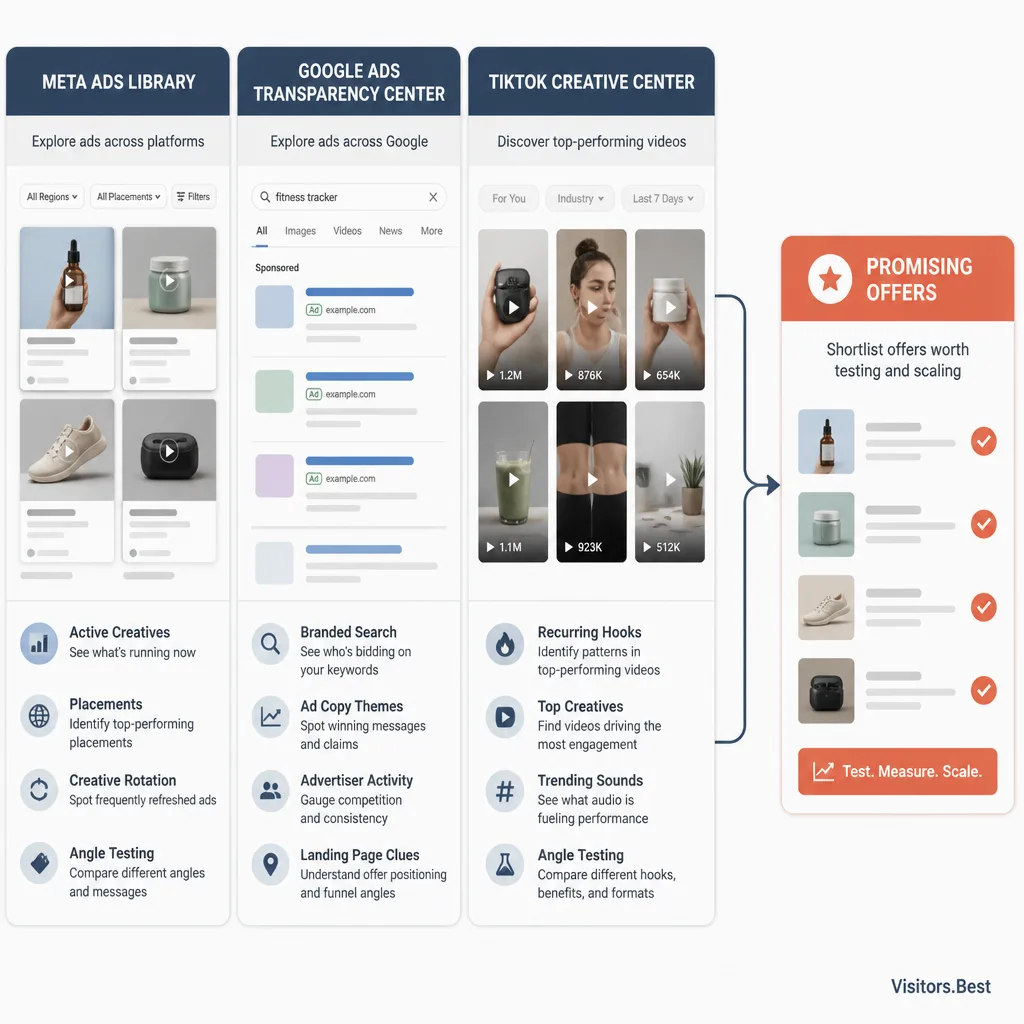
The first layer is simple: find advertisers that appear to be buying traffic now.
Meta Ads Library: look for sustained testing, not random volume
Meta Ads Library is useful for spotting breadth and persistence.[^1] Search by brand, product category, or problem language. Then look for patterns rather than isolated ads.
Signals worth watching:
- multiple active creatives at once
- meaningful hook variation, not just cosmetic changes
- recurring claims or promises
- localized versions for different geos
- the same advertiser appearing week after week
Suppose you track a skincare brand for four weeks and keep seeing fresh creatives built around the same promise, but with different entry angles: dermatologist framing, before-and-after framing, ingredient education, and creator-style testimonials. That usually suggests deliberate testing, not a one-day experiment.
What you should not do is treat raw ad volume as proof of profit. Large creative sets can also reflect moderation churn, agency process, or broad account structure.
Google Ads Transparency Center: add search intent to the picture
Google Ads Transparency Center adds a different layer of evidence.[^2] Search activity often matters more than social visibility in categories where people actively compare options, such as software, insurance, finance, home services, and B2B lead gen.
Useful things to look for:
- branded search ads
- review-term coverage
- comparison-intent positioning
- display creatives tied to the same funnel
- consistency between ad copy and landing-page messaging
If a budgeting app or tax-relief brand is bidding on its own name, category terms, and review-style intent, that suggests it is not relying only on interruption-based social traffic. There may be durable demand underneath.
Again, caution matters. Search visibility does not reveal impression share or profitability. It simply gives you a stronger intent signal.
TikTok Creative Center: spot hooks before they spread
TikTok Creative Center is especially useful for early creative pattern recognition.[^3] It can show how products are being framed before those hooks spread everywhere else.
Watch for:
- repeated creator-style variations around one product story
- strong product-demo formats
- the same mechanism explained by different creators
- movement from novelty hooks to sharper conversion messaging
A posture product might first show up as “look at this weird gadget” creative, then evolve into pain-relief explanations, office-worker angles, and before-and-after lifestyle framing. That shift often suggests the advertiser is refining what converts, not just what gets attention.
TikTok is also where people get fooled fastest. Strong top-of-funnel creative can hide weak downstream economics. A product that looks viral is not automatically a good offer.
Reverse-engineer the funnel behind the ad
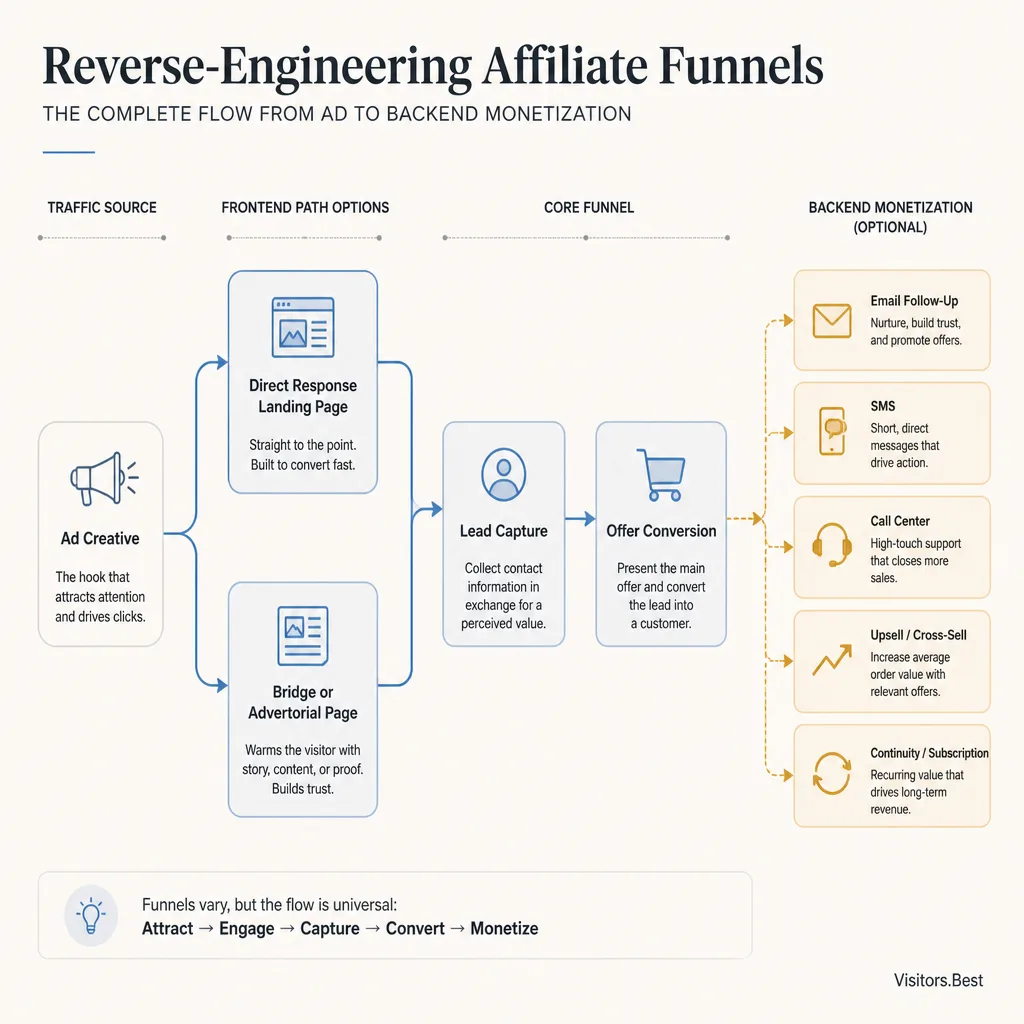
This is the step many people skip. Seeing the ad is not enough. You need to inspect the funnel logic behind it.
Landing pages: direct response or bridge page?
A direct response page asks for the conversion quickly: buy now, start trial, submit a lead, book a call.
A bridge page does something else first. It warms the click through education, pre-qualification, or softer compliance framing before sending the visitor to the money page.
That distinction matters. A software trial may go straight to signup because the product already matches search intent. A joint-pain offer from social traffic may need a bridge page or quiz because the user needs more persuasion first.
Advertorials: what belief shift is the page creating?
Do not judge advertorials by polish alone. Ask what belief shift they are trying to create.
Usually it is one of these:
- skepticism to belief in a mechanism
- curiosity to urgency
- problem awareness to solution awareness
- fear to action
- confusion to simplification
A finance lead-gen page, for example, may not be trying to sell immediately. It may be moving the visitor from vague financial stress to the belief that a short application is worth completing. That is a very different job from a direct ecommerce checkout page.
Lead capture: where follow-up value gets created
If the funnel captures email, phone, quiz data, or application details before the final offer, pay attention. That often means the economics depend on follow-up.
The lead may be monetized through:
- email nurture
- SMS remarketing
- call-center qualification
- lead resale
- appointment setting
- delayed close sequences
This is one of the biggest hidden variables in affiliate research. A front-end funnel can look mediocre if you judge it only by immediate conversion, while the advertiser makes the economics work on the backend.
Upsells and post-click flow: what the model may depend on
Some offers can afford aggressive acquisition because the real margin comes after the first conversion.
Common clues include:
- continuity subscriptions
- order bumps
- post-purchase upsells
- booked-call transitions
- premium upgrades
- retention-driven LTV
If you see a supplement funnel with a low-entry trial and multiple continuity cues, or a software funnel routing qualified leads into demos and upgrades, the front-end economics may not be reproducible for a third-party affiliate on a standard payout.
Use SERP signals to filter false positives
Ad-library visibility alone creates too many false positives. SERP behavior helps separate noise from something more durable.
Repeated search presence is a durability signal
If you keep seeing the same advertiser in search results over time, that is often a stronger clue than a single social creative sighting.
This matters most in categories with active comparison behavior:
- insurance
- finance
- SaaS
- home services
- high-consideration health products
If a brand keeps appearing on problem-aware queries, branded terms, or review-intent searches, there is at least some evidence of continuing demand capture.
Short bursts are harder to interpret
A brief ad burst may signal weak economics, but not always.
Common explanations include:
- the test failed
- moderation killed the campaign
- seasonality ended
- inventory ran short
- the advertiser rotated domains or accounts
- the campaign reached a narrow objective and stopped
So if an ad disappears, do not jump straight to “the offer is dead.” Public observation is suggestive, not diagnostic.
Brand search, review SERPs, and compliance clues
Brand search tells you whether demand exists beyond the ad impression.
Check for:
- branded ads on the advertiser’s own terms
- review pages ranking for the offer
- comparison queries around the product or category
- SERPs crowded with thin affiliate reviews
- mismatches between claims and disclaimers
If review SERPs are already packed with low-quality affiliates, the opportunity may be late and crowded. If the brand has little public noise but clear paid presence, that can be more interesting.
Also watch for compliance clues. Sensational claims, vague disclaimers, and frequent domain rotation can point to short-half-life campaigns. Active ads are not the same as safe ads.
Build a shortlist you can act on
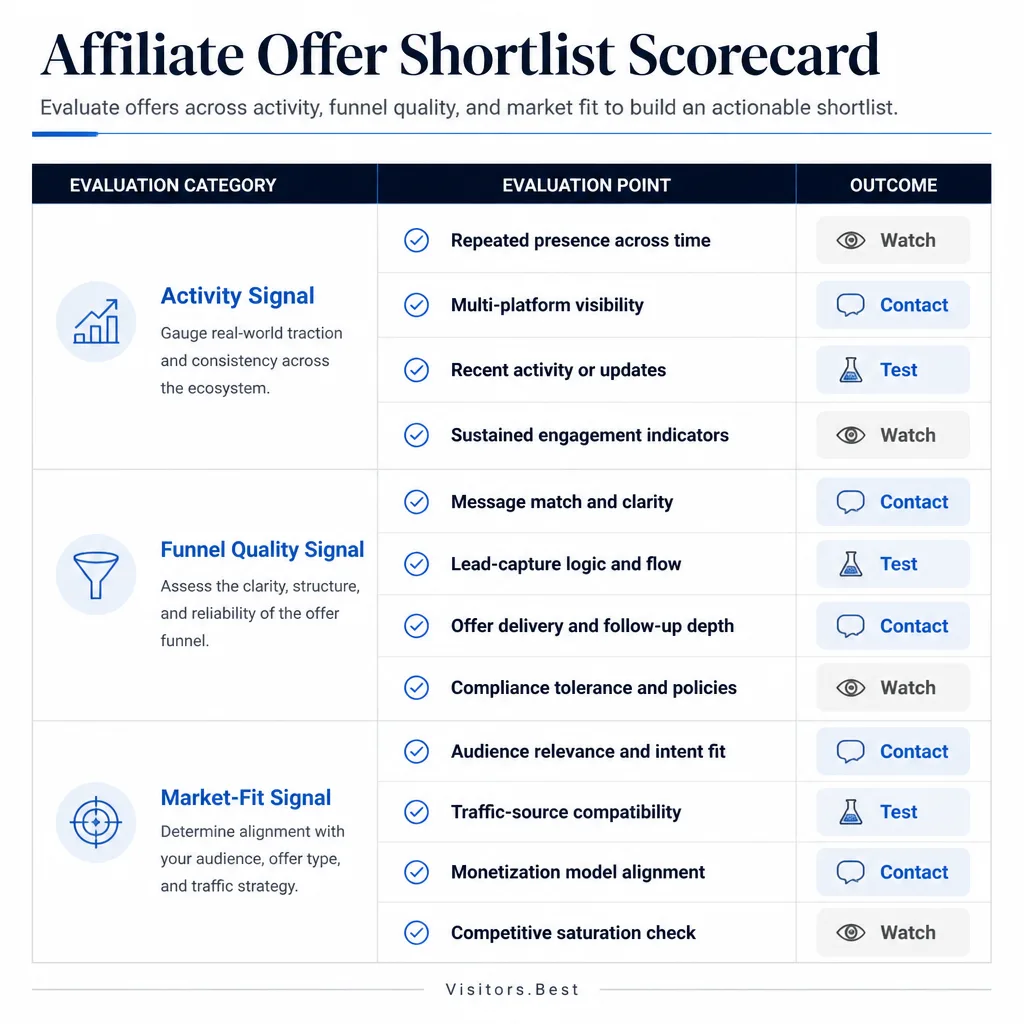
Research only matters if it leads to better decisions.
Score offers by activity, funnel quality, and market fit
A simple scorecard works better than a folder full of screenshots. Use three buckets:
1. Activity signal
- repeated weekly presence
- multi-platform visibility
- angle variation
- geo expansion
2. Funnel quality signal
- strong message match
- coherent persuasion path
- visible lead-capture logic
- believable conversion design
- signs of backend economics
3. Market-fit signal
- matches your traffic source
- fits your compliance tolerance
- works in your geos
- suits your operational strengths
A finance lead-gen funnel may score high on activity and funnel quality but low on market fit if your strength is short-form ecommerce traffic from TikTok. That matters. Good offers still fail when the traffic-source fit is wrong.
What to note before contacting an affiliate manager
Before outreach, document:
- brand or offer name
- category
- geos observed
- platforms observed
- primary hooks
- landing-page type
- lead-capture or upsell clues
- SERP notes
- why your traffic source fits
That changes your outreach from “Do you have any good offers?” to something much stronger:
I’ve been tracking this funnel in the US and Canada across Meta and Google for three weeks. The review-intent SERPs look active, and I think it fits my search traffic. Is there a private or direct deal available?
That sounds like a buyer, not a browser.
When direct outreach makes more sense than waiting for a listing
Direct outreach is often smarter when:
- the advertiser is clearly active but absent from common networks
- the category tends to run on private deals
- you want better economics than public listings usually offer
- the funnel looks sophisticated enough that coordination matters
Private opportunities often go to affiliates who can show they have done the homework.
Mistakes that make this process look smarter than it is
This method improves decision quality. It does not create certainty.
Confusing ad presence with profitability
The most common mistake is also the simplest one. Visible ads prove visible activity. They do not prove a winning offer.
Ignoring traffic-source fit
A bridge funnel built for cold Meta traffic may fail on search. A TikTok impulse product may not survive native traffic economics. The offer is only half the question. Traffic-source fit is the other half.
Missing backend and retention economics
If the advertiser relies on continuity, call-center closes, CRM follow-up, or high-LTV upsells, copying the front end alone can produce misleading test results.
Copying surface elements instead of understanding the mechanism
Headlines, colors, and advertorial layouts are surface features. What matters is the mechanism: what belief is being created, what objection is being handled, and how the funnel earns the right to ask for the conversion.
A simple weekly workflow
You do not need a huge research system. You need consistency.
What to review each week
Once a week, run this cadence:
- Check saved brands, product categories, and problem keywords in Meta Ads Library.
- Review Google advertiser visibility for branded and review-intent patterns.
- Scan TikTok Creative Center for emerging hooks and repeated product stories.
- Revisit landing pages and note any funnel changes.
- Spot-check SERPs for durability and crowding.
What to document
Keep a date-stamped sheet with columns like:
- offer or brand
- category
- first seen
- last seen
- platforms observed
- main hook
- landing-page type
- lead capture present
- monetization clues
- SERP notes
- compliance notes
- outreach status
The dates matter. Without weekly snapshots, it is hard to tell the difference between active scaling and random discovery.
When a signal is strong enough to justify outreach or testing
Usually not after one ad sighting.
A better threshold is:
- repeated presence across multiple checks
- a coherent funnel
- at least one extra durability clue, such as search visibility or multi-platform activity
That still does not prove profitability. It simply lowers the odds that you are chasing dead noise.
Final takeaway
Most affiliates start with what is public to affiliates. The better place to start is what is public to the market.
Network listings tell you what can be promoted. Ad libraries and SERPs show where money may already be moving.
That is the habit worth building: watch sustained advertiser behavior, inspect the funnel behind it, and validate demand with search signals before you ask for a link.
You do not need insider lists to find better opportunities earlier. You need a disciplined way to notice who keeps showing up, what their funnel is designed to do, and whether the pattern is strong enough to deserve your testing budget.
FAQ
Can ad libraries prove an affiliate offer is profitable?
No. They can show that an advertiser is active, testing creatives, or persisting over time, but they do not reveal profit margins, conversion rates, refund rates, targeting quality, or backend monetization. Use them as directional signals, not proof.
What is the main advantage of using ad libraries for affiliate offer research?
They let you observe public market behavior instead of relying only on affiliate network listings. That helps you spot active advertisers, repeated hooks, and funnel patterns earlier, sometimes before an offer becomes crowded.
Why are network listings a weak starting point?
Because they show availability, not momentum. An offer can sit in a network for a long time without scaling, while active advertisers may be spending heavily on offers that are private, geo-limited, or not yet visible across major networks.
How should I use Meta Ads Library in this process?
Use it to identify advertisers with multiple active creatives, recurring hooks, localized variants, and week-over-week persistence. The goal is not to count ads blindly, but to see whether the same brand or product keeps showing signs of active testing.
What does Google Ads Transparency Center add?
It adds search and display context. Search activity can be especially useful because it may reflect intent-driven demand, branded bidding, review-term coverage, and more durable market interest than a short burst of social traffic.
How is TikTok Creative Center useful for finding offers early?
It helps surface emerging hooks, creator-style ad patterns, product demos, and repeated story angles. That makes it useful for spotting early momentum, although strong top-of-funnel creative does not guarantee good post-click economics.
What should I look for when reverse-engineering a funnel?
Look at message match between ad and landing page, whether the page is direct response or a bridge page, what belief shift the advertorial is trying to create, whether there is lead capture, and whether upsells or post-click steps suggest backend monetization.
Why does ad persistence matter more than one-off discovery?
Because one-off discovery often finds noise. Persistence across repeated checks is a stronger sign that a campaign may still be meeting some economic threshold. It still does not prove profitability, but it usually means more than spotting a single creative once.
How can SERP signals help validate an offer?
Repeated advertiser presence in search results, branded search activity, review SERP coverage, and ongoing ad visibility can suggest that demand is more durable than a brief social push. Used with ad-library data, SERPs help reduce false positives.
What are the biggest mistakes with this method?
The biggest mistakes are treating visibility as proof of profitability, ignoring traffic-source fit, overlooking hidden backend economics like upsells or retention, and copying surface funnel elements without understanding the conversion mechanism.
When is a signal strong enough to justify outreach?
Usually when you have more than one supporting sign: repeated advertiser presence, a coherent funnel, and at least one extra durability clue such as search visibility, multi-platform activity, or consistent angle testing. One ad sighting alone is usually too weak.
When does direct outreach make more sense than waiting for a network listing?
When an advertiser appears active but is missing from common marketplaces, when the category often runs on private deals, or when better economics likely depend on a more direct relationship.
[^1]: Meta Ads Library, official resource: https://www.facebook.com/ads/library/ [^2]: Google Ads Transparency Center, official resource: https://adstransparency.google.com/ [^3]: TikTok Creative Center, official resource: https://ads.tiktok.com/business/creativecenter/