How to Drive Relevant Traffic to a Telegram Channel From Google Search (Without a Website-First Strategy)
If you want Google traffic without building a full content site, Telegram can seem like the obvious shortcut. It is fast, direct, and built for ongoing updates. The catch is that Telegram itself is rarely what Google wants to rank for non-branded searches.
That creates a simple split. Google needs a public, indexable page that clearly answers a searcher’s question. Telegram works better later, once someone understands the value and wants ongoing alerts, curation, or access.
So the practical model is not “make Telegram rank.” It is: create a small set of lightweight search pages that match clear intent, build trust quickly, and send the right people into your channel. If Google is the discovery layer, Telegram should usually be where the relationship continues, not where it starts.[^1]
Why Google-to-Telegram works differently from a normal SEO funnel
In a typical SEO funnel, one asset does two jobs: it ranks and it converts. A blog post or landing page gets found in Google, answers the query, and drives the next action.
With Telegram, those jobs are usually split.
Telegram is the destination, not usually the ranking asset
Public Telegram pages can appear in Google, but they give you limited control over metadata, page structure, internal linking, and on-page relevance. That makes Telegram a weak primary SEO asset compared with even a basic owned page.[^1]
The issue is not just crawlability. Search performance depends on being the best match for a specific query, and a Telegram channel page rarely gives you enough room to do that well.
So yes, Telegram can be the destination. It usually should not be the main ranking surface.
The real challenge is trust
Getting the click from Google is only part of the job. The harder part is convincing a stranger to join a channel they have never seen before.
Someone searching for “remote startup jobs Telegram channel” or “SEO news Telegram for agencies” is not looking for a generic invite. They want proof that the channel is focused, current, useful, and not spammy.
That is why thin pages fail twice: they struggle to rank, and they do not build enough trust to convert.
What can rank if the goal is Telegram subscribers
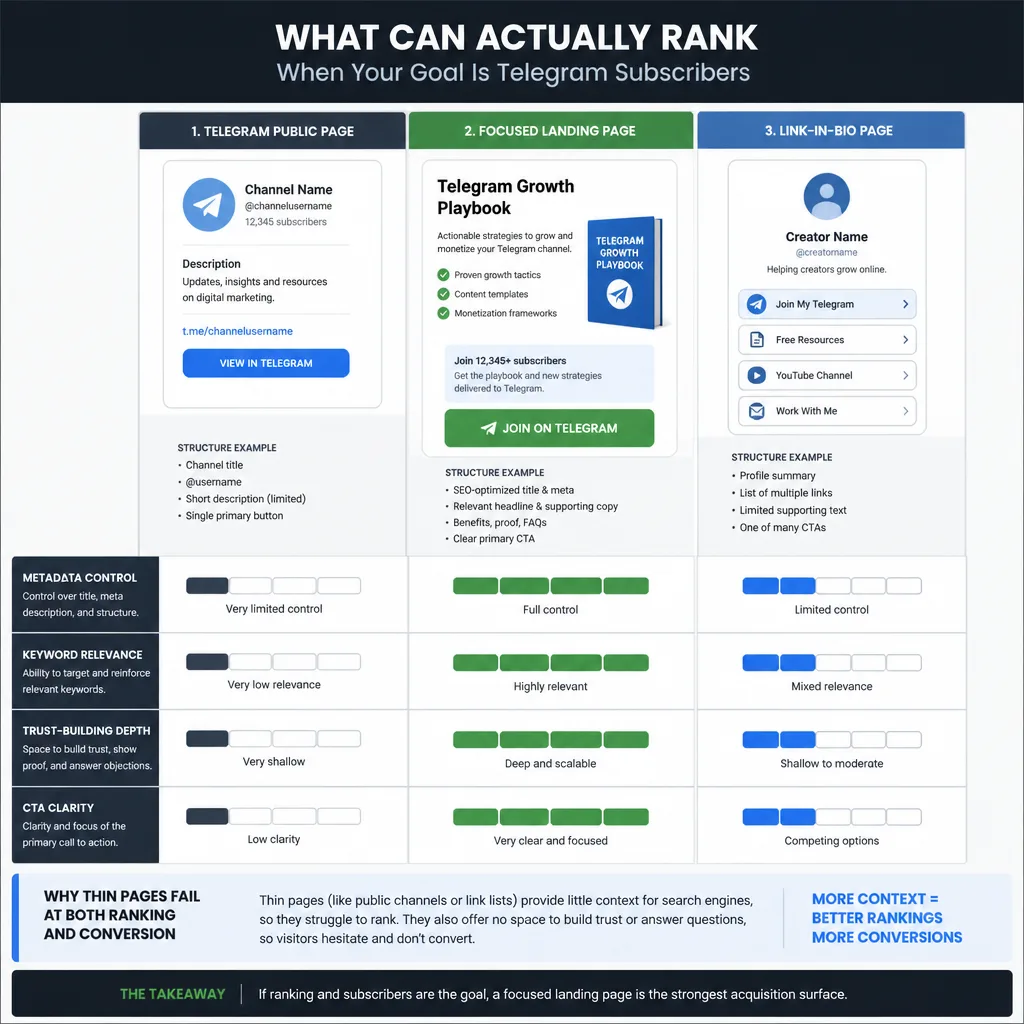
You do not need a large website. You do need some searchable surface outside Telegram.
Option 1: a focused landing page
For most small operators, this is the best default.
A focused landing page can target one intent cluster with one page. You control the title, heading, copy, screenshots, FAQ, CTA, and analytics. That makes it much easier to compete for non-branded searches than with a generic profile or link hub.
Good examples are not “Join my Telegram channel.” They are more specific:
- “Daily crypto airdrop alerts Telegram channel”
- “Remote startup jobs Telegram channel”
- “SEO news Telegram channel for agencies”
These are not ranking guarantees. They are examples of intent-focused pages where Telegram is a natural destination because the value continues over time.
Option 2: a link-in-bio page
A link-in-bio page is convenient, but usually weak for SEO.
It spreads attention across multiple destinations, rarely matches a single query well, and often lacks enough original information to satisfy search intent. That makes it more useful for branded search, podcast mentions, social traffic, or profile visits where discovery is already solved.
If people already know you, a link hub may be enough.
If they are searching Google for a problem, it usually is not.
Option 3: lightweight publishing platforms
This is the middle ground.
Tools like Carrd, Notion, Substack, or Beehiiv can work as search entry points, but not equally well.
A few patterns show up in practice:
- Carrd is fast and simple, but many pages are too thin. It works better when you treat it like a real landing page rather than a digital business card.
- Notion is easy to publish, but the presentation can feel generic and conversion control is limited.
- Substack works better when content is doing more of the discovery and Telegram is a secondary CTA.
- A simple custom site usually gives the best long-term balance of control and effort once the idea starts working.
The real question is not which tool is best in theory. It is which one gives you enough clarity for indexing and enough trust to make the Telegram click feel reasonable.
The simplest setup that works for most people
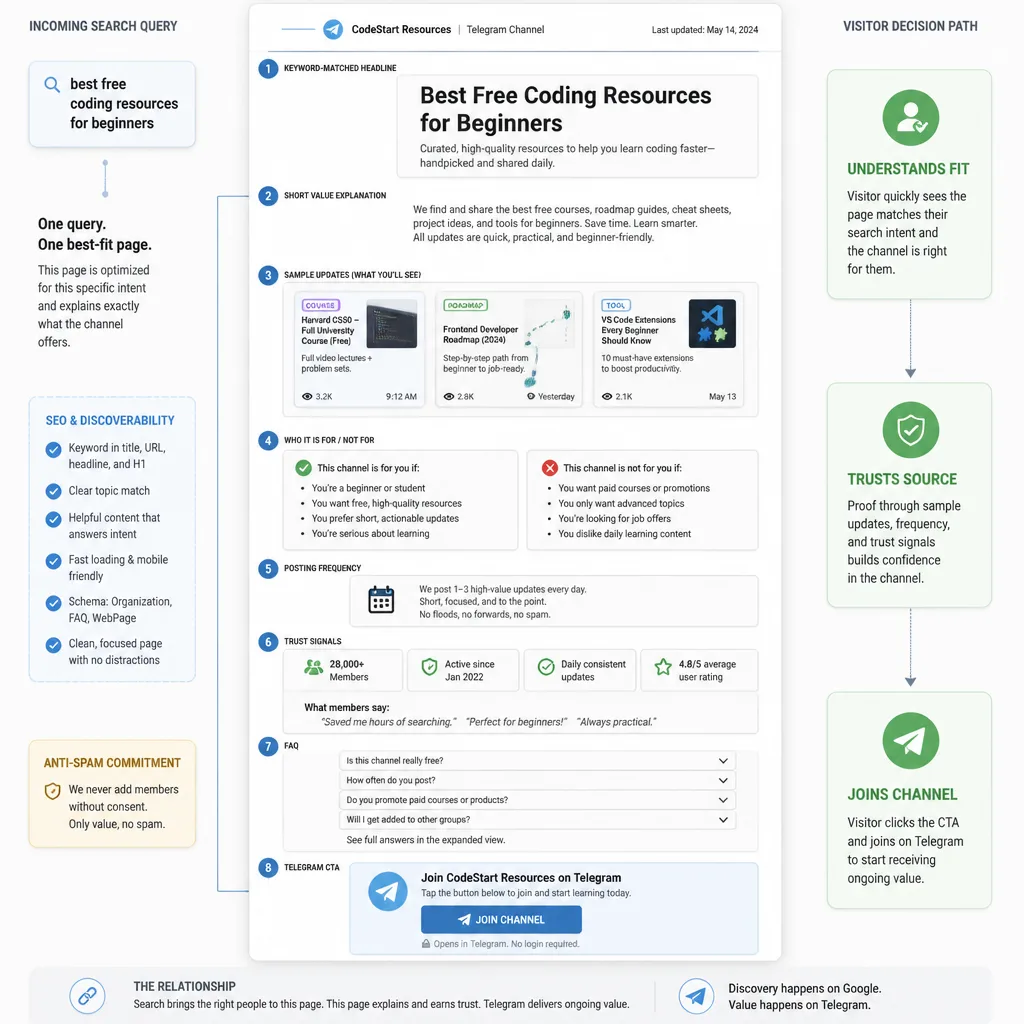
For most readers, the best setup is intentionally small.
Use one search page per intent cluster
Do not start with a homepage and a vague blog.
Start with three to five pages, each built around a clear query cluster. One page might target startup job seekers. Another might target agency SEO updates. Another could target deal alerts for a specific niche.
This tends to work better than a generic “about the channel” page because search intent is specific. New or low-authority projects usually perform better with narrow relevance than broad positioning.
Let the page explain; let Telegram deliver
Think of the flow like this:
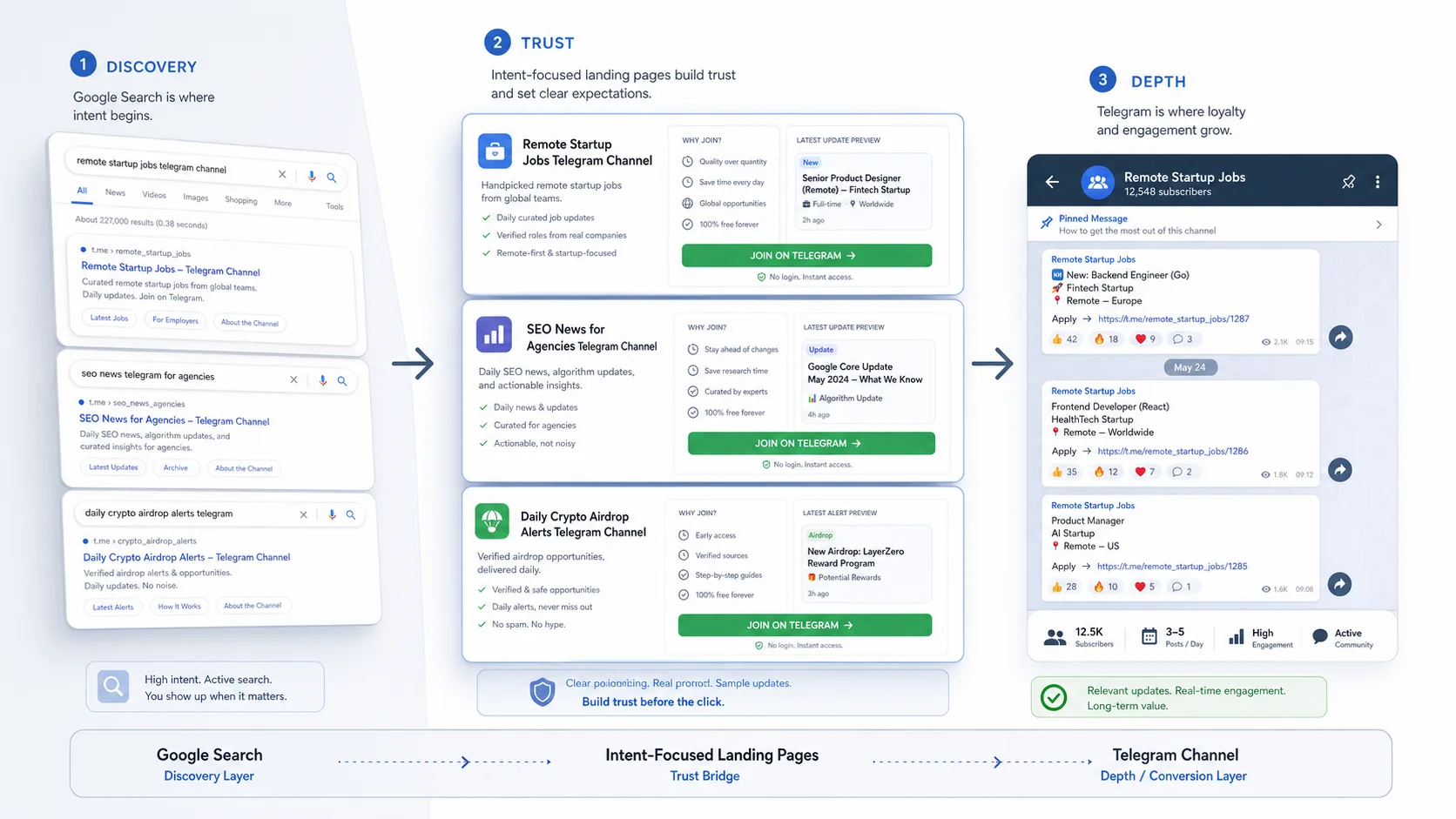
Search Surface -> Trust Page -> Telegram Depth
That is the model.
The public page earns discovery.
The page explains the value and qualifies the visitor.
Telegram delivers the ongoing benefit.
This matters because if the Telegram channel has to do all the explaining, the join feels abrupt. If the page does enough educational work first, joining feels like the natural next step.
Add trust signals before the click
Before asking someone to join, answer the obvious questions:
- Who runs this?
- What exactly gets posted?
- How often?
- Is it curated or noisy?
- Who is it for?
- Will this waste my time?
Useful trust elements include:
- a named operator or brand
- a short statement of specialization
- screenshots or sample updates
- posting frequency
- who the channel is for, and who it is not for
- anti-spam expectations
- testimonials or credibility markers, if they are legitimate
One useful contrarian point: filtering out the wrong subscribers often improves channel quality more than maximizing joins.
How to make the page discoverable and credible
This part is less technical than many people assume.
Match one clear intent per page
Do not target something vague like “marketing Telegram.”
Target a specific need. For example, “SEO news Telegram for agencies” is clearer than “best SEO channel.” Narrow phrasing gives you a better shot at matching what the searcher actually wants.
A page should usually serve one query cluster, not a grab bag of loosely related topics.
Write for answer-first behavior
Searchers decide quickly, so the top of the page should immediately answer three things:
- what the channel provides
- who it is for
- why Telegram is the right format
A simple structure works well:
- headline that matches the query
- short explanation of the value
- recent examples of updates
- who should join
- posting frequency
- proof or credibility
- Telegram CTA
- short FAQ
This structure helps both ranking and conversion because it feels useful rather than pushy.
Make the offer specific
The page should not try to replace the channel. It should make the channel feel worth joining.
If the page targets “remote startup jobs Telegram channel,” do not just say you post jobs. Explain how you filter them. Early-stage only? Remote-first? Salary-visible? Global? Founder-vetted?
Specificity builds trust.
Cover the indexing basics
If you control the page, handle the basics from Google Search Essentials:
- unique title tag
- descriptive H1
- readable URL
- enough original copy
- mobile-friendly layout
- public, crawlable page
- no accidental
noindex - internal links if you have multiple pages
- a simple sitemap if possible
If you use your own domain, connect it to Google Search Console so you can inspect indexing and see query data.[^2]
You do not need complex SEO architecture here. You need clear, helpful pages that can be indexed.
A simple search-to-channel funnel
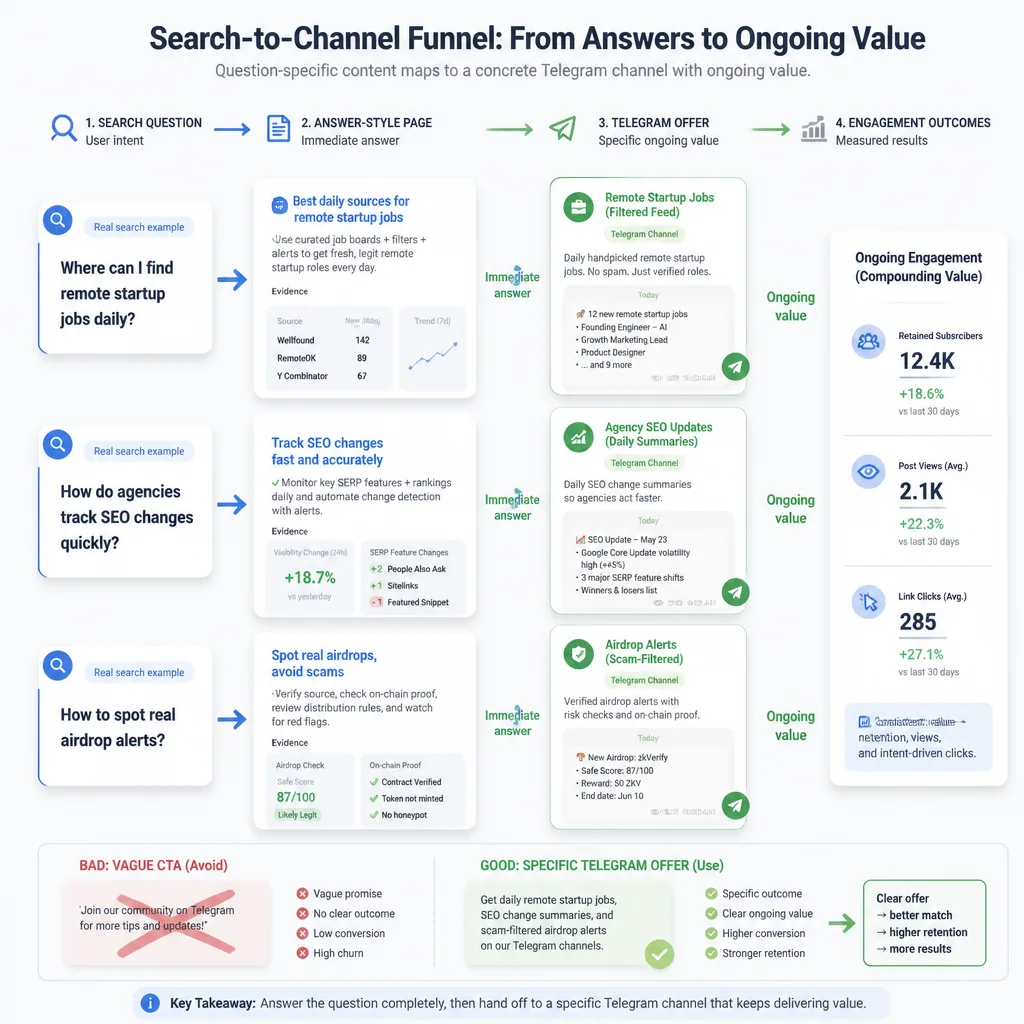
The best version of this model is not “publish a page and hope.” It is repeatable.
Publish pages that answer a specific search question
Answer-style pages work well because they mirror how people search. They also fit small operators better than trying to run a large editorial site.
This approach tends to work best for:
- alerts
- curated updates
- jobs
- niche news
- market or compliance changes
- tool launch tracking
- “how to find X consistently” topics
These topics work because the public page solves the immediate question, while Telegram delivers ongoing value afterward.
Make the Telegram offer concrete
This is where many pages go wrong. They answer a question, then end with “Join our Telegram for more.”
More what?
The invitation needs to be specific. Better examples:
- get daily filtered jobs instead of stale listings
- get same-day SEO update summaries instead of monitoring multiple sources
- get curated airdrop alerts with scam filtering
- get weekly agency-relevant changes instead of general SEO chatter
The ongoing value should be more timely, more filtered, or more actionable than the page itself.
Create a clean handoff
Give enough on the public page to earn trust. Keep the recurring value inside Telegram.
A page about “SEO news Telegram for agencies,” for example, could explain what busy agency teams actually need, show three sample update summaries, and then invite readers to join for ongoing curated alerts instead of constant industry noise.
That is a much stronger handoff than “join our community.”
Tracking: what you can measure and what you cannot
Measurement helps, but it has limits.
Use UTM parameters on Telegram links
Add UTM parameters so you can see which page drove the click. A simple convention is:
utm_source=google&utm_medium=organic&utm_campaign=seo-news-agencies
If you use Google Analytics 4, this gives you directional visibility into which landing pages and CTA variants generate outbound Telegram clicks.[^3]
Track by page and CTA
Do not treat every Telegram link as the same.
Track by:
- landing page
- topic cluster
- CTA position
- CTA wording
- content format
This helps you compare outcomes. A jobs-focused page, for example, might send fewer clicks than a broader news page but attract subscribers who stay longer.
Be honest about attribution limits
UTMs do not solve subscriber attribution inside Telegram.
In most cases, you cannot cleanly map organic keyword -> individual subscriber -> long-term retention without extra systems. So subscriber quality usually has to be estimated through proxies such as:
- custom invite links
- bot onboarding questions
- welcome-flow actions
- retention after 7 or 30 days
- clicks on pinned links
- downstream actions off-platform
The reliable takeaway is not that one workaround is perfect. It is that Telegram attribution is directional, not exact.
When a link-in-bio page is enough
A link-in-bio page is enough when trust already exists.
It works for branded or social spillover traffic
If people search your name, come from Instagram, hear you on a podcast, or already know what you do, a link hub can work well. In that case, they do not need much explanation. They just need a way to navigate.
It is usually weak for non-branded search
For cold Google traffic, the weaknesses show up quickly.
A link-in-bio page usually lacks:
- topical depth
- strong relevance to one query
- enough proof
- a single focused CTA
That makes it a poor fit for ranking and a mediocre fit for conversion.
If you still need search pages, is this technically a website strategy? In the most minimal sense, yes. But it is not website-first in the usual sense. You are not building a full content operation. You are building only the public infrastructure needed to support search-to-Telegram acquisition.
Where this strategy breaks down
This model is useful, but it is not universal.
High-trust topics
If you operate in legal, medical, financial, or sensitive identity-related categories, a Telegram join is often too abrupt. People may need credentials, disclaimers, case studies, or a longer nurture path first.
In those niches, email or a richer website flow often works better.
Highly competitive SERPs
A small page is unlikely to outrank established publishers for broad, competitive terms.
That does not invalidate the model. It means you need to go narrower. Long-tail intent can still work. Broad category terms often will not.
Offers that need richer onboarding
Some offers need demos, forms, calculators, CRM routing, or detailed case studies. Complex B2B services and high-ticket consulting are common examples.
Telegram is strong for high-frequency delivery and low-friction updates. It is weaker when the conversion path requires deeper education, qualification, and follow-up.
A lean rollout plan
The best approach is to stay narrow until the signal is clear.
Start with one niche promise and three to five pages
Choose one promise that makes Telegram feel natural.
For example:
- curated remote startup jobs
- agency-relevant SEO news summaries
- local event alerts
- deal or inventory drops
- regulatory update alerts for a niche audience
Then build three to five pages around adjacent intent clusters.
Measure subscriber quality before scaling
Do not optimize for subscriber count first.
Define what a good subscriber looks like before you expand. That might mean someone who:
- is still subscribed after 30 days
- views recent posts
- clicks tracked links
- responds in a bot flow
- converts to a downstream offer
A page with lower click-through but better retention is often the stronger asset.
Expand only when message-market fit is visible
The signal you want is not “this page got indexed.”
It is “search-acquired subscribers behave like the audience I actually want.”
Once that happens, expand carefully. Add adjacent clusters, improve internal linking, test stronger CTA framing, and consider moving from a no-code page to a small custom site for more control.
If that signal never appears, do not scale noise.
Conclusion
The key shift is simple: Telegram can be the conversion destination without being the main SEO asset.
That is where this strategy becomes practical. You do not need a full website-first model, but you do need a few searchable pages outside Telegram that do three things well: match intent, build trust, and give people a clear reason to join.
For most small operators, the best starting point is lean: three to five focused pages, one intent cluster per page, clear proof, UTM-tagged Telegram links, and a real definition of subscriber quality. Keep the public page useful. Keep the ongoing value inside Telegram.
If Google is the discovery layer, Telegram should usually be the depth layer. That is the version of this strategy most likely to work.
FAQ
Can Google index a Telegram channel well enough to use Telegram itself as the main SEO asset?
Sometimes public Telegram pages or links appear in Google, but Telegram is usually a weak primary SEO asset. You have limited control over metadata, page structure, internal linking, and on-page relevance. In most cases, a small external search page works better for non-branded discovery.
Do I need a full website to get Google traffic into a Telegram channel?
No. You usually do not need a full website-first strategy. But you do need some searchable surface outside Telegram, such as a focused landing page or lightweight publishing page that can rank and explain the value before the click.
What works better for SEO: a link-in-bio page or a simple landing page?
For non-branded Google traffic, a simple landing page usually works better because it can closely match one query or intent cluster. A link-in-bio page is often too broad, too thin, and split across multiple CTAs. It is more useful for branded, social, or direct traffic.
What should a search page include if the goal is Telegram subscriptions?
It should match the search intent, explain what the channel delivers, show sample updates, identify who it is for, set expectations around posting frequency, add proof or credibility, and include a clear Telegram CTA. The page should answer enough to build trust without replacing the ongoing value of the channel.
How many pages do I need before this strategy can work?
A lean starting point is usually three to five intent-focused pages around one narrow promise. That is often enough to test whether searchers join, stay subscribed, and engage. More pages do not help if the first ones are weak or attract the wrong audience.
What kinds of topics fit a Google-to-Telegram funnel best?
Topics with ongoing value tend to fit best, such as alerts, curated updates, jobs, deals, niche news, market changes, tool launches, or other time-sensitive information. Topics that are one-and-done, highly trust-sensitive, or require long onboarding are usually weaker fits.
How should I use UTM parameters on Telegram links?
Use UTM-tagged Telegram links on each landing page so you can see which pages and CTAs drive clicks. A simple convention is utm_source=google, utm_medium=organic, and utm_campaign based on the topic cluster or page type.
Can UTMs tell me which Google keywords produce the best Telegram subscribers?
Only directionally. UTMs can show which landing pages and CTAs generated Telegram clicks, but they do not create perfect keyword-to-subscriber attribution inside Telegram. To judge quality, you usually need proxies such as retention, in-channel engagement, custom invite links, bot onboarding, or downstream actions.
When does this strategy break down?
It tends to break down in highly competitive SERPs, in niches that require heavy trust before joining, and for offers that need richer onboarding than Telegram can support. In those cases, a broader website or email-first system may work better.
If I still need search pages, is this really different from building a website?
Yes, mainly in scope. This approach uses a few focused search pages as entry points instead of building a full editorial site, complex information architecture, or large content operation. The goal is not a website-first model. It is a search-to-Telegram model with minimal but necessary web infrastructure.