Most paid search teams use search terms reports for one thing: adding keywords. Useful, yes. But it leaves a lot of value on the table.
The bigger opportunity is not the keyword itself. It is the buyer state hiding inside the query. “Plumber,” “emergency plumber,” and “same day plumber near me” may all be relevant, but they are not the same conversation. Send all three to one generic page and message match starts to break down. Conversion rate usually follows.
That is why high-intent keyword mining is really a landing-page and account-structure exercise. A search terms report shows what people actually typed to trigger your ads, not just what a tool predicts they might search.[^1] Used well, it shows where your pages are too broad, where a new page is justified, and where tighter ad copy or negatives will solve the problem without creating unnecessary page sprawl.
High-intent keyword mining is really about message match
Why search terms reports reveal demand that keyword planners miss
Keyword planners estimate possible demand. Search terms reports show observed demand inside your actual acquisition funnel. For lead gen, that is usually more useful.
A planner might tell you “HVAC repair” has volume. Your search terms report might show that “same day HVAC repair,” “HVAC repair cost,” and “emergency AC repair near me” behave very differently after the click. That is much closer to revenue.
Google’s search terms report documentation explains that the report includes search terms that triggered impressions and clicks, but it is not exhaustive because of reporting thresholds and privacy limits.[^1] Treat it as directional, not complete.
The real opportunity is intent pockets, not just new keywords
The useful unit is not a list of variants. It is an intent pocket.
An intent pocket is a recurring pattern of queries that reflects a distinct need, urgency level, or decision stage. “Pricing,” “same day,” and “alternative to” each signal a different reason for searching and usually require different persuasion.
That shift matters. The question is no longer, “Should I add this keyword?” It becomes, “Does this cluster need a different page, CTA, proof set, or routing rule?”
What usually goes wrong
The common mistake is sending different buyer states to the same page.
Teams often notice wording changes before they notice intent changes. A page built for general service discovery may be relevant enough for urgent searchers, price-sensitive searchers, and comparison shoppers. But “relevant enough” is not the same as well matched. It works. It just underperforms.
Start with search terms that already signal commercial or urgent intent
What to export from Google Ads before clustering
Pull more than query text. At minimum, export:
- Search term
- Clicks
- Impressions
- CTR
- Cost
- Conversions
- Conversion rate
- Cost per conversion
- Campaign
- Ad group
- Landing page
If you have offline quality data, include that too. A page that increases form fills but lowers qualified leads is not an improvement. It is just a more expensive misunderstanding.
Which modifiers usually signal lead-gen value
In lead gen, a small set of modifiers often reveals meaningful intent shifts:
- Urgency: near me, same day, emergency, 24/7, open now
- Decision stage: pricing, price, cost, quote, estimate
- Comparison: alternative to, vs, competitor names
- Trust: reviews, best, licensed, certified
- Problem specific: repair, replace, install, fix, audit, consultation
These are not magic words. They are clues. “Affordable” and “cheap” may point to the same pricing intent. “Emergency” and “same day” often belong in the same urgency cluster.
A simple filter
Do not build pages from noise.
Start with terms or clusters that pass three tests:
- They are clearly relevant to the offer.
- They show commercial or urgent intent.
- They appear often enough to justify action.
There is no universal threshold. A local service advertiser may act on a small but steady pattern. A larger B2B account may wait for more data. The goal is not perfect statistical confidence. It is avoiding page creation based on one interesting but unproven query.
Cluster search terms by what the prospect is trying to solve
Cluster by buyer need, not shared stems.
Urgency clusters: near me, same day, emergency, open now
These searches usually want speed, availability, and local reassurance.
A set like “emergency plumber,” “same day plumber near me,” and “24/7 plumbing service” belongs together because the visitor has a now problem. The page should reflect that above the fold: response time, service area, phone-first CTA, and maybe a shorter form.
Decision-stage clusters: pricing, cost, quote, estimate
These users are trying to reduce uncertainty or pre-qualify affordability.
“HVAC repair cost” is not just a variation of “HVAC repair.” It asks for transparency. A generic “book a consultation” page often sidesteps the exact question the visitor came to answer.
That does not always mean publishing full pricing. Sometimes the better move is a pricing explainer, a range, or a “get an estimate in 15 minutes” CTA. But the page should address the question directly.
Competitive comparison clusters: alternative to, vs, competitor names
Comparison traffic needs positioning, not just relevance.
A query like “HubSpot alternative” or “ServiceTitan vs Housecall Pro” is not asking what the product is. It is asking why this option is better for a specific use case. These pages usually need differentiation, migration reassurance, honest tradeoffs, and careful claims. If you mention competitor brands, review policy and trademark constraints before publishing.
Trust and qualification clusters: reviews, best, licensed, certified
These often reflect risk reduction more than a different offer.
That is why they do not always need a standalone page. “Licensed electrician” may be handled well by stronger trust blocks, accreditation badges, and proof elements on an existing service page.
Problem-specific clusters: repair, install, replace, fix, audit, consultation
This is often where separate pages make the most sense.
“Repair” and “install” may sit in the same category, but they imply different economics, urgency, expectations, and CTAs. Someone looking for roof repair is usually not in the same decision state as someone pricing a full roof replacement.
Turn each cluster into a landing-page decision
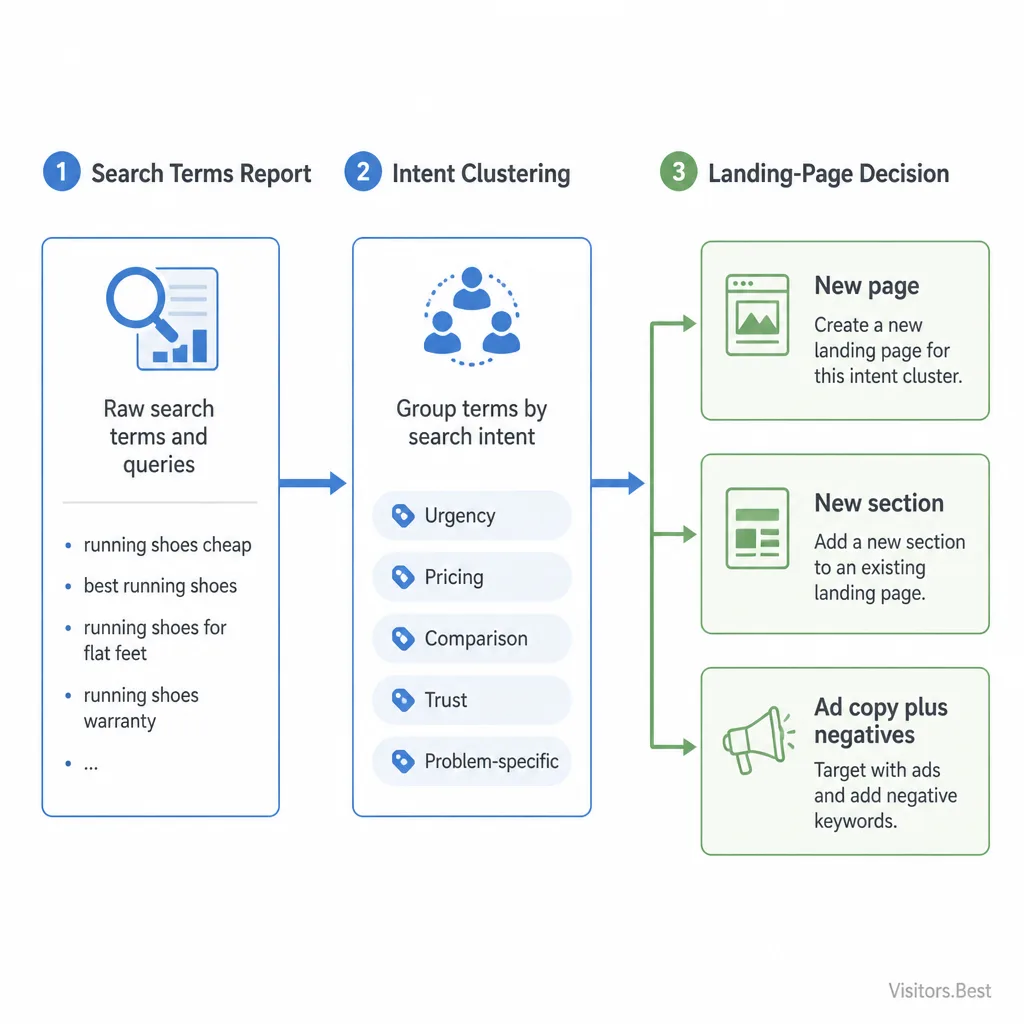
This is the step many teams skip. They see the pattern, but they do not turn it into a clean operating decision.
When a new page is justified
Create a new page when the cluster changes the conversation in a material way.
That usually means one or more of these is true:
- The headline promise needs to change
- The CTA changes
- The proof elements change
- The qualification logic changes
- The current page underperforms for that traffic pattern
- The cluster appears often enough to justify maintenance
A “same day plumber” page is a good example. The offer is not just plumbing. It is rapid response.
When a new section is enough
Use a new section when the core offer stays the same but one concern is under-addressed.
Examples:
- A pricing explainer block on a core service page
- A financing section
- A licensing or certification block
- A service-area reassurance section for local traffic
This is often the better move for trust modifiers and lighter pricing intent.
When ad copy and negatives are enough
Sometimes the variation is real but not page-worthy.
If “affordable PPC agency” and “PPC agency pricing” lead to the same sales conversation, a pricing-focused ad variant and tighter negatives may be enough. Thin or inconsistent traffic usually does not justify a standalone page either.
A useful rule: if the page would mostly repeat the same story with minor wording changes, do not build it.
A simple page-creation template for lead gen teams
Decision criteria: volume, conversion potential, offer difference, operational feasibility
Before creating a page, score the cluster against four questions:
- Volume: Does this pattern recur enough to matter?
- Conversion potential: Is there a plausible case that message match will improve conversion or lead quality?
- Offer difference: Does the visitor need a meaningfully different conversation?
- Operational feasibility: Can the team build and maintain the page properly?
If one of those is weak, be cautious.
Planning template
Use a simple planning sheet:
| Field | What to define |
|---|---|
| Query cluster | Example queries in the group |
| User need | What the prospect is trying to solve |
| Core headline | The promise that matches that need |
| Proof | Testimonials, credentials, response-time claims, pricing context |
| CTA | Call now, get quote, book estimate, compare plans |
| Friction reducers | Service area, availability, no-obligation quote, financing, guarantees |
| Qualification language | Who this is for, budget fit, service limits |
| Ad-group mapping | Which ad group should send traffic here |
| Negatives needed | Which terms to exclude from adjacent groups |
| Success metric | CVR, CPL, qualified lead rate |
Example: same-day cluster
Suppose a plumbing account shows recurring queries like:
- same day plumber
- emergency plumber near me
- 24/7 plumbing service
Right now, they all go to a general plumbing services page.
That is a strong case for a dedicated urgency page because the conversation changes. The new page might lead with:
- Headline: Same-Day Plumbing Service Available
- Proof: response window, local coverage, emergency call availability
- CTA: Call Now first, form second
- Friction reducers: “Serving [city],” “licensed technicians,” “upfront estimate before work begins”
Then restructure ad groups so urgency terms route only to that page, and add negatives like “same day,” “emergency,” and “24/7” to the general plumbing ad group.
A different case: “HVAC repair cost” may not justify a new page if the existing repair page is already strong and traffic is moderate. A pricing section with cost ranges, quote drivers, and an estimate CTA may be enough.
Write the offer for the intent, not just the keyword
How urgency changes the CTA and proof
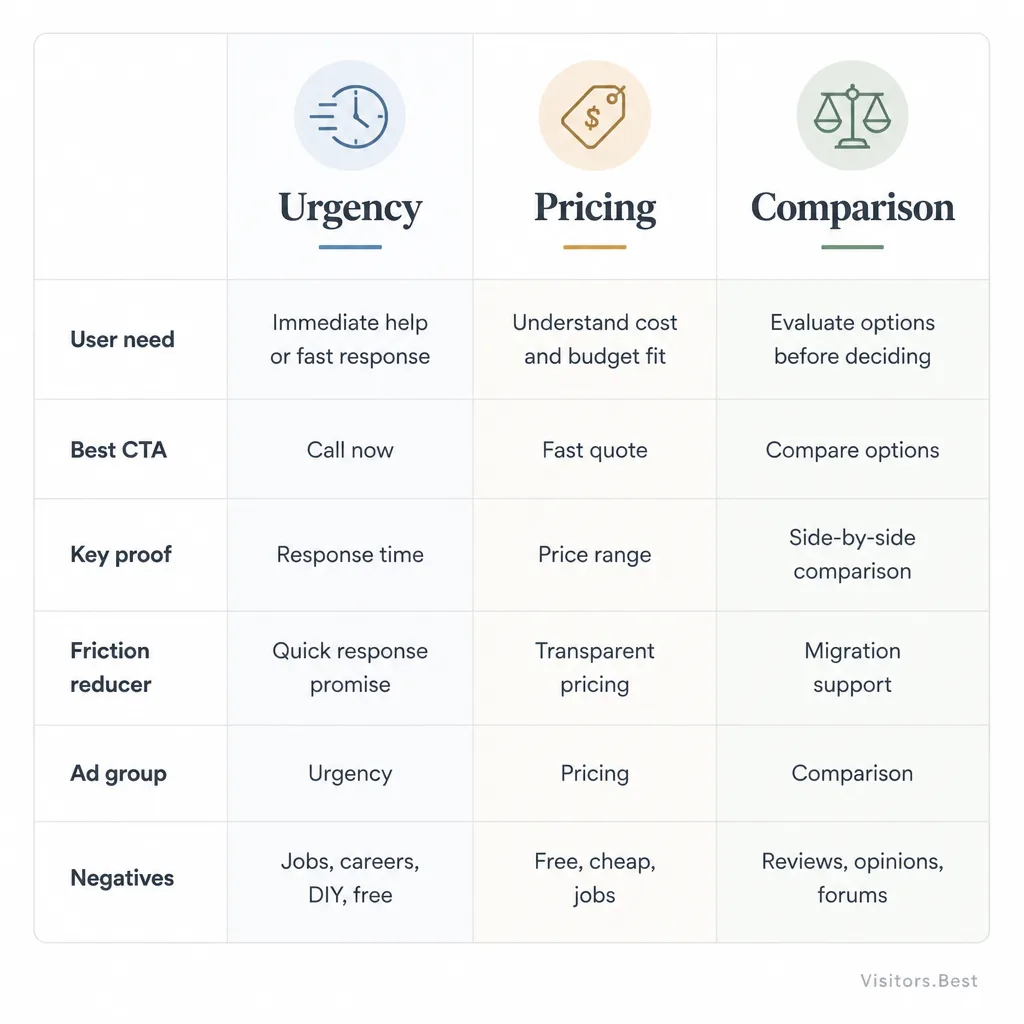
Urgent pages should reduce delay.
That usually means phone-first CTAs, shorter forms, visible hours, service-area confirmation, and proof that speed is real. The visitor is not asking for a brand essay. They want to know whether you can help now.
How pricing intent changes transparency and qualification
Pricing-intent traffic usually wants one of three things: a rough number, a pricing framework, or a fast quote.
If you refuse to address cost at all, conversion will often suffer. But full transparency is not always the answer either. Poorly handled pricing pages can attract low-fit bargain hunters. Good ones qualify. They explain what affects cost, provide ranges where appropriate, and guide the visitor to the next step.
How comparison intent changes positioning
Comparison pages should make tradeoffs easier to understand.
That often means a differences table, best-fit scenarios, migration reassurance, and honest boundaries. If the page reads like a generic homepage with a competitor term bolted onto it, it will feel evasive.
Map landing pages back into ad groups and negative keywords
Why page changes fail without account structure changes
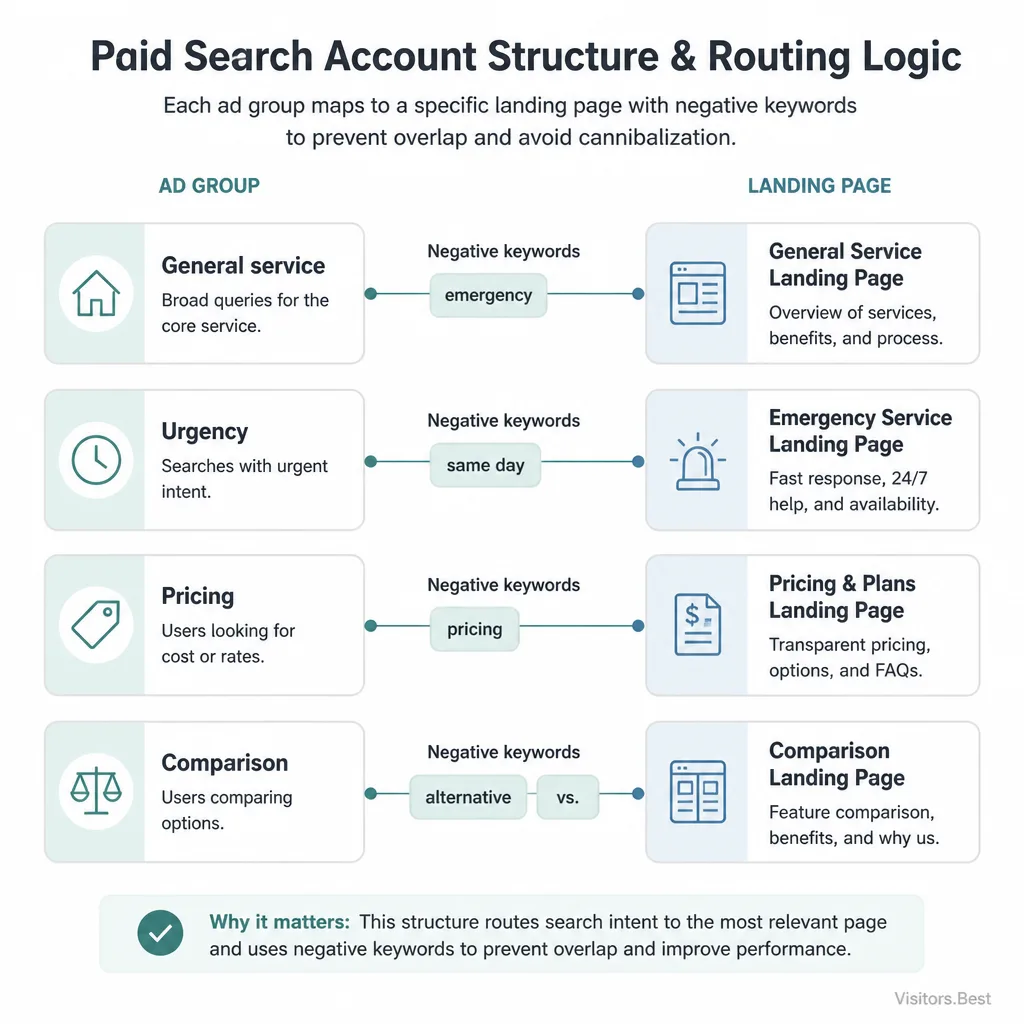
A new page alone does not fix routing.
If “same day” queries can still enter broad general ad groups, the account will keep sending mixed-intent traffic to mixed-intent pages. The landing-page fix and the account-structure fix need to happen together.
Using negatives to separate intent lanes
Negatives are not just waste control. They are routing logic.
A simple structure might look like this:
- General service ad group → general page
- negatives: same day, emergency, pricing, alternative, vs
- Urgency ad group → same-day page
- negatives: pricing, alternative, vs
- Pricing ad group → pricing page or pricing section
- negatives: emergency, same day
- Comparison ad group → comparison page
- negatives: emergency, quote, near me if irrelevant
This protects message match and reduces overlap.
How to avoid overlap and dilution
The mistake is building multiple pages without defining clear intent lanes.
If general, pricing, and urgency ad groups all match the same queries, performance data gets muddy and page relevance gets diluted. Keep the routing rules simple enough that a future account manager can understand them in five minutes.
Measure whether the new page was worth building
Metrics that matter
Start with business metrics:
- Conversion rate
- Cost per lead or cost per conversion
- Lead quality, if available
- Close rate downstream, if available
You can also watch relevance signals such as engagement and Quality Score diagnostics, but keep them in perspective. Google describes Quality Score as a diagnostic tool, not the business goal.[^2] Better landing-page relevance may help, but it does not guarantee profitable outcomes.[^3]
What counts as a real win
A win is not “the page exists.”
A win is one of these:
- Higher conversion efficiency for the targeted cluster
- Better qualified leads
- Cleaner separation of intent lanes
- Lower wasted spend from cross-intent leakage
Sometimes the gain is modest but durable. That still counts.
When to merge, expand, or retire an intent page
If a page gets thin traffic, weak differentiation, and no measurable lift after a fair test, merge it back into a stronger parent page or reduce it to a section.
If a page shows clear traction, expand the ad copy, proof, and routing around it.
The practical rule
Create pages only when intent meaningfully changes the conversation.
A workable monthly workflow looks like this:
- Export search terms
- Highlight recurring commercial and urgent modifiers
- Cluster by buyer need
- Compare cluster intent against the current landing page
- Decide: new page, new section, or ad-copy/negative change
- Update ad groups and negatives
- Measure by cluster, not just page totals
The biggest mistake is page bloat. Too many teams create thin pages around minor wording differences, then end up with fragmented data, duplicated copy, and more maintenance than performance gain.
There is a fair counterargument here: sometimes fewer, stronger pages are better. That is often true in SEO. In paid search, though, deliberate message match can justify more variants when traffic patterns are distinct enough to deserve different conversations.
That is the restraint principle worth keeping: build pages only when intent changes what the visitor needs to see, believe, or do next.
FAQ
What is high-intent keyword mining in lead generation?
It is the process of reviewing real search queries from paid campaigns, spotting patterns that signal strong buying or action intent, and using those patterns to improve targeting, messaging, and landing pages. The useful unit is usually not a single keyword but an intent cluster such as same day, pricing, or alternative to.
Why use Google Ads search terms reports instead of keyword tools alone?
Keyword tools estimate possible demand. Search terms reports show actual queries that triggered your ads. That makes them more useful for finding buyer-state differences tied to your offer, geography, and conversion funnel. They are still incomplete because Google applies reporting thresholds, so the report is directional rather than exhaustive.
How do I know when a query cluster deserves a new landing page?
Create a new page when the cluster changes the sales conversation in a material way. Good signals include recurring volume, different conversion behavior, a distinct CTA, different proof requirements, or a qualification step that does not fit the current page. If the concern is narrower, a new section or better ad copy may be enough.
Which modifiers usually signal high lead-gen intent?
Common high-intent modifiers include near me, same day, emergency, 24/7, open now, quote, estimate, cost, price, pricing, reviews, best, licensed, certified, repair, replace, install, consultation, competitor names, and vs phrases. Not every modifier justifies a page, but many do reveal a different buying state.
Should near me queries always get their own landing page?
No. Near me signals local intent, but it does not automatically require a standalone page. If your existing page already has strong service-area proof, local trust signals, and geo-aligned ads, a separate page may add little. Build one only if local intent clearly changes what the visitor needs to see first.
What is the difference between a new page and a new page section?
A new page is better when the user need, offer framing, CTA, or proof elements are meaningfully different. A new section is better when the core service and sales narrative stay the same, but one concern needs clearer treatment, such as financing, licensing, service area, or a short pricing explainer.
How do negative keywords fit into intent-based landing pages?
Negative keywords do more than block waste. They help route traffic into the right intent lane. If you build a same-day page, pricing page, or comparison page, negatives prevent those queries from drifting into general ad groups and landing on less relevant pages.
Can intent-specific landing pages improve Quality Score?
They can support better message match and landing-page relevance, which may contribute to stronger Quality Score signals. But Quality Score is a diagnostic metric, not the business goal. The real test is whether conversion rate, cost per lead, and lead quality improve for the targeted query cluster.
What metrics should I use to judge whether a new page was worth building?
Start with conversion rate, cost per lead or cost per conversion, lead quality if you can measure it, and query-cluster performance after launch. If available, also look at engagement and relevance indicators. Judge the page by the traffic segment it was built for, not only by overall account averages.
What is the biggest mistake in this workflow?
Creating too many thin pages around minor wording variations. That usually leads to fragmented data, duplicated copy, weak maintenance discipline, and little conversion gain. Build new pages only when intent meaningfully changes the conversation.
Conclusion
The search terms report is more than a keyword-mining tool. It is a map of buyer states already entering your funnel.
The goal is not to create a page for every modifier. It is to find the intent pockets that change the conversation, then support them with the right landing page, ad-group structure, and negative-keyword routing. Done well, this turns paid search data into stronger conversion assets.
[^1]: Google Ads Help, Search terms report: https://support.google.com/google-ads/answer/2472708
[^2]: Google Ads Help, About Quality Score: https://support.google.com/google-ads/answer/6167118
[^3]: Higher relevance can improve user experience and efficiency, but business impact depends on traffic quality, offer strength, sales process, and measurement quality.