AI SDRs in 2026: A Hybrid Workflow Built on Intent Triggers, Not More Volume
Most outbound teams do not have a volume problem. They have a timing problem.
For a while, the promise behind AI SDRs was straightforward: automate more work, send more messages, and pipeline will follow. That logic did not hold up. Inbox competition intensified, cold email became easier to ignore, and mailbox providers made it clear that brute-force sending is not a strategy.
So the useful question in 2026 is not, “How do we send more?” It is, “How do we get more from the sends that are actually worth making?”
That is where AI SDR workflows start to earn their keep. Not as autonomous closers. Not as machines for slightly better cold email. As orchestration systems that watch for intent, summarize context, suggest angles, and route accounts into the right next step across email, retargeting, nurture, or a human rep.
AI SDRs in 2026 are not a volume play
Why the old promise failed
Automation removed labor from outbound. It did not remove the cost of poor targeting.
If your ICP is loose, your offer is forgettable, and your data is stale, AI just helps you do irrelevant outreach faster. Activity metrics may improve. The business usually does not.
That is the mistake behind many disappointing AI SDR rollouts: teams treat the model as the strategy. It is not. It is a multiplier. If the system underneath is weak, the multiplier works against you.
What changed
Deliverability pressure is now structural. Sender requirements are stricter. Buyers are also better at spotting fake personalization.
A line about “noticing your recent post” or “seeing your company is growing” is rarely persuasive on its own. Without a real reason to reach out, that kind of personalization feels thin. It does not create relevance. It just decorates the message.
The better frame
The more durable approach is simple: use AI to improve conversion per send, not sends per rep.
That means better account selection, better timing, better angle generation, and better routing. The metric that matters is not raw activity. It is qualified replies, meetings, and opportunities per 1,000 sends.
What an AI SDR should actually do in a hybrid workflow
Research
This is where AI is genuinely useful.
A good AI SDR layer should pull together:
- account fit against ICP
- recent site behavior
- content consumed
- past outreach history
- CRM context
- likely commercial questions based on segment
It is not glamorous work, but it matters. A rep should start with a useful brief, not a blank screen.
Angle generation
The system should produce two or three plausible outreach angles tied to the trigger, not ten versions of the same template.
If a target account viewed a pricing page twice and then spent time on a competitor comparison page, the right move is not generic “personalization.” It is a message built around likely evaluation questions: pricing model, implementation tradeoffs, migration risk, or proof points.
Follow-up logic
This is the orchestration layer most teams actually need.
If intent is strong, send the email. If the signal is real but still light, route to retargeting. If the account is strategic and the trigger matters, create a human task. If confidence in the data is weak, do nothing.
That last path matters more than vendors usually admit.
What should stay human
AI can support the middle of the workflow. It should not own the strategic edges.
Keep these human:
- ICP definition
- offer and positioning
- segmentation judgment
- live objection handling
- high-ACV account strategy
- important replies and meeting conversion
A model can draft. It cannot reliably decide what your market should care about.
The trigger layer: intent signals that make outreach timely
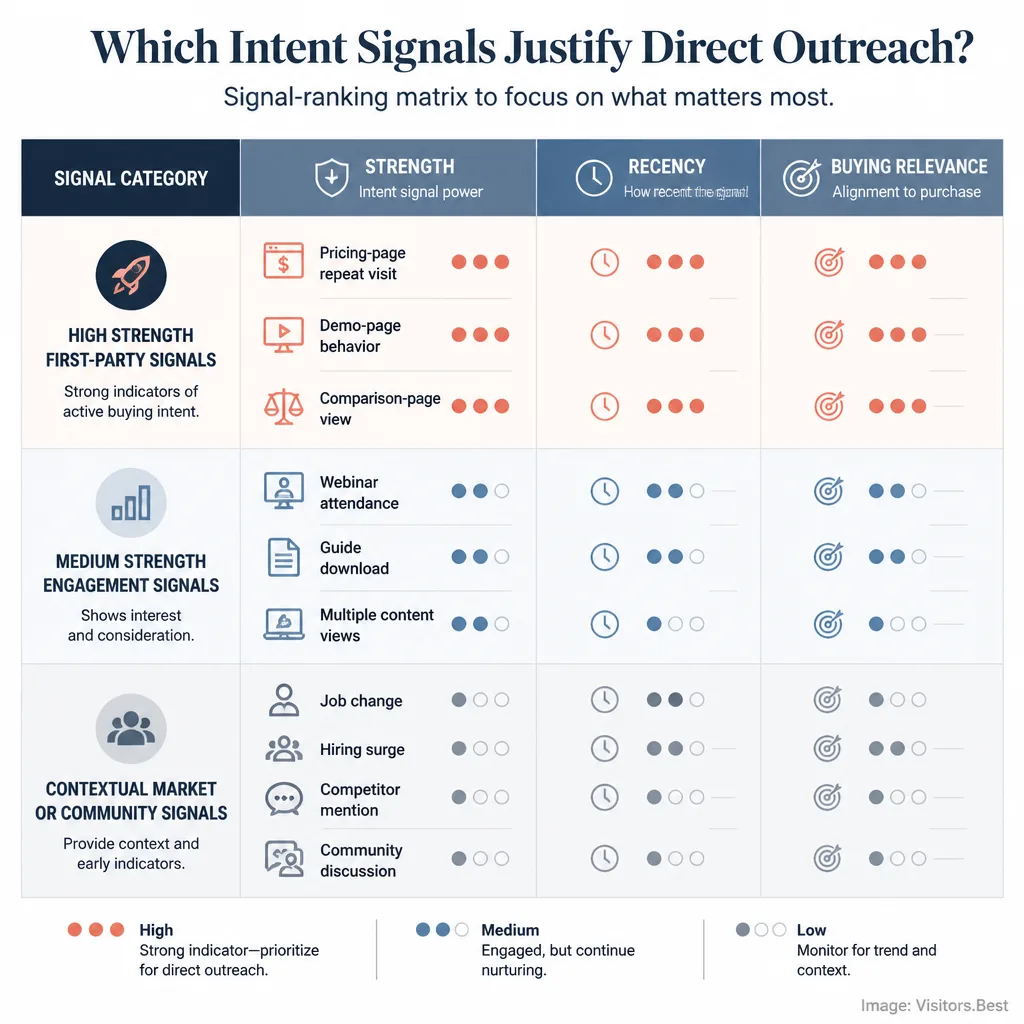
Not all intent is equal. Treat every signal as a green light and the system quickly becomes noise.
First-party signals
First-party signals come from your own properties and channels. They are usually the strongest timing indicators because they reflect direct engagement with your business.
Signals most likely to justify direct outreach include:
- repeat visits to pricing pages
- comparison-page views
- demo-page behavior
- return visits from target accounts within a short window
- high-intent email clicks
Content engagement signals
These sit in the middle.
A webinar attendee is more interesting than a random blog visitor, but not every engagement means the buyer wants a rep in the inbox today.
These signals are often strong enough for scoring, nurture acceleration, or light-touch outbound when paired with good account fit.
Market and community signals
Competitor mentions, job changes, hiring patterns, community discussions, and similar cues can be useful context. They are not always direct outreach triggers.
A new VP hire or a burst of hiring may indicate change. It may also mean nothing immediate. Treat these as watchlist or prioritization inputs unless they are reinforced by first-party behavior.
How to rank signal quality
A simple rule of thumb:
- High strength: pricing, demo, comparison, repeat first-party visits
- Medium strength: webinars, solution guides, repeat product-content engagement
- Contextual strength: hiring, job changes, community chatter, third-party topic surges
Third-party intent data can help with prioritization. It is usually less precise than first-party behavior when deciding whether one-to-one outreach is timely.
A practical workflow: from signal to sequence
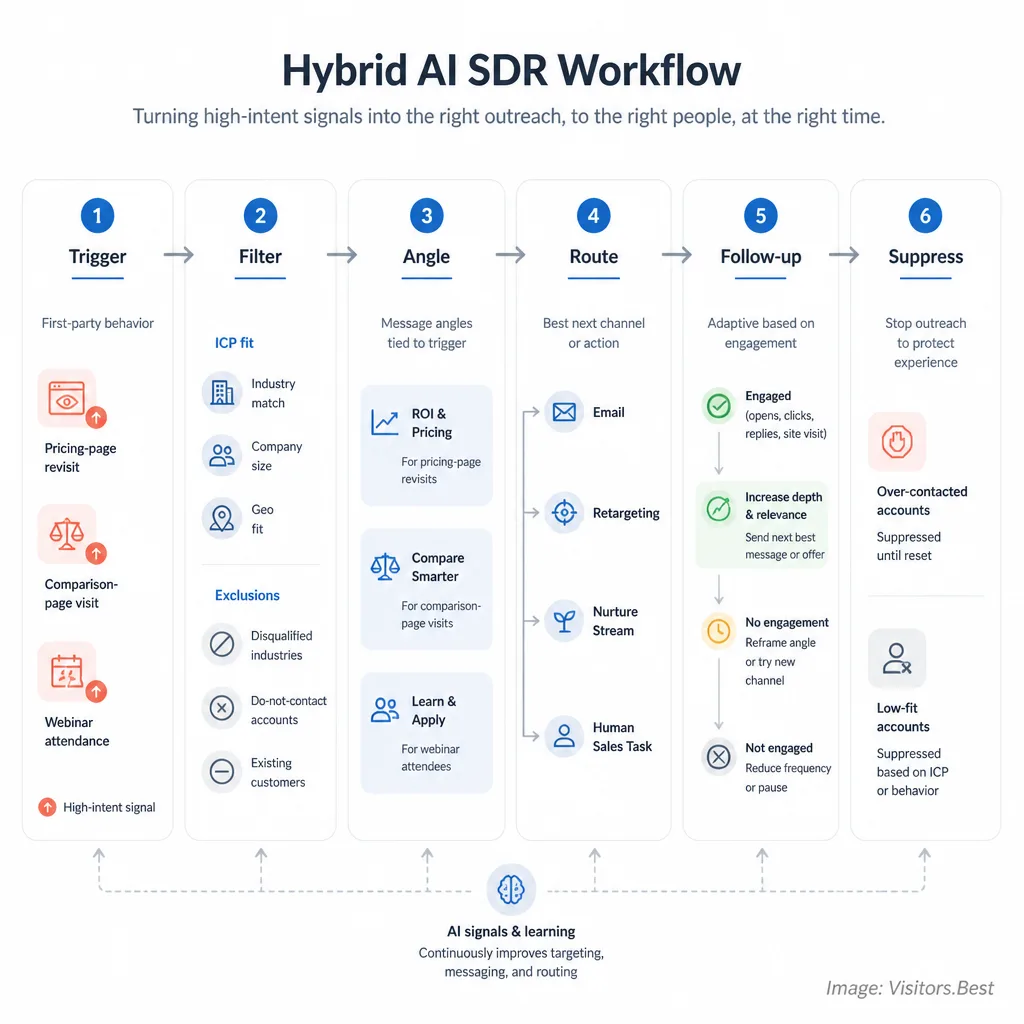
The simplest useful framework is:
Trigger -> Filter -> Angle -> Route -> Follow-up -> Suppress
Here is what that looks like in practice.
Step 1: Filter the account against ICP and exclusions
Before AI writes anything, check:
- firmographic fit
- open opportunity status
- recent outreach
- suppression lists
- customer or closed-lost status
- obvious disqualifiers
This is where bad outbound should die early.
Step 2: Enrich the contact and account record
You need current role, account context, clean ownership, and enough history to avoid nonsense personalization.
Dirty CRM fields produce bad outputs faster than almost any model flaw.
Step 3: Generate two or three plausible angles
Suppose a mid-market SaaS account returns twice in 10 days, views pricing, and reads a competitor comparison page. A decent system should generate angles like:
- evaluation help: key differences buyers care about at this stage
- migration risk: what changes operationally after switching
- pricing clarity: where total cost tends to surprise teams
That works better than generic role-based copy because it is grounded in observed behavior.
Step 4: Route into the right path
For that example:
- email if ICP fit is high and recent behavior is strong
- retargeting for supporting proof, such as customer evidence or implementation clarity
- sales task if account value is high enough to justify manual follow-up
- nurture if behavior is interesting but not urgent
Step 5: Use adaptive follow-up logic
This is where most sequences get dumb.
If the contact opens but does not click, do not automatically force a five-email cadence. If the account returns to the site after the first touch, one follow-up may be justified. If nothing happens, suppression is often the smarter move.
Step 6: Suppress over-contacted accounts and low-fit leads
Suppression is not a cleanup feature. It is part of the growth model.
The point is to protect sender reputation, preserve attention, and stop wasting touches on accounts that are not ready or not relevant.
Where AI SDR tools usually fail
Bad ICP
If the list is wrong, the workflow is wrong. Better copy may lift response rates at the margin, but it will not fix a market mismatch.
Weak offer
A lot of AI personalization is lipstick on an offer nobody cares about.
If there is no clear commercial reason to respond, the model is decorating weakness.
Dirty CRM
Wrong titles, stale employment data, duplicate records, and vague segmentation create fake relevance. Teams often call this an AI problem. It is usually a systems problem.
No guardrails
The model should not be free to invent stack details, buying stage, customer pain, or product claims.
Constrain it to approved proof points, approved positioning, and fallback behavior when confidence is low.
Channel isolation
Some accounts are curious, not ready. Some are ready but need a human touch. Some should be warmed with retargeting first.
If every signal ends in email, the system is too blunt.
How to avoid deliverability ceilings while still scaling outbound
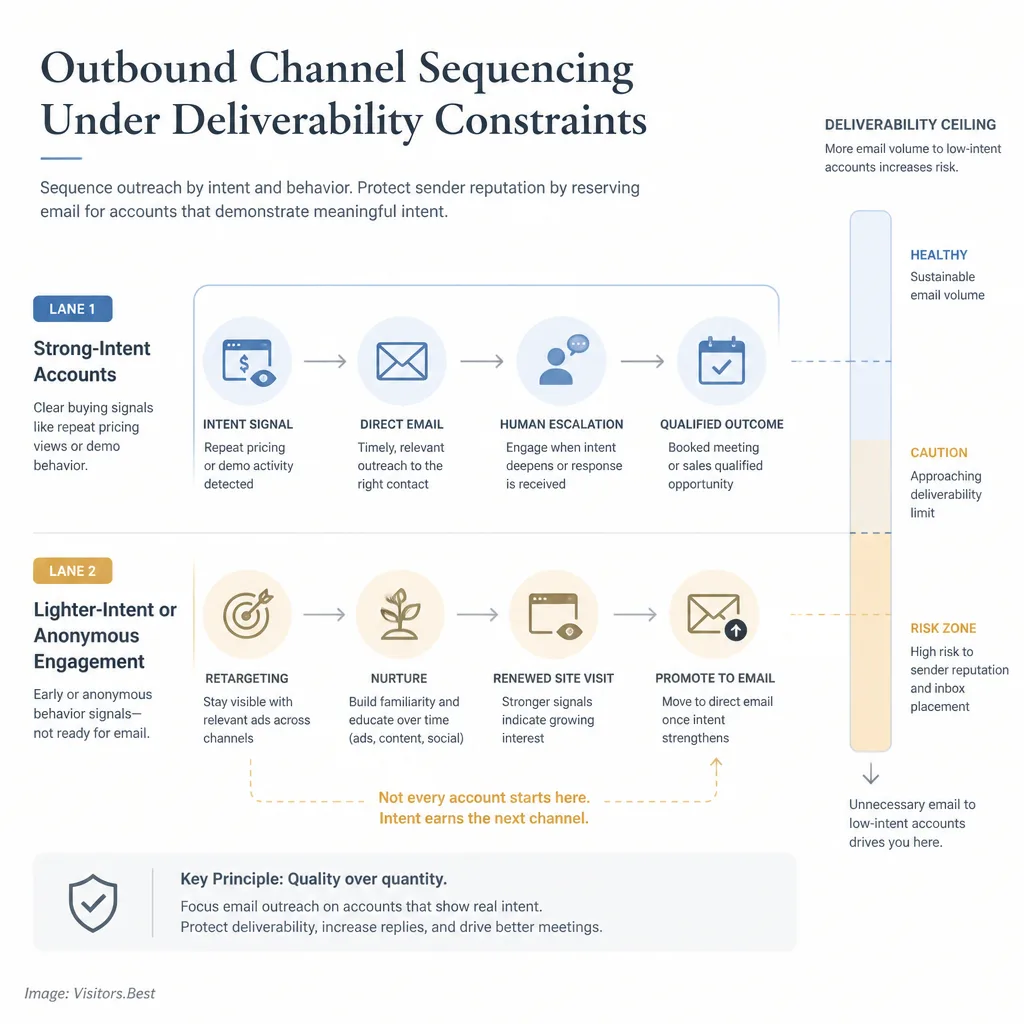
Why more volume stops working
Deliverability is a systems constraint. More messages do not create more appetite. They often create more risk.
In that environment, “send more” becomes a fragile growth lever.
Use intent thresholds
Direct outbound should require a threshold, not just a lead record.
If the signal is weak, route to retargeting or nurture. If the record is incomplete, suppress. If the account was contacted recently, wait.
Keep infrastructure under control
Authentication, unsubscribe handling, complaint management, and unwanted-mail avoidance are baseline requirements. They are not advanced tactics.
Separate retargeting and nurture from true outbound
Not every interested account deserves a one-to-one message.
Retargeting can absorb light intent without adding cold-email pressure. That distinction is operationally useful and strategically important.
Measure the right things
Useful metrics include:
- qualified replies per 1,000 sends
- meetings per 1,000 sends
- positive response rate by trigger type
- opportunity creation by signal tier
- complaint, unsubscribe, and bounce rate by segment
Those numbers tell you whether the system is getting sharper, not just busier.
The channel mix that makes the model work
Email for strong intent
Use email when first-party behavior suggests active evaluation.
Retargeting for lighter intent
Use retargeting when the account shows interest but has not earned direct outreach yet.
This is the pressure-release valve many teams need.
Paid and owned touchpoints as reinforcement
The point is coordination. A light outbound touch supported by useful retargeting and relevant nurture can outperform a louder email sequence because it feels more timely and less desperate.
Escalate to a human when judgment matters
Escalate when:
- ACV is high
- the account is strategic
- the trigger is strong
- a reply introduces nuance
- the opportunity requires judgment, not another generated follow-up
Guardrails and operating rules
At minimum, set rules for:
- data hygiene: role, company, ownership, lifecycle stage, exclusions, freshness
- messaging constraints: approved claims only, no invented pain points, no unsupported assumptions
- compliance and brand safety: unsubscribe handling, suppression lists, approved language boundaries
- frequency caps: per contact, per account, per time window
- review thresholds: human approval for high-value accounts, regulated verticals, or novel messaging
- ownership: marketing owns triggers and retargeting, RevOps owns routing logic and data quality, sales owns replies and strategic escalation
Without ownership, “AI SDR” becomes a software purchase sitting on top of organizational ambiguity.
Who should use this model and who should not
Best fit
This model works best for companies with:
- enough traffic or engagement signal
- a clear ICP
- usable CRM structure
- an offer buyers actually care about
Poor fit
If first-party engagement is minimal, positioning is fuzzy, and the CRM is unreliable, an AI SDR platform will mostly automate confusion.
A minimum viable setup for smaller teams
You do not need an agentic stack to start.
A credible small-team version looks like this:
- one CRM with clean ICP segmentation
- website intent tracking for key pages
- basic enrichment
- suppression rules
- one retargeting audience
- human approval for first-touch outbound
That is enough to test whether timing and routing improve yield before adding more software.
Closing thought
AI SDRs are useful in 2026, but only when you stop asking them to be miracle reps.
The real advantage is not more automated email. It is better judgment at scale: spotting the right moment, choosing the right channel, generating a relevant angle, and suppressing outreach that should never have been sent.
If you want the short version, it is this: attach AI to intent, put guardrails around messaging, and optimize for conversion per send instead of raw activity.
FAQ
What is an AI SDR workflow in 2026?
An AI SDR workflow in 2026 is best understood as an orchestration system, not a replacement rep. It uses AI to summarize account context, generate outreach angles, prioritize follow-up, and route accounts into email, retargeting, nurture, or human review based on real signals.
Why are intent triggers better than sending more cold email?
Intent triggers improve timing. Instead of increasing volume and risking inbox placement, the team sends fewer messages to accounts showing meaningful buying behavior, such as repeat pricing-page visits, comparison-page engagement, or high-intent email clicks.
What intent signals are strong enough to trigger direct outreach?
The strongest signals are usually first-party behaviors with clear buying relevance: repeat visits to pricing or demo pages, comparison-page views, return sessions from target accounts, and high-intent content engagement. Weaker signals, like broad topic research or community chatter, are often better used for scoring or retargeting.
How is first-party intent different from third-party intent?
First-party intent comes from behavior on your own site, emails, forms, and content. Third-party intent comes from off-site activity aggregated through external networks or partners. Third-party intent can help with prioritization, but first-party intent is usually more useful for deciding when direct outreach is timely.
Why do AI SDR tools fail so often?
They usually fail because the surrounding system is weak. Common problems include a bad ICP, an offer that is not compelling, poor CRM hygiene, weak enrichment, noisy trigger logic, and no messaging guardrails. AI can speed up bad decisions just as easily as good ones.
Can AI SDRs fix a weak outbound offer?
No. AI can improve research, timing, and message drafting, but it cannot create market relevance where none exists. If the offer is weak or the account is a poor fit, better copy only makes irrelevant outreach more efficient.
How do AI SDR workflows help avoid deliverability ceilings?
They reduce unnecessary sends. A trigger-based workflow filters accounts before outreach, suppresses low-fit or over-contacted records, and routes lighter intent into retargeting or nurture. That improves yield per send and lowers the pressure to scale volume blindly.
When should retargeting be used instead of email?
Retargeting makes sense when interest is real but not strong enough for direct one-to-one outreach. If an account shows early engagement, category research, or light repeat visits without stronger buying behavior, retargeting can keep the brand visible without adding avoidable cold-email risk.
What should stay human in a hybrid AI SDR model?
Humans should still own ICP definition, offer design, segmentation judgment, objection handling, high-value account strategy, and important replies. AI is useful in the middle of the workflow, but strategic judgment and nuanced conversations still need human control.
What is a practical framework for running this model?
A simple operating model is Trigger -> Filter -> Angle -> Route -> Follow-up -> Suppress. It keeps the workflow grounded in signal quality, qualification, channel choice, and contact discipline rather than raw automation.
Who is the best fit for an AI SDR workflow like this?
The best fit is a B2B company with a clear ICP, usable CRM structure, enough first-party traffic or engagement data, and a real commercial offer. Teams with vague positioning, low signal volume, or messy data usually need to fix the system before adding AI SDR tooling.
What metrics matter most in a deliverability-constrained outbound model?
The most useful metrics are qualified replies per 1,000 sends, meetings per 1,000 sends, positive response rate by trigger type, opportunity creation by signal tier, and complaint, unsubscribe, and bounce rates by segment or sending domain.