Google Maps Lead Lists That Convert: Pairing Local Intent Signals with Enrichment + Deliverability Engineering
Most Google Maps lead generation fails for a simple reason: the list was never very good.
A team exports a batch of local businesses, appends a few fields, finds some emails, and starts sending. When replies are weak, they blame the copy. Sometimes the copy deserves it. More often, the real problem is earlier in the process: raw local business data was treated like a finished prospect list instead of what it actually is—a signal source.
That distinction matters. Google Maps and Google Business Profile can show local commercial presence, visible customer activity, and hints of operational maturity. They do not reliably tell you whether a business is a fit, whether the contact route is safe, or whether the account is worth risking sender reputation on.[^1][^2] The advantage appears later, when you layer intent, enrich the record, verify contacts, and test with discipline.
Google Maps Is Not the Lead List. It Is the Starting Signal.
Local business listings are useful because they sit close to real-world demand. If a company appears in Maps with reviews, photos, hours, and an active profile, that usually says more about its current local presence than a stale business database does.
That is the attraction. It is also where teams get sloppy.
Why local listings reveal more than generic business databases
A generic business record may confirm that a company exists. A local listing can show whether it is visible, maintained, and customer-facing right now. Google Business Profile may expose website links, phone numbers, hours, reviews, photos, posts, and attributes.[^1] For local prospecting, that matters because firmographics alone are rarely enough. What you really want to know is whether the business looks active enough to care about demand, reputation, and lead flow.
A home services company with recent reviews, a working website, and clear service pages is a stronger starting point than a random company record with a legal name and an old phone number.
What Maps data can tell you, and what it cannot
Maps data can tell you:
- category and local positioning
- whether a website is present
- whether reviews exist and seem recent
- whether the profile appears maintained
- whether the business has one location or several
It cannot reliably tell you:
- who the decision-maker is
- whether an email is valid
- whether the business has budget
- whether the contact route is safe for outbound
- whether the business is operationally ready to buy marketing help
That is why Maps is a seed list, not the list itself.
The Real Edge Comes From Intent Layering, Not Raw Volume
No single Maps signal predicts responsiveness. Strong lists are built from combinations, not shortcuts.
Core local intent signals
Google encourages businesses to maintain accurate hours, add photos, include websites, choose the right categories, and keep profiles useful for customers.[^1] That makes profile completeness a reasonable signal of commercial presence, though not proof of buying intent.
Here is a practical way to think about the strongest signals:
| Signal | Why it matters | Where it misleads |
|---|---|---|
| Category | Useful first-pass niche filter | Categories are often broad or messy |
| Website presence | Suggests the business cares about discovery | A website alone says little about quality |
| Review recency | Can suggest current transaction volume | Old review volume can hide stagnation |
| Photo freshness | May indicate profile maintenance | Some owners upload once and stop |
| Hours completeness | Suggests active profile management | Not all businesses use standard hours |
| Location count | Helps separate owner-operators from scaled businesses | Multiple listings do not equal sophistication |
“Rating velocity” can be a useful operator term, but it is an inferred pattern, not an official Google metric. In practice, what matters less is the label and more whether reviews appear recent enough to suggest active customer flow.
Operational signals that suggest readiness to buy marketing help
This is where enrichment starts to matter. The highest-value prospects often show some combination of visible demand and obvious conversion gaps.
For example:
- recent reviews, but a weak or outdated website
- strong local visibility, but no booking flow
- an active profile, but poor lead capture on mobile
- multiple locations, but inconsistent location pages
- reputation exposure, but no clear review response process
A local agency targeting plumbers, roofers, or med spas can do well with businesses that already generate demand but fail to convert it after the click.
Signals that look useful but often mislead
Some data points feel predictive because they are easy to sort by. They usually are not.
Be careful with:
- star rating without context
- total review count without recency
- a phone number treated as proof of contact readiness
- broad labels like “contractor” or “consultant”
- visual judgments based on profile aesthetics alone
Weak proxies get expensive when you scale them.
Build an Enrichment Stack That Makes the List Actionable
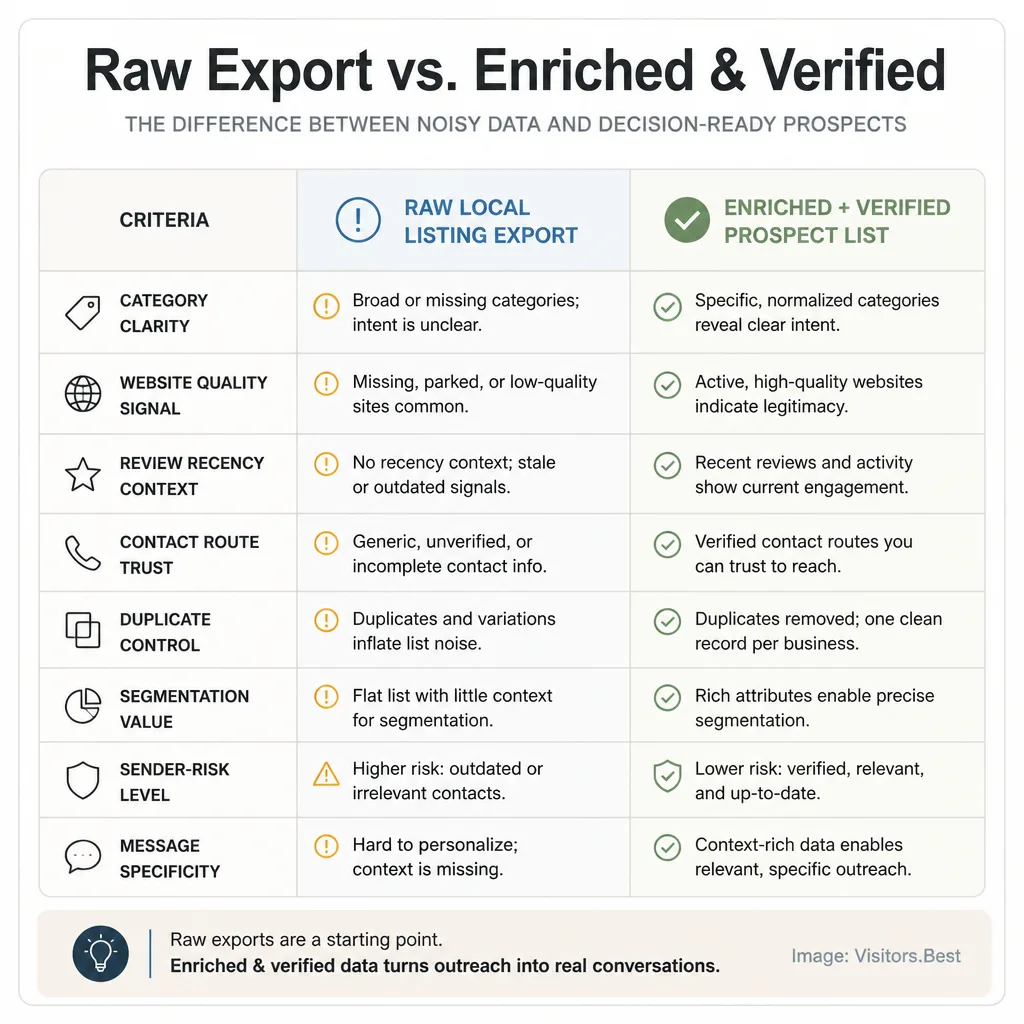
Enrichment is not just about finding an email. It changes prioritization, messaging, and offer fit.
Must-have fields
At minimum, an enriched local lead list should include:
- normalized business name
- canonical website and root domain
- domain status
- deduplicated phone
- city and state
- primary category
- normalized subcategory or vertical
- location count
- contact route type
Without those fields, clean segmentation and reliable suppression become much harder.
Useful enrichment layers
This is where the list becomes usable:
- website CMS or tech stack
- booking widget presence
- lead form quality
- social profile presence
- ad activity indicators
- review recency
- social links
- business model clues from the site
Google Business Profile can include website URLs and social links, but that is still only part of the picture.[^1] The useful question is what the business looks like after a prospect clicks through.
A chiropractor with a polished intake funnel is not the same lead as a chiropractor whose site still feels stuck in 2017 and asks users to call manually.
How enrichment changes prioritization, messaging, and offer fit
Suppose you export 5,000 local businesses in home services. The raw number looks impressive. After normalization, website checks, domain review, and contact-route filtering, you may be left with 700 records that are actually usable.
That smaller list is usually stronger because it lets you say something specific.
Instead of saying, “we help local businesses get more leads,” you can say, “You’re getting recent review activity, but your site has no visible financing CTA and no fast quote path on mobile.” That is not clever copy. It is relevance built from data.
Deliverability Engineering Starts Before the First Email
A bad list does not just hurt campaign metrics. It can damage your infrastructure.
High bounce rates and poor list hygiene weaken sender reputation and reduce inbox placement over time.[^3][^4] That makes verification part of list building, not a last-minute cleanup step.
Why poor list hygiene damages more than campaign performance
If you send to invalid or risky contacts, the problem is not only a few wasted emails. You are training mailbox providers to trust you less. That can make future campaigns underperform even after targeting improves.[^3][^4]
List quality compounds in both directions.
A practical verification workflow
Keep it simple:
- Deduplicate by business, domain, phone, and location.
- Normalize names, websites, and categories.
- Set a role-account policy for addresses like
info@orsupport@. - Validate email syntax, domain status, and mailbox plausibility.
- Suppress prior bounces, unsubscribes, dead domains, closed businesses, and risky records.
Role accounts deserve nuance. In local markets, they may be the only visible route. Sometimes they work. They also tend to lower relevance and raise risk. Use them selectively, not by default.
When to discard a lead even if the business looks like a fit
Discard the lead if:
- the domain is dead or broken
- validation is poor
- the business appears closed or duplicated
- there is no trustworthy contact route
- the website and profile do not align
- the business is structurally wrong for the offer
A visually attractive prospect with bad contact data is still a bad send.
Segment the List by Commercial Reality, Not Just Industry
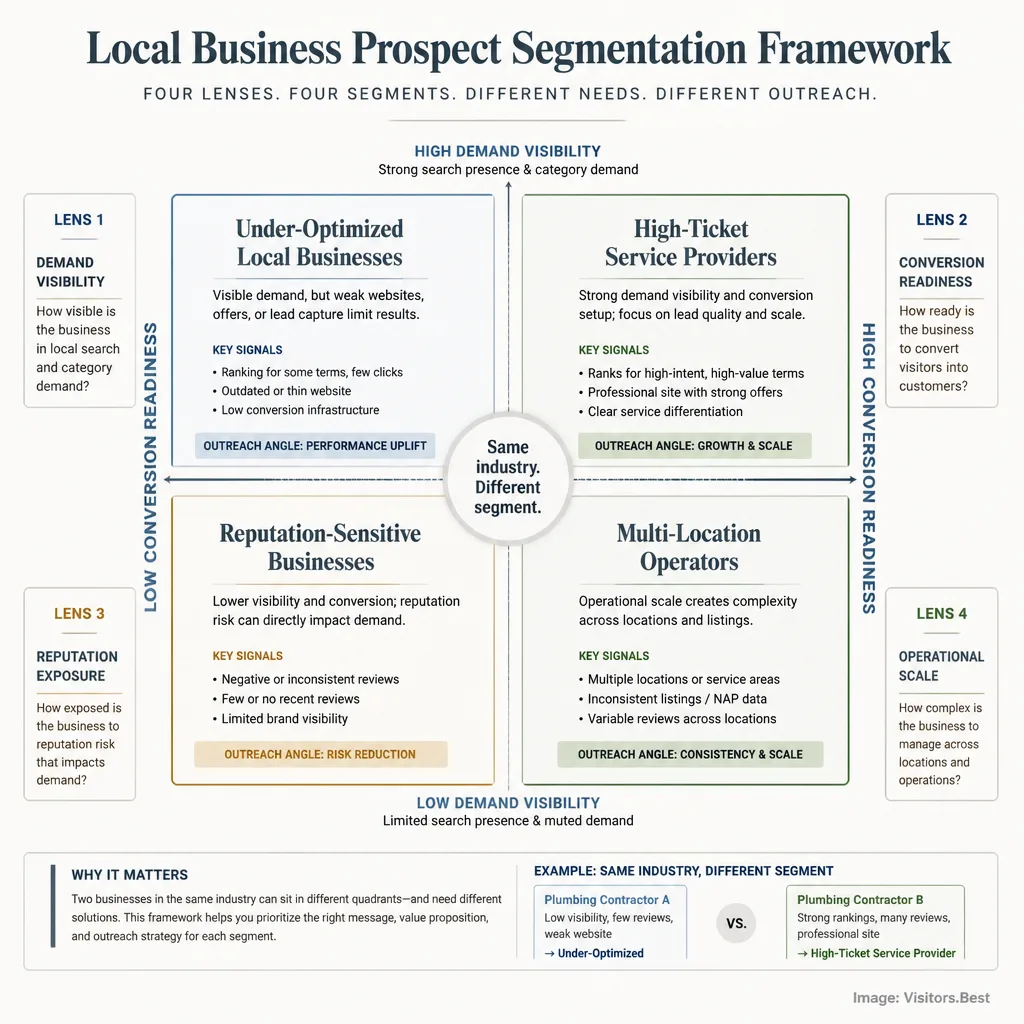
Industry-only segmentation is too blunt. Two dental practices can sit in the same category and need very different outreach.
Simple segmentation models for agencies
A practical agency model uses four lenses:
- demand visibility: are reviews and activity signals present?
- conversion readiness: does the site capture demand well?
- reputation exposure: does review quality materially affect sales?
- operational scale: single-location or multi-location?
That creates more useful groups than “dentists” or “HVAC.”
Simple segmentation models for affiliates and lead resellers
Affiliates should add monetization readiness.
A business may look active on Maps and still be a weak buyer if it lacks intake capacity, follow-up systems, or a clear path from inquiry to revenue.
Examples
- Under-optimized local businesses: strong demand signs, weak site, or no booking flow
- Reputation-sensitive businesses: clinics, legal practices, med spas, where reviews carry heavy weight
- High-ticket service providers: roofers, remodelers, personal injury firms, where one lead can matter a lot
- Multi-location operators: more budget, more complexity, harder sale, better long-term value
Separate List Quality From Copy Quality With a Clean Measurement Plan
This is where many teams fool themselves.
The mistake most teams make when judging outbound performance
They change the list, the copy, the segment, and the sender setup at the same time. Then they learn nothing.
If performance is weak, you need to know whether the problem came from targeting, contact quality, or messaging.
Metrics for list quality
Track list quality first:
- valid contact rate
- verified-email yield
- bounce rate
- duplicate-domain rate
- usable contact-route coverage
- reply relevance by segment
- positive reply rate by segment
These metrics tell you whether the list deserves more sending.
Metrics for messaging quality
Then evaluate the creative side:
- reply rate
- positive reply rate after segment control
- meeting or booked-call rate
- downstream conversion rate
Open rate can still be directionally useful in some contexts, but privacy features make it a weak diagnostic metric on its own.
How to run fair tests
Change one major variable at a time.
Do not swap:
- segment logic
- verification standards
- sender domain
- offer
- copy angle
all in the same test window.
A small controlled batch often teaches more than a loud scale test that burns 10,000 sends and produces no clean answer.
What a Practical Workflow Looks Like
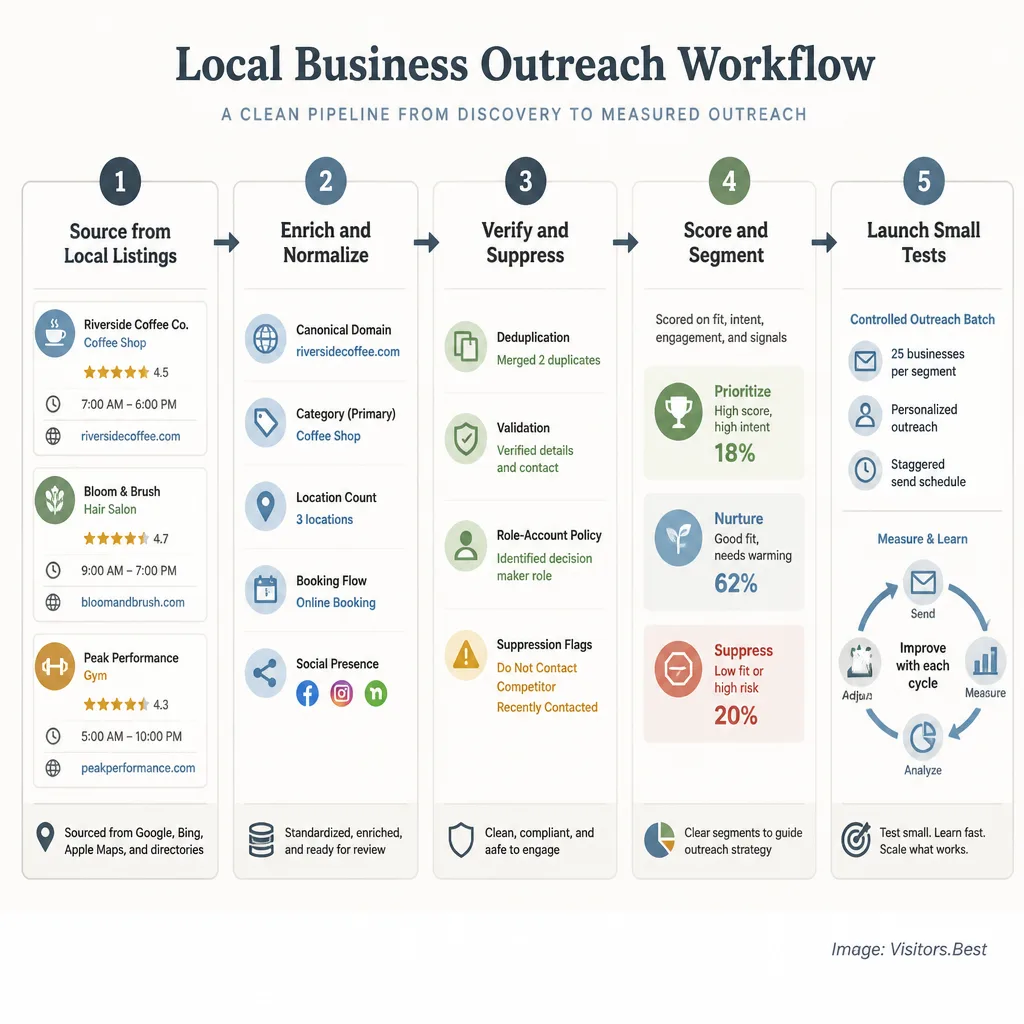
A good workflow is operational, not glamorous.
Source from Maps
Use compliant sourcing methods and avoid treating Google Maps as a bulk-export loophole. Google’s terms restrict scraping or extracting Maps content for use outside the service, so this process should be framed around compliant research workflows and lawful data sourcing rather than direct scraping tactics.[^2]
Enrich and normalize
Clean the names. Match the right site. Standardize categories. Identify whether the profile belongs to a solo operator, a serious local brand, or a multi-location company.
Verify and suppress
Run validation before the first send, not after the bounce report arrives.
Score and segment
A lightweight model works well:
| Status | Logic |
|---|---|
| Prioritize | Strong fit, valid route, visible gap, manageable risk |
| Nurture | Plausible fit, but weak timing or incomplete data |
| Suppress | Duplicate, closed, invalid, irrelevant, or risky to send |
Launch small tests before scaling
Start with a narrow slice. If a 100-record cohort shows weak contact quality or irrelevant replies, fixing the list is smarter than writing five new sequences.
The Strategic Takeaway
Google Maps lead lists work best when you stop treating them like lead lists.
They are a high-intent starting signal. The businesses are visible. Some are active. Some show obvious commercial gaps. But the value appears only after enrichment, verification, segmentation, and careful testing.
The seductive version of this strategy is the 5,000-record export. The useful version is the 700-record list that is clean, segmented, and safe to send. One gives you volume. The other gives you a real chance to learn, protect deliverability, and find prospects worth contacting.
Smaller is not always better. Cleaner is.
FAQ
Are Google Maps lead lists enough on their own for cold outreach?
No. Google Maps and Google Business Profile data work better as a high-intent seed source than as a finished prospect list. They can reveal local commercial presence, but not whether a contact route is valid, whether the business fits the offer, or whether outreach is safe for sender reputation.[^1][^3]
Which Google Maps signals matter most when building local business lead lists?
The strongest signals are usually category, website presence, review recency, profile completeness, photo freshness, hours, location count, and visible customer-facing activity.[^1] None of them should be treated as proof on their own. They work better in combination.
Why does enrichment matter for Google Maps leads?
Because enrichment turns raw listings into usable prospect records. It helps normalize categories, identify the right domain, detect booking or lead-capture gaps, assess business maturity, and improve segmentation.
What fields should be in an enriched local lead list?
At minimum: normalized business name, canonical website, domain status, primary category, location, phone, location count, and contact route type. Useful extra fields include review recency, tech stack, booking widget presence, lead form setup, social links, and ad activity indicators.
How does email verification protect deliverability?
Verification reduces the chance of sending to invalid or risky addresses, which helps lower bounce rates and protect sender reputation.[^3][^4] A sound workflow should include deduplication, normalization, role-account handling, validation, and suppression before the first send.
Should role accounts like info@ or support@ be used in local outreach?
Sometimes, but carefully. In local markets, role accounts may be the only visible contact route. They can work in some segments, but they often produce lower relevance and higher risk than direct contacts.
How should agencies segment Google Maps lead lists?
Segment by commercial reality, not industry alone. Useful factors include demand visibility, conversion readiness, reputation sensitivity, and operational scale.
How should affiliates or lead resellers segment local business prospects?
Add monetization readiness. A business may look active on Maps but still be a weak buyer if it lacks clear intake, poor lead routing, or limited operational capacity.
What is the biggest mistake teams make with Google Maps lead generation?
They confuse volume with intent. They export a large list, enrich it loosely, send too fast, then blame copy when the real problem started with noisy signals, weak verification, and poor segmentation.
How do you measure list quality separately from copy quality?
Track list-quality metrics like valid contact rate, verified-email yield, bounce rate, usable contact-route coverage, and reply relevance by segment. Then judge messaging with reply rate, positive reply rate, meeting rate, and downstream conversion rate.
What does a practical workflow for Google Maps lead lists look like?
Start with compliant sourcing, then normalize the records, enrich the business and website data, verify contact routes, suppress risky entries, score the list by fit and risk, segment it, and launch small controlled tests before scaling.[^2]
What is the core takeaway from this strategy?
Google Maps data becomes valuable when treated as a signal source, not a turnkey list. The real gains come from layering intent signals, adding enrichment, protecting deliverability, and measuring data quality before deciding the copy is the problem.
[^1]: Google Business Profile guidance indicates profiles can include customer-facing details such as website, phone, hours, photos, reviews, posts, attributes, and social links, making them useful as commercial-presence signals rather than complete prospect records.
[^2]: Google Maps Platform / Google Cloud terms restrict scraping or extracting Maps content for use outside the service, so sourcing should stay compliant and this article should not be read as a scraping tutorial.
[^3]: Deliverability guidance from SendGrid states that keeping bounce rates low and removing hard bounces is important for sender reputation and inbox placement.
[^4]: Mailchimp guidance similarly warns that high bounce rates can damage sender reputation and lead to filtering or blocking.