Open-Internet Lead Scraping in 2026: A Marketer’s SOP
Most advice about lead scraping fixates on extraction: tools, proxies, browser automation, export volume. That is rarely where a marketer’s pipeline actually fails.
The trouble starts after the data lands in a spreadsheet. Public web records are messy, duplicated, stale, and thin on context. A list is easy to collect. A list worth contacting is not.
This SOP is for that gap. It is not a developer tutorial. It is a practical workflow for turning public web data into leads that are contactable, relevant, segmented, and ready for outreach.
The hard part is not scraping. It is making the data usable.
If you remember one thing, make it this: the value is not in how many records you collect. It is in how many become outreach-ready.
A scraped record is not a lead. An enriched record is not a lead. Even a verified email is not always a good prospect.
The useful pipeline looks like this:
| Stage | What it means | Go/no-go question |
|---|---|---|
| Raw record | Publicly captured business data | Is this even a real commercial entity? |
| Normalized record | Cleaned, deduplicated, standardized | Can we identify and match it reliably? |
| Enriched record | Added company or contact context | Do we know enough to judge fit? |
| Verified contact | Contact route checked for basic validity | Can we reach this prospect without obvious risk? |
| Outreach-ready lead | Fit, contactability, and message angle confirmed | Should this enter a campaign now? |
Many teams treat these stages as interchangeable. They are not.
What this SOP is for
When an open-web workflow makes sense
This approach fits when you need targeted prospecting and already have a fairly clear ICP. Typical examples include:
- local businesses in a defined geography
- agencies in a niche
- B2B companies in a narrow category
- marketplace sellers with visible commercial activity
- partner or affiliate prospects with public websites
It works best when your team values a smaller, better list over raw volume.
When it does not
Open-web sourcing is a weaker fit when you need:
- immediate scale
- strong buying-intent signals
- highly standardized contact data across large markets
- stricter compliance handling across multiple jurisdictions without internal review
It is also worth separating public data collection from compliant outreach. They are not the same thing. In the U.S., commercial email still has to follow CAN-SPAM requirements, including accurate header information, non-deceptive subject lines, a physical postal address, and a working opt-out mechanism, and those rules apply to B2B email as well.[^1] In the UK and many EU contexts, public visibility does not automatically make processing or direct marketing risk-free; lawful-basis analysis still matters.[^2]
Step 1: Choose sources that produce usable records, not just big exports
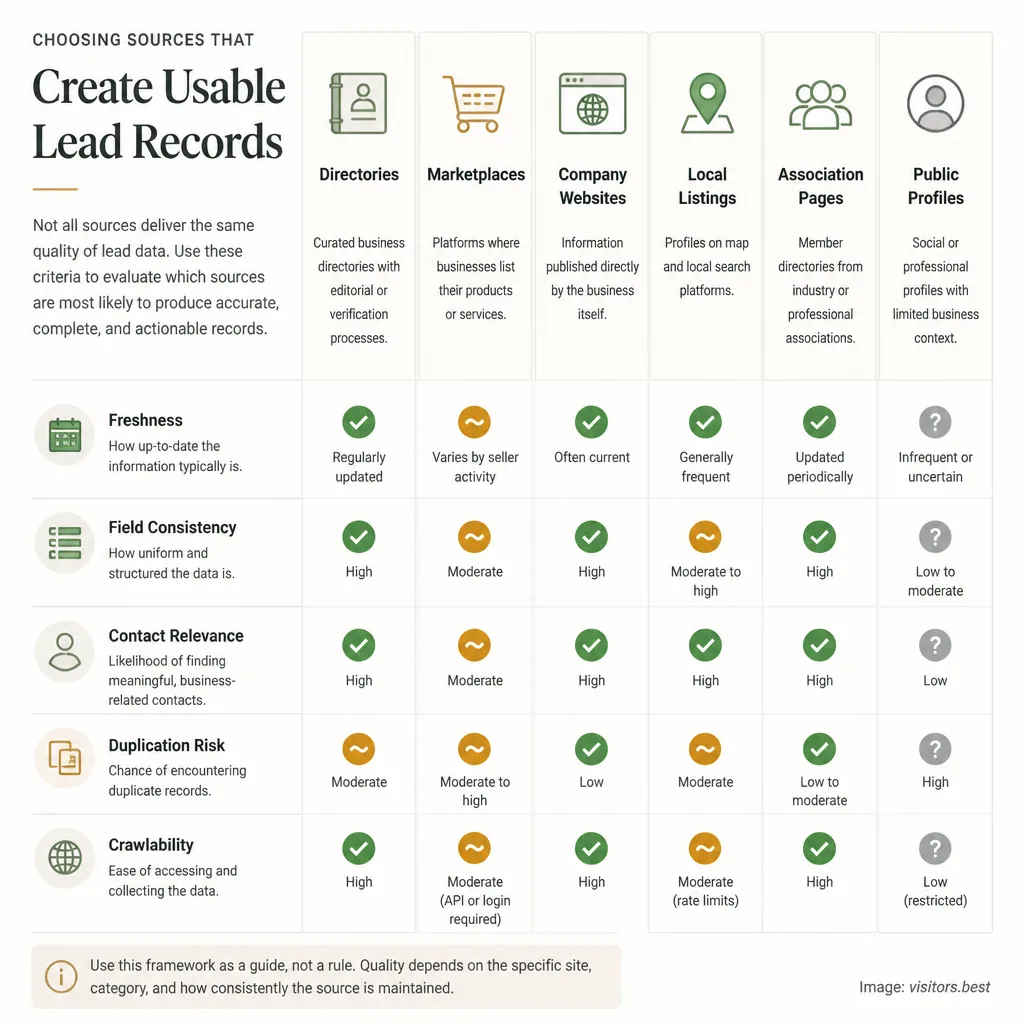
The cheapest place to improve lead quality is source selection.
Bad sources cost you twice: once in cleanup time, and again in enrichment and verification spend on records that never should have entered the workflow.
High-yield source types
The best public sources usually expose a real business entity with enough structure to match later:
- company directories
- marketplace seller pages
- company websites
- local business listings
- trade association member pages
- selected public profiles tied to a real company presence
A local roofing contractor with a website, service area, and phone number is useful. A thin directory profile with no domain and no recent activity usually is not.
How to judge a source
Use five filters:
- Freshness: Does the source appear to be maintained?
- Field consistency: Are company names, locations, and URLs structured clearly?
- Contact relevance: Does the source point to a real business contact path?
- Duplication risk: Will it mostly repeat records you already have?
- Crawlability/accessibility: Can you collect it without making the workflow fragile?
Filter early
Exclude sources if they regularly produce:
- no company domain
- no meaningful location data
- thin or placeholder profiles
- obviously stale pages
- heavy duplicate overlap
- non-commercial or hobby entities
A smaller source pool with cleaner records usually beats a giant export full of ambiguity.
Step 2: Capture the minimum viable lead record before spending money
Do not over-collect upfront. Capture enough to identify the entity, match it later, and troubleshoot when something breaks.
Core fields
Your minimum viable lead record should usually include:
- company name
- domain or website
- source page URL
- source type
- location
- category or niche
- one contact clue
- scrape or capture date
That is enough to move into cleanup and matching without pretending you already know more than you do.
Must-have vs. nice-to-have
Must-have fields help you identify the company.
Nice-to-have fields help you prioritize it.
Employee count, tech stack, social activity, and likely decision-maker names can be valuable, but they usually belong in enrichment, not initial capture.
Why provenance matters
Source URL, source type, and capture date seem boring until the list underperforms.
Then they tell you whether the problem came from one weak directory, one stale source type, or one old batch. They also help answer internal compliance questions about where a record came from.
Step 3: Clean and normalize before enrichment
This is where many teams waste money. They enrich first, then realize half the batch was junk.
Cleaning first protects budget and improves match accuracy.
Deduplicate at three levels
Deduplication should happen across:
- company name
- root domain
- contact identity, if available
“Acme Digital,” “Acme Digital LLC,” and “acmedigital.com” should not trigger three separate enrichment paths.
Normalize the fields that break matching
Normalize:
- company naming conventions
- locations
- URLs and root domains
- phone formats
- category labels
Strip tracking parameters from URLs. Standardize state and country names. Collapse category sprawl into labels your team will actually use.
Even lightweight tools can help. For small teams, spreadsheets are often enough for first-pass deduplication and normalization before anything more complex.[^3]
Remove junk before it triggers spend
Kill records early if they have:
- malformed domains
- parked or dead sites
- duplicate entities already in the CRM
- no clear commercial activity
- no plausible route to contact
Enrichment does not fix bad source data. It usually just decorates it.
Step 4: Build an enrichment waterfall instead of relying on one provider
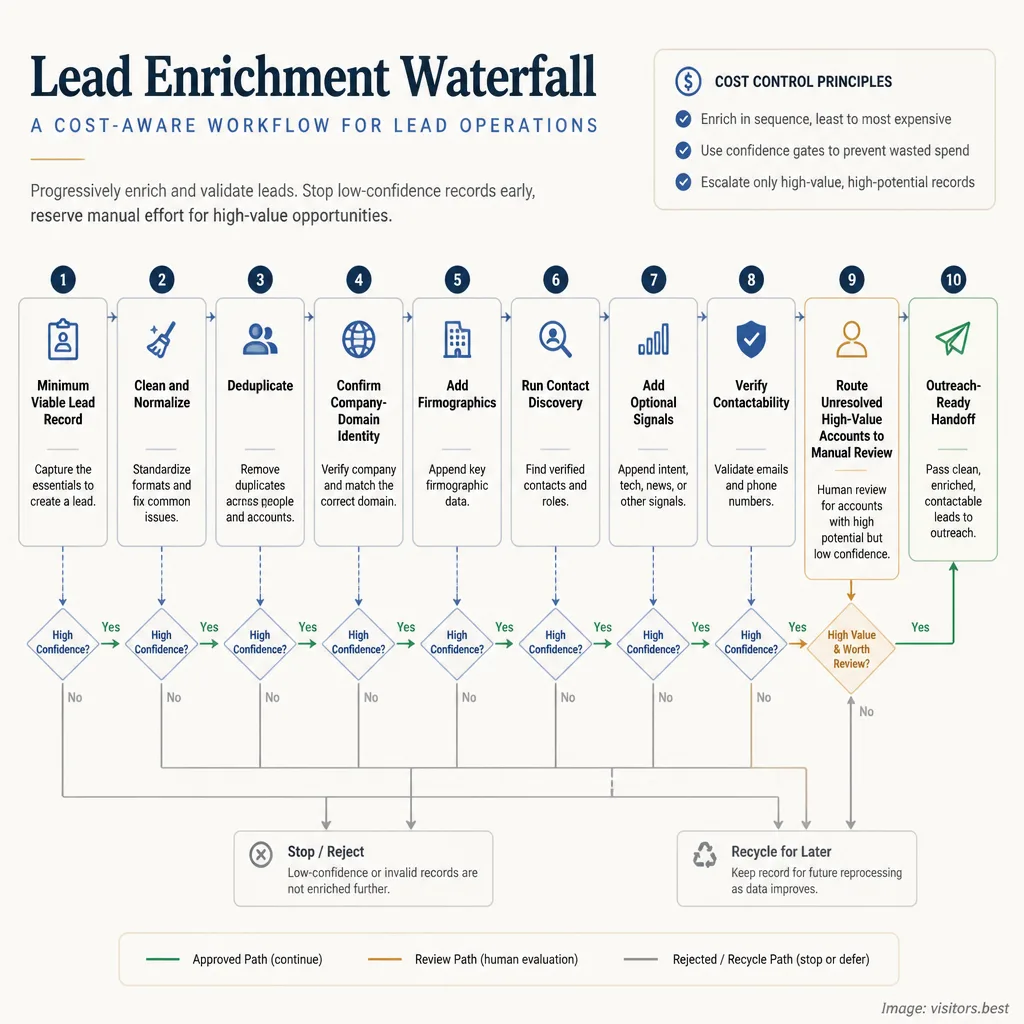
An enrichment waterfall is not about owning more tools. It is about using them in the right order.
What to enrich
Typical enrichment layers include:
- company identity confirmation
- firmographics such as size, geography, and industry
- contact discovery
- social presence
- tech stack
- activity or maturity signals
Not every campaign needs every layer. A local lead-gen offer usually needs far less than an enterprise outbound motion.
A practical order of operations
A workable waterfall often looks like this:
- Identity first: confirm the company-domain match
- Firmographics second: add company-level context
- Contact discovery third: find the best route to reach someone
- Signals fourth: add website, hiring, or stack cues for messaging
- Premium or manual last: reserve this for high-value unresolved accounts
The logic is simple: run the cheapest or highest-confidence checks first, then save expensive lookups for records that have already earned them.
Match confidence and fallback logic
Some matching rules are stronger than others:
- exact root-domain match: strong
- company name + location: often usable with review
- social-profile-only match: weaker
- free-email-domain match: weak without additional evidence
No single provider has the best coverage across every region, company type, and field. That is why a waterfall is often more cost-efficient than depending on one source alone. Still, small teams should treat it as a template, not doctrine.
Step 5: Verify contactability and relevance before outreach
This is the point where teams confuse “deliverable” with “good.”
They are not the same.
Check more than email validity
Before outreach, verify:
- email status
- role relevance
- domain health
- basic website sanity
If the site is broken, the business looks inactive, or the only contact route is generic and unsupported by context, the record should not move forward automatically.
Official verifier guidance helps here. Hunter, for example, distinguishes between valid, invalid, blocked, and accept-all statuses, and notes that accept-all domains cannot be fully guaranteed as deliverable because the server accepts all addresses.[^4]
Why a valid email can still be a bad lead
A technically valid email can still be wrong because:
- the person is irrelevant
- the company is outside your ICP
- the site is abandoned
- the business appears inactive
- the messaging angle is weak or unclear
- the account is a role inbox with no buying context
A valid mailbox is a deliverability signal, not a qualification signal.
When manual review is worth it
Manual review makes sense when:
- the account is strategically important
- automated signals conflict
- the domain verifies but the company fit is unclear
- the only contact path is weak or generic
- the record sits just below your confidence threshold
This is where experienced operators protect campaign quality.
Step 6: Segment by outreach angle, not just industry
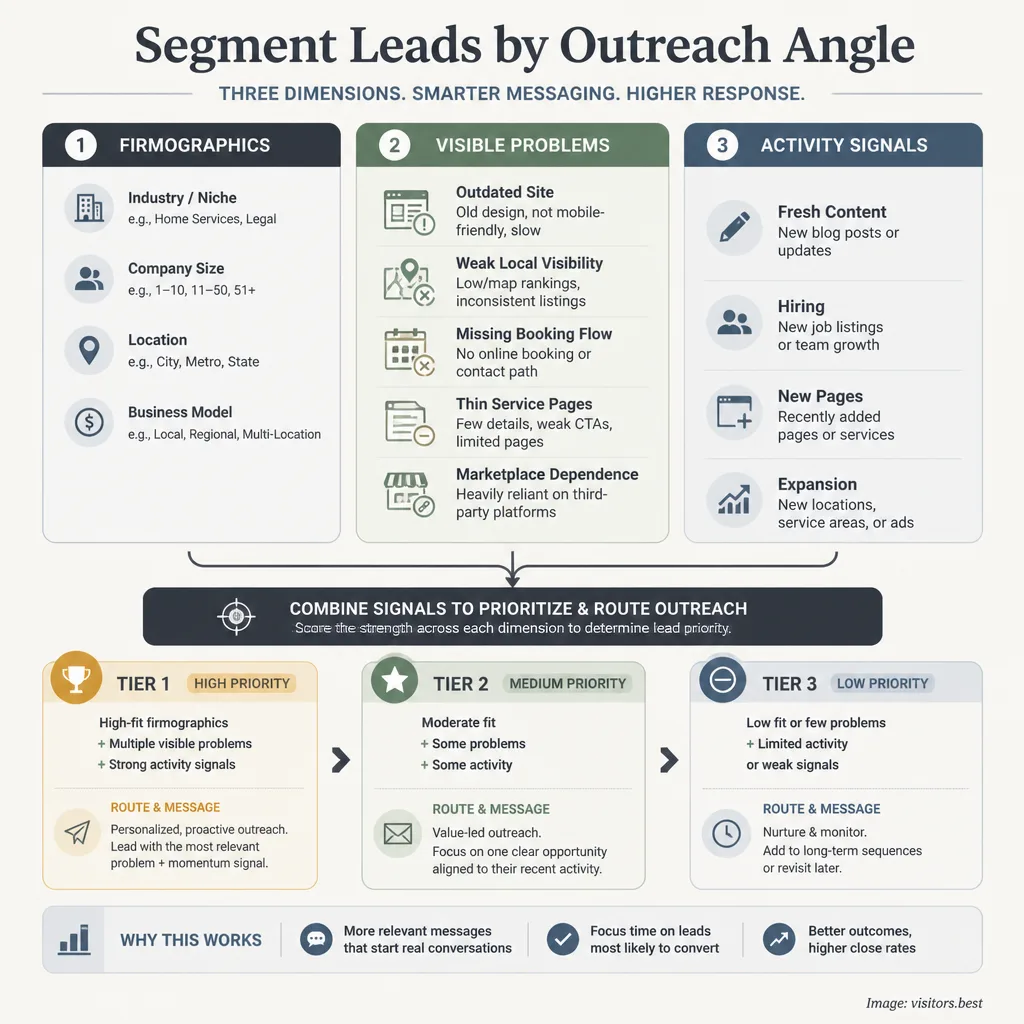
Industry-only segmentation is usually too blunt.
Two dental clinics may both sit in healthcare, but one has a modern site and weak local visibility while the other ranks well and leaks conversions. Same industry, different message.
Firmographic segmentation
Start with basics like:
- geography
- size
- business model
- service category
- single-location vs. multi-location
This helps with routing and offer fit.
Problem-based segmentation
This is often where response rates improve. Segment by visible issues such as:
- outdated website
- weak local SEO presence
- missing booking or quote flow
- thin service pages
- weak conversion elements
- overdependence on third-party marketplaces
Signal-based segmentation
Then layer in momentum signals:
- recently updated site
- active hiring
- new location pages
- fresh content activity
- visible category expansion
Priority tiers and routing rules
A simple model works well:
- Tier 1: strong fit, clear problem, viable contact path
- Tier 2: strong fit, weaker signal or lower contact confidence
- Tier 3: possible fit, needs manual review or recycling
Segmentation should improve messaging, not just reporting.
Step 7: Hand off only outreach-ready leads
Your CRM or sequencer should not become a storage unit for unresolved data.
Define outreach-ready clearly
A lead is outreach-ready when it has:
- confirmed company identity
- at least one viable contact route
- basic ICP fit
- a segment label
- a clear outreach angle
- no obvious disqualifier
Anything less is still inventory.
Required fields before import
Before handoff, require:
- company name
- domain
- contact name or route
- contact status
- segment
- source provenance
- owner or routing tag
- disqualification or review status
HubSpot’s distinction between lifecycle stage and lead status is a useful reminder here: not every imported record should be treated as sales-ready just because it exists in the CRM.[^5]
Disqualification and recycle logic
Common disqualifiers include:
- unverifiable domain
- duplicate in CRM
- outside target geography or size
- no relevant contact path
- low-confidence entity match
- unclear commercial activity
Promising but unresolved records should go into a recycle queue, not a live campaign.
The metrics that matter more than leads per day
“Leads collected per day” is a vanity metric. It measures input volume, not sales usefulness.
Track these instead:
- Coverage rate: percentage of raw records with your minimum viable fields
- Match rate: percentage matched to a real company identity
- Verification pass rate: percentage that pass contact checks
- Duplicate rate: share removed during cleaning
- Contactable lead rate: percentage of raw records that end with at least one viable contact route
- Reply rate by segment: signal of message-market fit
- Meeting rate by source: signal of source quality
- Qualified pipeline or revenue per 1,000 raw records: the metric that tells you whether the operation is worth running
That last metric forces honesty. A source can look productive at the top of the funnel and still be weak once you measure downstream results.
A simple example: 1,000 raw records may shrink to 650 normalized records, 420 enriched records, 260 verified contacts, and 140 outreach-ready leads. If those 140 produce more meetings than another source’s 500 “verified” contacts, the smaller source is better.
Common failure points in open-web lead operations
The same mistakes show up repeatedly.
Scraping too broadly
Broad sourcing creates cleanup debt and weakens fit.
Enriching dirty data
This burns budget and lowers match accuracy.
Ignoring provenance
Without source tracking, you cannot prune weak channels intelligently.
Treating all valid emails as equal
Accept-all domains, generic inboxes, and irrelevant contacts are not the same as strong contact opportunities.[^4]
Segmenting too late
If segmentation starts after outreach copy is written, the campaign is already weaker than it should be.
Optimizing for list size instead of pipeline yield
More rows do not mean more revenue.
A simple operating cadence for small teams
Small teams need rhythm more than sophistication.
Daily capture
Add new records from approved sources and tag provenance immediately.
Twice-weekly cleaning and enrichment
Run deduplication, normalization, and early-stage enrichment in batches. For a lean team, that is usually frequent enough.
Weekly QA and segmentation review
Spot-check records, review low-confidence matches, and tighten segment definitions based on actual outreach performance.
Monthly source pruning
Cut sources that produce poor contactable-lead rates, weak reply rates, or low meeting yield. Add new sources slowly and judge them on downstream results, not export volume.
Final thought
Open-internet lead scraping still works in 2026, but not because it produces large lists. It works when the workflow is disciplined enough to turn public data into contactable, relevant, segmented leads without wasting time and budget on junk.
That is the real advantage.
The teams that win do not scrape more aggressively. They filter earlier, clean before they spend, enrich in sequence, verify with skepticism, and measure success by pipeline yield instead of row count.
FAQ
What is open-internet lead scraping?
Open-internet lead scraping is the process of collecting publicly available business data from sources such as directories, company websites, marketplace pages, local listings, and association sites, then turning those raw records into usable outreach inputs through cleanup, enrichment, verification, and segmentation.
Is scraping public web data enough to build a good lead list?
Usually not. Raw public data is only the starting point. A useful lead list needs normalized fields, duplicate control, enriched company and contact data, verification checks, and segmentation rules before it is ready for outreach.
What fields should marketers capture before enrichment starts?
A minimum viable lead record should usually include company name, domain or website, source page URL, source type, location, category or niche, one contact clue, and capture date.
Why should cleaning happen before enrichment?
Cleaning first removes junk records, malformed domains, and duplicates before they trigger enrichment costs. It also improves match accuracy because normalized company names, URLs, and locations are easier to resolve correctly.
What is an enrichment waterfall?
An enrichment waterfall is a staged lookup process that starts with the cheapest or highest-confidence checks and only moves to more expensive providers or manual review when needed.
What is the difference between a verified contact and an outreach-ready lead?
A verified contact has passed technical checks such as email validity or domain sanity. An outreach-ready lead goes further: the record is relevant to your target market, fits a segment, has a clear messaging angle, and meets your handoff standards for CRM or sequencer import.
Should marketers segment scraped leads by industry alone?
No. Industry can help, but better outreach usually comes from combining firmographic segmentation with problem-based and signal-based segmentation. Two companies in the same industry may need very different messaging depending on their visible problems or growth signals.
What metrics matter more than leads collected per day?
Better metrics include duplicate rate, match rate, coverage rate, verification pass rate, contactable lead rate, reply rate by segment, meeting rate by source, and qualified pipeline or revenue per 1,000 raw records.
When does an open-web lead workflow make sense?
It makes sense when you need targeted B2B or local-business prospecting, have clear ICP filters, and can operationalize cleanup and verification. It is a weaker fit when you need purchase intent, immediate scale, or stricter compliance handling without internal review.
Does public data collection automatically make outreach compliant?
No. Public availability does not automatically make downstream outreach compliant. Your sending practices still need to follow the rules that apply in the jurisdictions you target.[^1][^2]