Best Places to Find Affiliate Offers by Niche: SaaS, Finance, Health, iGaming, and Lead Gen
Most affiliates look for offers the wrong way. They join a big network, sort by payout, and assume the highest number wins.
That approach works just well enough to get expensive.
The right place to find an offer depends less on directory size and more on how that niche actually makes money. In some verticals, the advertiser owns the customer relationship, so the best offers are in direct partner programs. In others, profit depends on validation, routing, compliance, or retention. The headline payout is often the least useful number on the page.
If you want to source offers intelligently, treat each niche as its own system. SaaS, finance, health, iGaming, and lead gen reward very different sourcing strategies.
Best Places to Find Affiliate Offers by Niche
Why sourcing changes so much by vertical
Affiliate offers can look similar at a glance: a landing page, a payout, some creative, maybe an affiliate manager. Underneath, the mechanics are very different.
In SaaS, value usually comes from activation, trial-to-paid conversion, and retention. In finance and insurance, lead quality, consent language, and validation rules often determine whether a lead is payable at all.[^1][^2] In health, refund rates and claims compliance can quietly wreck a campaign.[^1][^3] In iGaming, licensing, KYC, first-time depositor rules, and retention matter as much as the initial signup.[^4] In classic lead gen, the form fill is only the start; routing and buyer responsiveness often determine the real value.
A useful rule: the best source is usually the one closest to how that niche validates conversions.
The four main sourcing channels
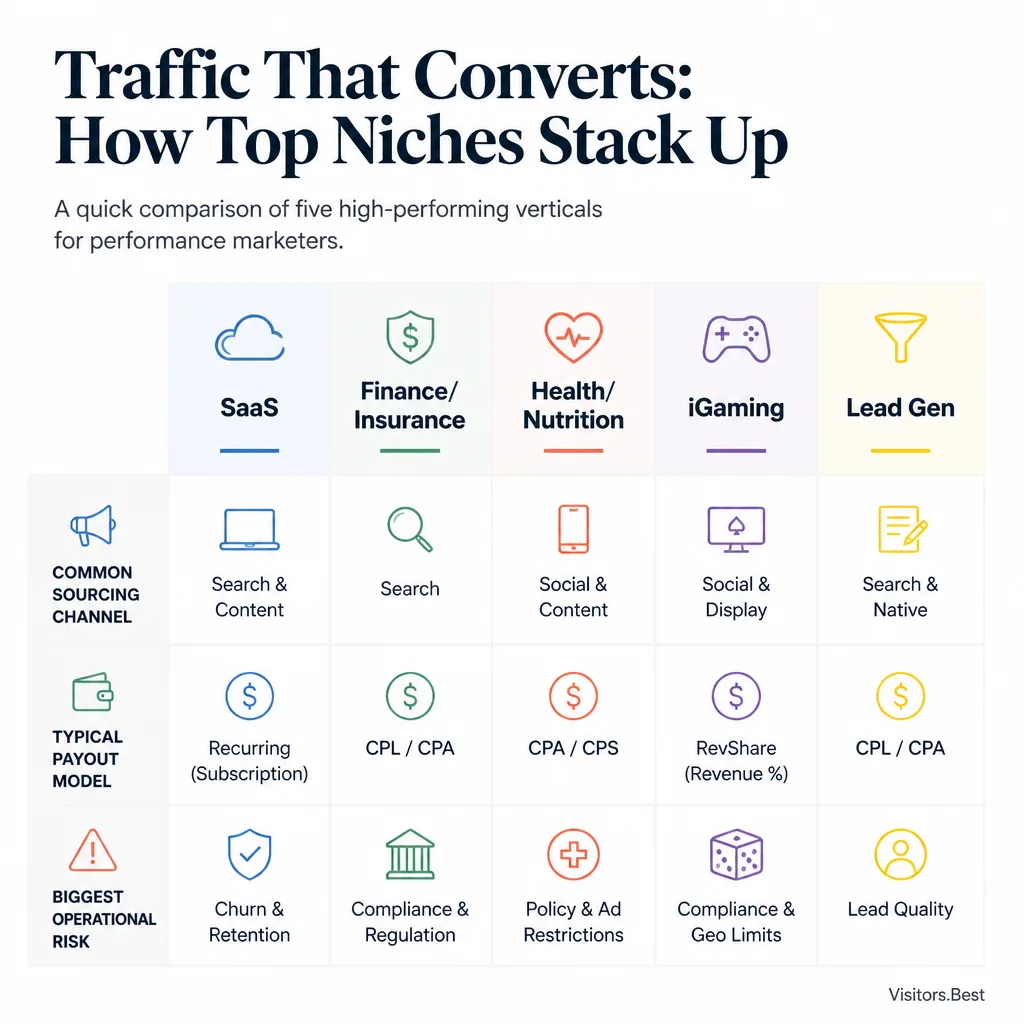
Before going niche by niche, separate the channel types:
- Direct programs are run by the advertiser.
- Affiliate networks sit between advertiser and publisher, usually handling tracking, approvals, and payments.
- Marketplaces help you discover and compare offers across brands.
- Lead aggregators or brokers are common in lead-driven verticals where leads may be routed or resold.
These channels are not interchangeable.
Direct programs usually offer better transparency and cleaner economics, but access is narrower. Networks make testing easier, but they add a layer between you and the buyer. Marketplaces are useful for discovery, not due diligence. Aggregators can open doors in harder verticals, but they often reduce visibility into margin, routing, and acceptance logic.
Here is the short version:
| Niche | Common source | Common payout model | Biggest operational risk | Best-fit traffic type |
|---|---|---|---|---|
| SaaS | Direct partner programs, partner platforms | Recurring rev share, CPA, demo/trial payouts | Weak attribution and low trial-to-paid conversion | Content, reviews, B2B audiences |
| Finance/Insurance | Specialized networks, brokers, direct buyers | CPL, CPA, call payouts | Compliance and lead rejection | Intent-led search, qualified lead funnels |
| Health | CPA networks, brand programs, DTC offers | CPA, CPS, rev share | Refunds, claims risk, unstable creatives | Native, email, content, compliant paid traffic |
| iGaming | Licensed operator programs, specialist platforms | CPA, rev share, hybrid | Geo/legal mismatch, poor player qualification | Geo-specific SEO, sports/casino traffic |
| Lead Gen | Buyers, call marketplaces, aggregators, direct | CPL, accepted lead, qualified call | Routing, answer rate, acceptance rules | High-intent forms, calls, local traffic |
SaaS: Partner Programs, App Ecosystems, and Marketplace Discovery
Where SaaS offers usually come from
SaaS offers often come from the software company’s own partner or affiliate program, or from platforms such as PartnerStack, Impact, CJ, and ShareASale. App ecosystems matter too. If you publish around e-commerce or CRM workflows, ecosystems like Shopify or HubSpot can be better discovery layers than generic affiliate directories.
Why direct programs often win in SaaS
SaaS is rarely a simple front-end conversion play. The real value usually sits downstream: trial quality, activation, paid conversion, retention, and sometimes sales-assisted closing.
That changes the sourcing logic. A direct program often gives you better reporting, better onboarding, and a clearer view of what actually counts. A public listing that promises “40% recurring commissions” may look attractive, but if the product churns quickly or attribution gets overwritten by branded search or sales follow-up, that headline means very little.
The common mistake is confusing availability with quality. SaaS offers are easy to find. Good SaaS offers are harder.
Choose this channel if
Direct SaaS programs or strong partner platforms make the most sense if:
- your traffic is content-led
- you convert through reviews, comparisons, tutorials, or workflow content
- your audience needs education before buying
- you care more about recurring revenue than a quick one-time CPA
This niche is usually easier from a compliance standpoint than finance or iGaming. It is not easier on product fit. SaaS punishes weak audience alignment fast.
Red flags
Watch for:
- short cookie windows
- no visibility into trial-to-paid conversion
- “recurring” commissions with no retention context
- referral programs presented as full affiliate programs
- weak onboarding or vague positioning
- signs that affiliate traffic rarely turns into strong customers
Finance and Insurance: Lead Networks, Approved Funnels, and Compliance First
Where finance and insurance offers usually come from
Finance and insurance offers are more likely to come through specialized lead networks, approved funnels, brokers, comparison brands, and direct buyer relationships than broad public directories. Compliance standards, data handling rules, and traffic-source restrictions tend to filter access early.[^1][^2]
Why buyers, brokers, and specialist networks matter more here
In finance, a submitted lead is not automatically a paid lead. It may be checked for geography, intent, duplication, debt amount, underwriting fit, consent language, or call connectivity, depending on the sub-vertical.
That is why buyers, brokers, and specialist networks matter. They sit closer to the validation layer. In some cases, the same lead can be worth very different amounts depending on who accepts it and how the routing works.
Once you start hearing terms like ping/post, real-time routing, or accepted lead, a generic affiliate directory is no longer enough.
Choose this channel if
Specialized networks or direct buyer relationships fit best if:
- you can control lead intent
- your geo targeting is precise
- you can clearly disclose traffic sources
- you can meet buyer requirements around consent and validation
- you understand that not every submitted lead becomes revenue
This niche can scale well, but the operational burden is high. It is a bad place to improvise compliance.
Red flags
Watch for:
- vague compliance requirements
- no written guidance on accepted traffic sources
- unrealistic CPL promises
- unclear duplicate suppression rules
- no explanation of rejection logic or scrub reasons
- long payment holds and aggressive clawbacks
At minimum, confirm current requirements with the advertiser and review relevant guidance from the FTC, CFPB, and, where calling or consent is involved, the FCC.[^1][^2]
Health and Nutrition: CPA Networks, Brand Programs, and High Compliance Friction
Where health offers typically originate
Health and nutrition offers often come from CPA networks, direct-to-consumer brand programs, e-commerce affiliate programs, and specialist supplement advertisers.
Why payout can be misleading in health
This is the niche where a high payout can hide the most risk.
A health offer may convert well up front and still be a poor business decision if refund rates are high, fulfillment is inconsistent, or the creative depends on claims that regulators and ad platforms will not tolerate.[^1][^3] The economics do not stop at the conversion pixel.
A lot of health campaigns fail after launch, not before it.
Choose this channel if
Health offers make sense if:
- you understand policy-sensitive traffic sources
- you can work within stricter creative limits
- you know how to assess brand transparency and fulfillment risk
- you are willing to favor stability over the flashiest CPA
Often the safer choice is a cleaner brand with a lower headline payout and a better chance of surviving compliance review.
Red flags
Watch for:
- disease-treatment or dramatic body-transformation claims
- before-and-after creatives that push policy limits
- continuity or autoship complaints
- hidden rebills
- rotating domains and constantly replaced landing pages
- low brand transparency
For compliance context, review guidance from the FTC and the FDA.[^1][^3]
iGaming: Licensed Operators, Affiliate Programs, and Geo-Dependent Economics
Where iGaming offers usually come from
iGaming offers usually come from licensed operators, sportsbook and casino affiliate programs, specialist iGaming platforms, and regional affiliate managers tied to regulated brands.
How licensing, KYC, and retention change offer selection
This niche is fundamentally geo-dependent. An offer is only as strong as the operator’s licensing status in your target market, the quality of local payment methods, KYC completion rates, and the share of registered users who become qualified first-time depositors.[^4]
That is why iGaming economics cannot be judged on CPA alone. Revenue share can be excellent when player retention is strong and reporting is transparent. It can also disappoint if the operator has weak retention, unfriendly deductions, or opaque qualification rules.
Choose this channel if
iGaming offers fit best if:
- your traffic is geo-specific
- you understand the local legal environment
- you can verify the operator’s licensing
- you know the difference between registration volume and payable player volume
This is not a broad “send traffic anywhere” niche. Precision matters.
Red flags
Watch for:
- unlicensed or unclear operator status
- broad geo claims that are hard to verify
- no clarity on KYC or first-time depositor rules
- opaque rev-share calculations
- negative carryover terms that work against the affiliate
- weak account management or limited reporting
If the operator cannot clearly explain what qualifies as a payable player, the deal is weaker than it looks. Verify legitimacy through the relevant regulator, such as the UK Gambling Commission, where applicable.[^4]
Lead Gen Verticals: Home Services, Education, Legal, and Calls
Where classic lead gen offers come from
Classic lead gen offers often come from direct buyers, call marketplaces, lead aggregators, broker networks, and specialized buyers in verticals like home services, legal, education, debt, or solar.
Why routing and acceptance rules matter more than payout
Lead gen is where the front-end payout hides the most operational reality.
A form fill is only worth what the downstream system can do with it. Routing logic, buyer availability, duplicate suppression, contact speed, call answer rate, and close quality often matter more than the advertised payout.
A call campaign makes the point clearly. A “$50 per call” offer may sound strong until you learn the call must last 120 seconds, be answered during business hours, avoid IVR drop-off, and match narrow geo criteria. At that point, the real offer is much stricter than the headline suggests.
Choose this channel if
Direct buyers or strong lead networks are a good fit if:
- you control the submission experience
- you can qualify intent before handoff
- you can optimize form friction
- you can monitor call quality, answer rates, and disposition feedback
This vertical rewards operational discipline far more than directory browsing.
Red flags
Watch for:
- no sample feedback on accepted vs. rejected leads
- undefined acceptance criteria
- delayed reporting
- poor buyer responsiveness
- long forms that lower intent without improving quality
- call buyers with weak answer coverage or long hold times
How to Choose the Right Sourcing Channel for Your Niche
Choose direct relationships when control matters most
Go direct when quality, transparency, and optimization feedback matter more than speed. This is often strongest in SaaS, mature lead gen relationships, and some finance or iGaming setups once you have proven traffic.
Choose networks when speed and testing matter most
Networks are often the right starting point when you want to test a niche, compare offers quickly, or keep payments and approvals centralized.
Choose marketplaces for discovery
Marketplaces are best used as a research layer. They help you find candidates. They do not prove offer quality.
Choose aggregators or brokers only if you understand the tradeoff
Aggregators can solve access problems, especially in finance and lead gen. They also add opacity. If you cannot see who ultimately validates or buys the lead, you are taking on more risk than the payout suggests.
The Decision Filter That Prevents Expensive Mistakes
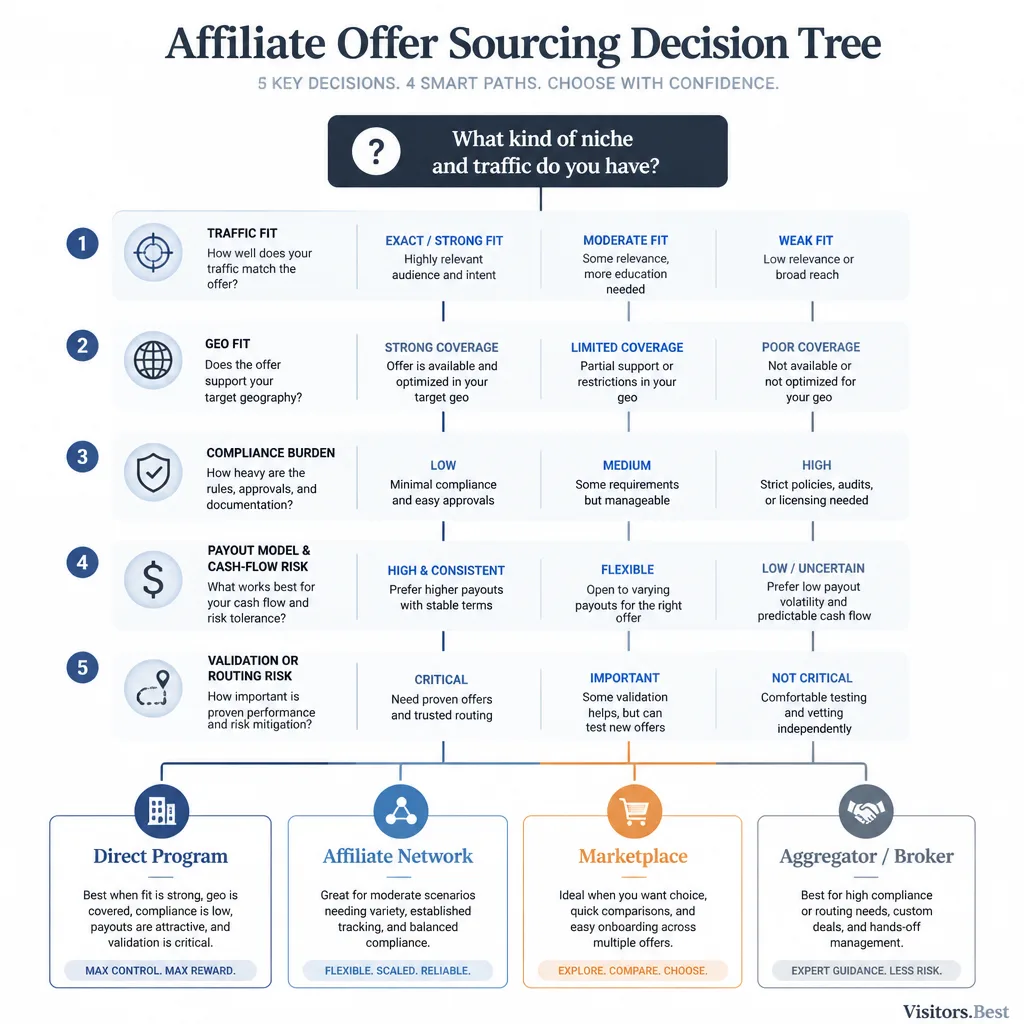
Traffic fit
SEO, PPC, email, native, social, influencer traffic, and calls do not monetize equally across niches. A SaaS tutorial audience behaves very differently from a debt-relief lead funnel.
Geo fit
Geo is not just language. It shapes legality, payout economics, payment methods, buyer demand, and acceptance rules.
Compliance burden
SaaS is usually lighter. Finance, health, and iGaming are not. If your team cannot support review, documentation, and restricted creative, choose accordingly.
Payout model and cash-flow risk
Recurring SaaS commissions may pay slowly. Finance and lead gen may involve validation holds. Health can hide refund exposure. iGaming rev share can create long-tail upside, but with more volatility.
Validation, routing, and reversal risk
If you do not understand how conversions are accepted, rejected, scrubbed, or reversed, you do not understand the offer.
What Experienced Affiliates Check Before Running Any Offer
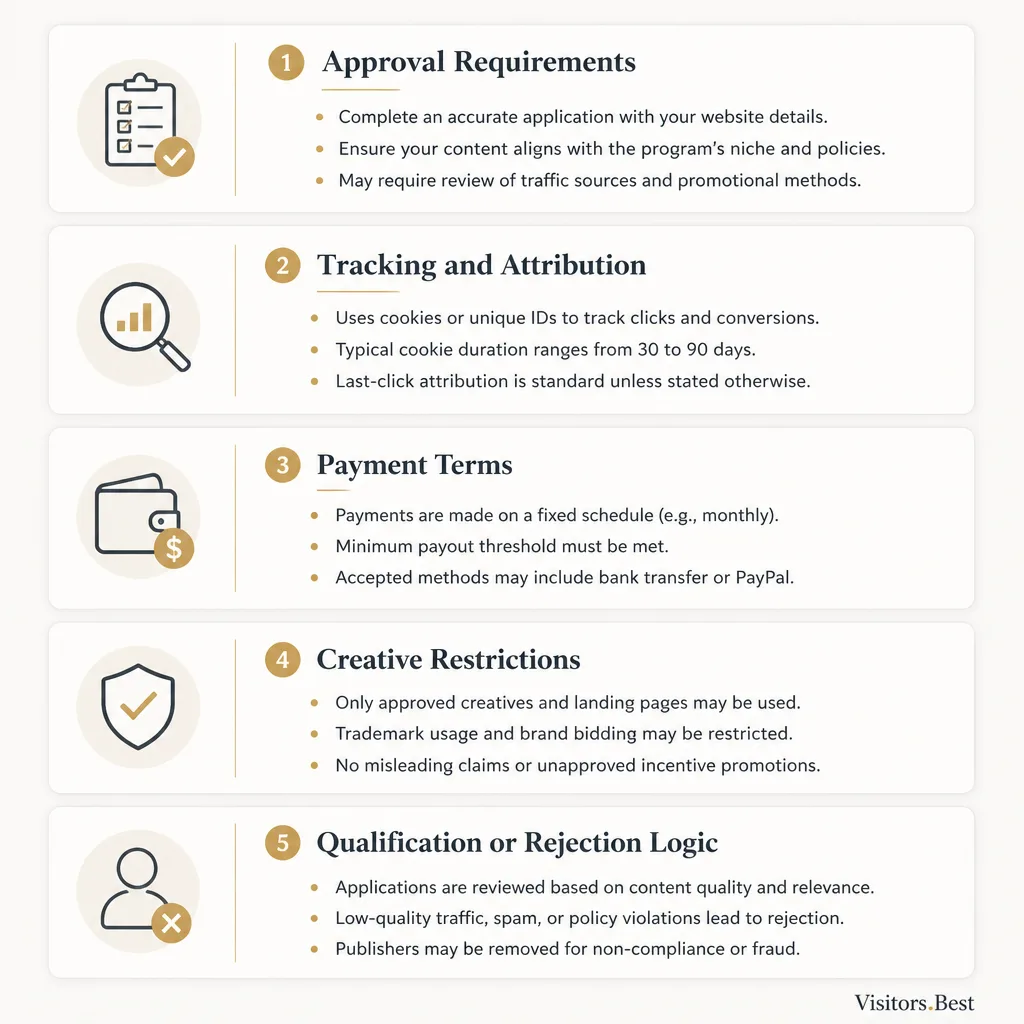
Approval requirements
Ask which traffic sources are allowed, whether creatives need approval, and what disclosures are mandatory.
Tracking and attribution details
Check cookie windows, last-click rules, cross-device limitations, free-trial attribution, offline conversion handling, and whether you receive disposition data.
Payment terms
Look at NET terms, thresholds, hold periods, clawbacks, and who actually pays: the network, the broker, or the advertiser.
Creative restrictions
This is especially important in finance, health, and iGaming. Restrictions can determine whether an offer is runnable at all.
Lead rejection logic or player qualification rules
For lead gen and finance, ask for rejection reasons and sample dispositions. For iGaming, ask exactly what defines a qualified player or first-time depositor.
Conclusion
The best place to find affiliate offers by niche is rarely the biggest directory. It is the source that matches how the niche actually works.
In SaaS, that often means direct partner relationships and strong partner platforms. In finance and insurance, it usually means specialized buyers and networks built around compliance and validation. In health, the safer money often comes from offers that can survive refund pressure and creative scrutiny. In iGaming, geo licensing and player qualification change everything. In lead gen, the offer is only as good as the routing and buyer response behind it.
The risk is rarely that an offer does not exist. The real risk is sending traffic to an offer whose payout model hides what actually determines profit.
FAQ
Why do affiliate offer sources vary so much by niche?
Because the business model changes by vertical. SaaS depends on product adoption and attribution, finance and insurance depend on compliance and lead validation, health adds refund and claims risk, iGaming depends on licensing and player qualification, and lead gen depends on routing and buyer acceptance.
What is the difference between a direct program, affiliate network, marketplace, and aggregator?
A direct program is run by the advertiser. An affiliate network sits between advertiser and publisher and usually handles tracking and payments. A marketplace helps with discovery and comparison. An aggregator or broker is more common in lead-driven niches and may route or resell leads to downstream buyers.
Where do SaaS affiliate offers usually come from?
Most SaaS offers come from direct partner programs, partner platforms, app ecosystems, and B2B-friendly affiliate platforms. Direct programs often work better in SaaS because attribution, product education, and recurring revenue matter more than quick CPA access.
Why are finance and insurance offers harder to source through open directories?
These niches are more tightly controlled because compliance, consent language, data handling, and lead quality all affect whether traffic can be accepted legally and profitably. Access often depends on approval, traffic-source review, and validation standards rather than public availability.
What makes a health affiliate offer risky even when the payout looks high?
High payouts can be offset by refund rates, chargebacks, ad policy restrictions, unstable landing pages, and aggressive claims that create compliance problems. In health, the real risk often appears after launch.
How is iGaming offer evaluation different from other affiliate niches?
iGaming depends heavily on geography, licensing, KYC completion, first-time depositor rules, and player retention. A strong-looking rev-share deal can still be weak if reporting is opaque, negative carryover is unfriendly, or qualified-player definitions are unclear.
What matters most in classic lead gen offers like home services, legal, or education?
The advertised payout is only part of the picture. Real value depends on routing logic, acceptance criteria, duplicate suppression, buyer responsiveness, call handling, and how quickly valid leads are contacted.
When should I choose a direct advertiser relationship instead of a network?
Choose direct when traffic quality is strong, volume is consistent, and transparency matters more than fast testing. Direct relationships become more valuable when you need better feedback, cleaner economics, and tighter control over compliance or attribution.
When is a network the better choice?
Networks are often better when you need speed, easier testing, centralized payments, or access to multiple offers without negotiating direct relationships one by one. They are especially useful early in niche evaluation.
What should I check before sending traffic to any affiliate offer?
Check approval requirements, tracking and attribution rules, payment terms, reversal windows, qualification logic, creative restrictions, and whether the advertiser clearly explains how conversions are accepted, rejected, or scrubbed.