Where to Find High-Converting Affiliate Offers in 2026 Without Getting Burned by Low-Quality Traffic
Finding affiliate offers is easy.
Finding offers that still make sense after you buy traffic, clear approvals, and try to scale is much harder.
That gap matters more in 2026 than it used to. Plenty of offers still look attractive in screenshots, network listings, or manager pitches. The trouble starts later: vague traffic rules, weak attribution, delayed approvals, aggressive reversals, or a funnel that converts just well enough to lure you into spending more before the margin disappears.
The best offer is rarely the one with the biggest payout. It is the one that survives contact with reality: clean tracking, stable approvals, clear restrictions, and an advertiser that does not rewrite the rules once volume shows up.
Where strong affiliate offers actually come from in 2026
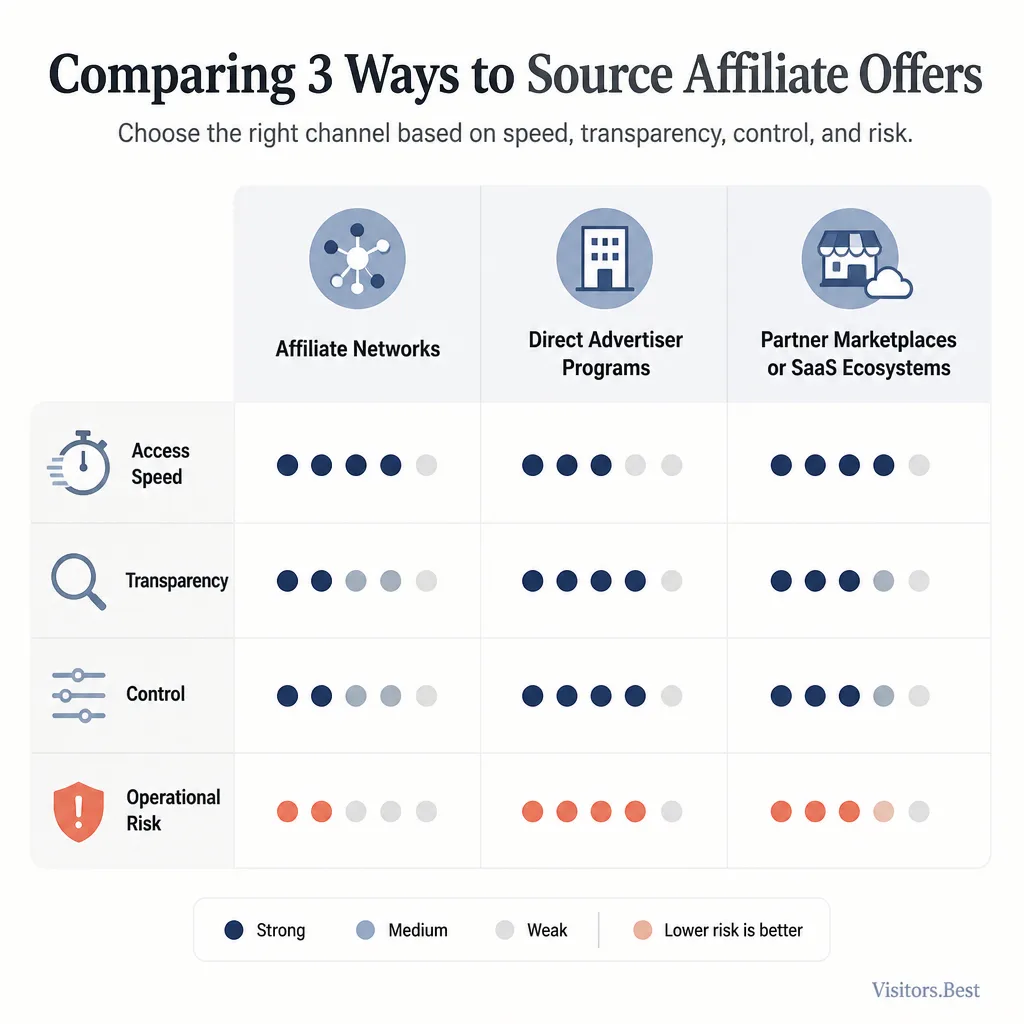
Most worthwhile offers come from four places. The trick is not just knowing where to look. It is knowing what each source tends to hide.
| Source | Main advantage | Main risk | Best for |
|---|---|---|---|
| Affiliate networks | Fast access to many offers | Uneven quality and limited transparency | Beginners and fast testers |
| Direct advertiser programs | Better communication and control | More diligence required | Experienced affiliates and niche buyers |
| Partner marketplaces / SaaS ecosystems | Cleaner operations and stronger brand governance | Narrower verticals and lower volume | SaaS, B2B, creator, and software traffic |
| Private referrals / manager intros | Access to less-public offers | Cherry-picked proof and weak documentation | Operators who verify everything |
Affiliate networks: fast access, uneven quality
Networks still matter. They are the quickest way to see what is active, which verticals are crowded, and what payout models are available.
Platforms like CJ, Awin, Rakuten Advertising, ClickBank, and MaxBounty give you speed and range. That is useful when you need to test quickly.
But a network is not quality control. It is distribution.
A listing on a reputable network tells you very little about approval consistency, duplicate rates, reporting delays, or what happens once paid traffic volume increases. Networks reduce access friction. They do not remove operator risk.
Direct advertiser programs: better control, more responsibility
Direct programs can be better when you know the niche and want fewer layers between you and the decision-maker.
You may get clearer traffic guidance, better cap discussions, faster answers on rejected leads, and sometimes more flexibility on creative or payout terms. Platforms such as Impact often support both direct brand relationships and marketplace discovery.
The tradeoff is simple: more control, more responsibility.
If you work directly with an advertiser, you need to verify how they define an approved lead or sale, how long holds last, how reversals work, and whether the tracking setup is reliable. The upside can be real. So can the diligence burden.
Partner marketplaces and SaaS ecosystems: often overlooked, sometimes cleaner
A lot of affiliates still hear “offers” and think only of traditional CPA networks. That is too narrow now.
Partner ecosystems in SaaS, software, and B2B can be attractive because brand governance is often tighter and traffic rules are usually clearer. PartnerStack is a good example in the SaaS partner space. These ecosystems are not automatically better, but they are often less chaotic than broad lead-gen offers pushed through aggressive distribution.
That matters if your traffic is content-driven, search-heavy, review-based, or aimed at professional buyers rather than impulse clicks.
The downside is fit. These programs may have lower volume, longer conversion lag, smaller GEO coverage, or payout structures that reward patience more than speed.
Private groups, broker relationships, and manager referrals: useful, but verify everything
Some strong offers never appear in public listings. They move through private Skype, Telegram, Slack, WhatsApp, or manager circles.
Sometimes that is where the real edge is. Sometimes that is where the best fiction is.
If a manager sends a screenshot showing a huge EPC and says the offer is “crushing on Facebook,” your first question should not be whether the offer is hot. It should be: under what GEO, what device mix, what approval stage, what date range, what traffic source, and what volume?
Private intros can be valuable. They just require the most skepticism.
The real filter: can the offer stay profitable after scale?
Most affiliate mistakes start with a shallow filter.
The payout looks high. The EPC looks strong. The manager sounds confident. The network is recognizable. That feels like enough.
It is not.
Why payout alone is a bad decision filter
A $120 payout with a weak funnel, long hold period, and unstable approvals can be worse than a $55 payout with fast validation and clean tracking.
That is not theory. It is simple economics.
If Offer A pays more but 30% of conversions get rejected, reporting lags by days, and caps change without warning, the campaign becomes harder to optimize and riskier to scale. If Offer B pays less but approvals are predictable and the funnel matches your traffic, your real margin may be better.
Headline payout gets attention. Approval-adjusted margin keeps campaigns alive.
What predictable approvals and clean attribution are really worth
Predictability shortens the learning cycle.
If your tracker sees conversions quickly, your postback fires correctly, and advertiser reporting mostly lines up with your click and lead data, you can make decisions faster. Tracking platforms like Everflow and TUNE exist for a reason: attribution is not an admin detail. It changes how safely you can buy traffic.
The same goes for approvals. If an advertiser validates clearly and on time, you are not left guessing whether a campaign is weak or the reporting chain is broken.
For small and mid-size media buyers, clarity is often worth more than a flashy payout.
How traffic quality disputes quietly destroy margin
This is where many apparently profitable offers go bad.
You generate leads. The dashboard looks healthy. Then the advertiser says the leads were low intent, duplicated, outside targeting rules, or failed internal quality filters. Sometimes that is fair. Sometimes the rules were vague from the start.
Either way, the damage is the same: top-line conversion data looked stronger than approved revenue.
That gap is where many paid campaigns die.
How to vet an affiliate offer before sending paid traffic
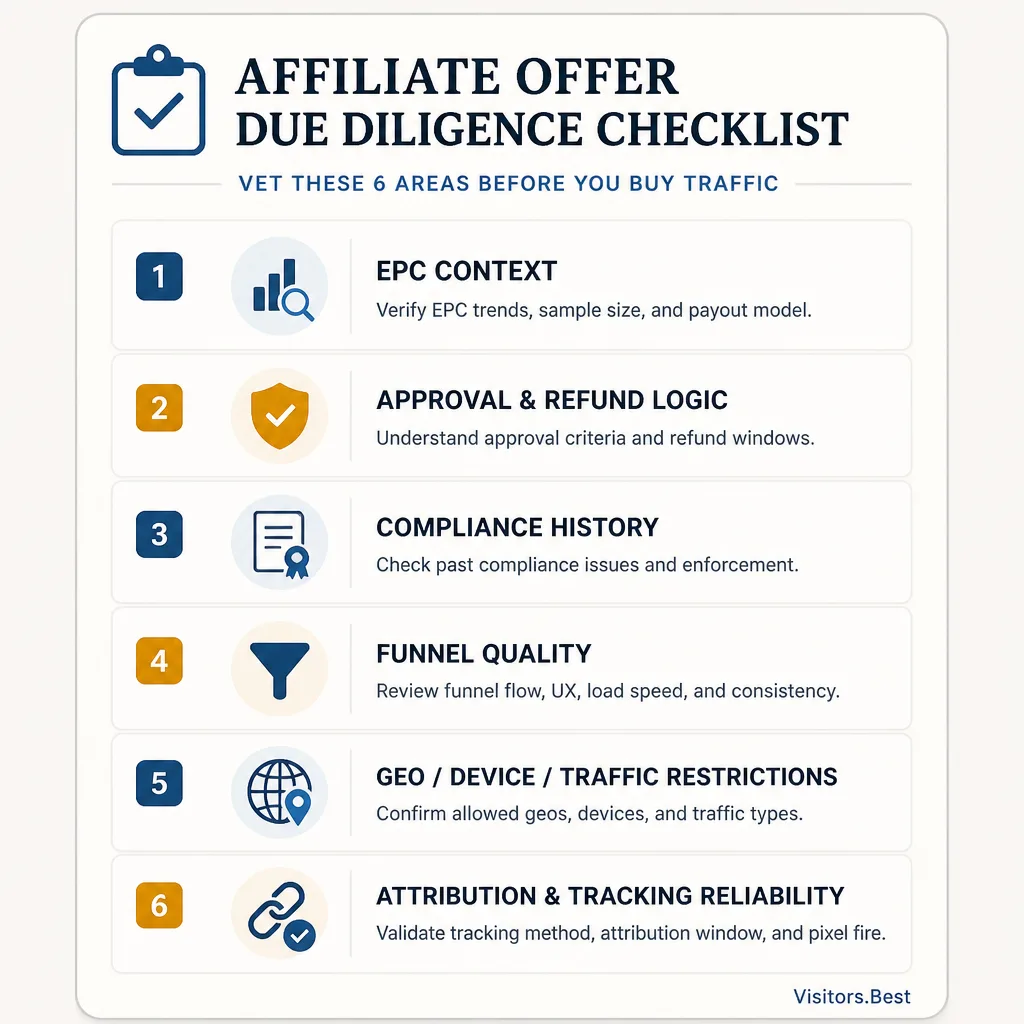
You do not need a week-long audit. But you do need more than a payout number and a screenshot.
EPC: useful signal, dangerous shortcut
EPC can help. It can also mislead.
An EPC number may reflect a different GEO, device mix, traffic source, date range, or only top affiliates with privileged placements. It may also reflect early conversion events rather than final approved revenue.
Treat EPC as context, not a forecast.
A practical example: an offer with a very high EPC on iOS social traffic may be mediocre on Android native traffic. The EPC is not false. It is just not portable.
Approval rate and refund rate: ask what happens after the lead or sale
This is the question too many affiliates skip: what counts as approved?
For lead gen, approval may depend on contactability, eligibility, geography, duplicate status, fraud screening, or internal sales acceptance. For sales offers, it may depend on refund windows, payment clearing, subscription retention, or locked commission rules.
Ask specifically:
- What defines an approved action?
- When is it approved?
- What gets rejected most often?
- What is the reversal or refund process?
- When does commission lock?
If the answer is vague, the risk is already visible.
Compliance history: look for reversals, vague policy shifts, and inconsistent enforcement
An offer can fail because the funnel is weak. It can also fail because the rules keep moving.
Check the advertiser terms, network rules, and relevant platform policies. If you plan to run paid social or search, review current policies from Google Ads, Meta, and TikTok Ads. If endorsements or reviews are involved, the FTC’s endorsement guidance matters too.[^1]
Red flags include:
- rules explained only in chat, not in writing
- traffic methods that are “probably fine”
- sudden changes in allowed creative
- selective enforcement after volume arrives
Compliance risk rarely shows up early. It usually appears after spend.
Funnel quality: credibility, speed, friction, and message match
A high payout cannot rescue a weak funnel.
Open the offer on mobile. Check load speed, form friction, trust signals, ad-to-page message match, and whether the page feels credible enough for a real user to complete. If your ad promises a free quote and the page opens with aggressive copy, hidden conditions, or a confusing form flow, lead quality will usually suffer.
One common false positive looks like this: click-through rate is strong because the ad is sharp, but approved leads are weak because the page qualifies badly or misaligns with the promise.
That is not always a traffic problem. Sometimes it is a funnel problem wearing a traffic-quality mask.
GEO, device, and traffic-source restrictions: where many campaigns fail before launch
This is one of the most expensive avoidable mistakes in affiliate media buying.
Confirm:
- allowed traffic sources
- banned traffic sources
- GEO restrictions
- device restrictions
- pre-lander rules
- branded bidding rules
- email or SMS restrictions
- incent or reward traffic policy
Do not assume “social allowed” means every social format is acceptable. Do not assume “search allowed” includes brand-plus-review angles or direct linking. Restrictions are often narrower than managers first imply.
Get it in writing.
Attribution and tracking: postback reliability, deduplication, and delayed reporting
If attribution is weak, a decent offer can look unprofitable.
Ask whether the offer supports postbacks, whether reporting is real time or delayed, what the attribution window is, and whether duplicate leads are filtered before or after reporting. In lead generation especially, deduplication can erase what looked like valid conversions.
A heavily distributed offer may burn broad traffic not because users do not convert, but because many already exist in the advertiser’s system.
That changes how you test and scale.
How to spot offer rot before it gets expensive
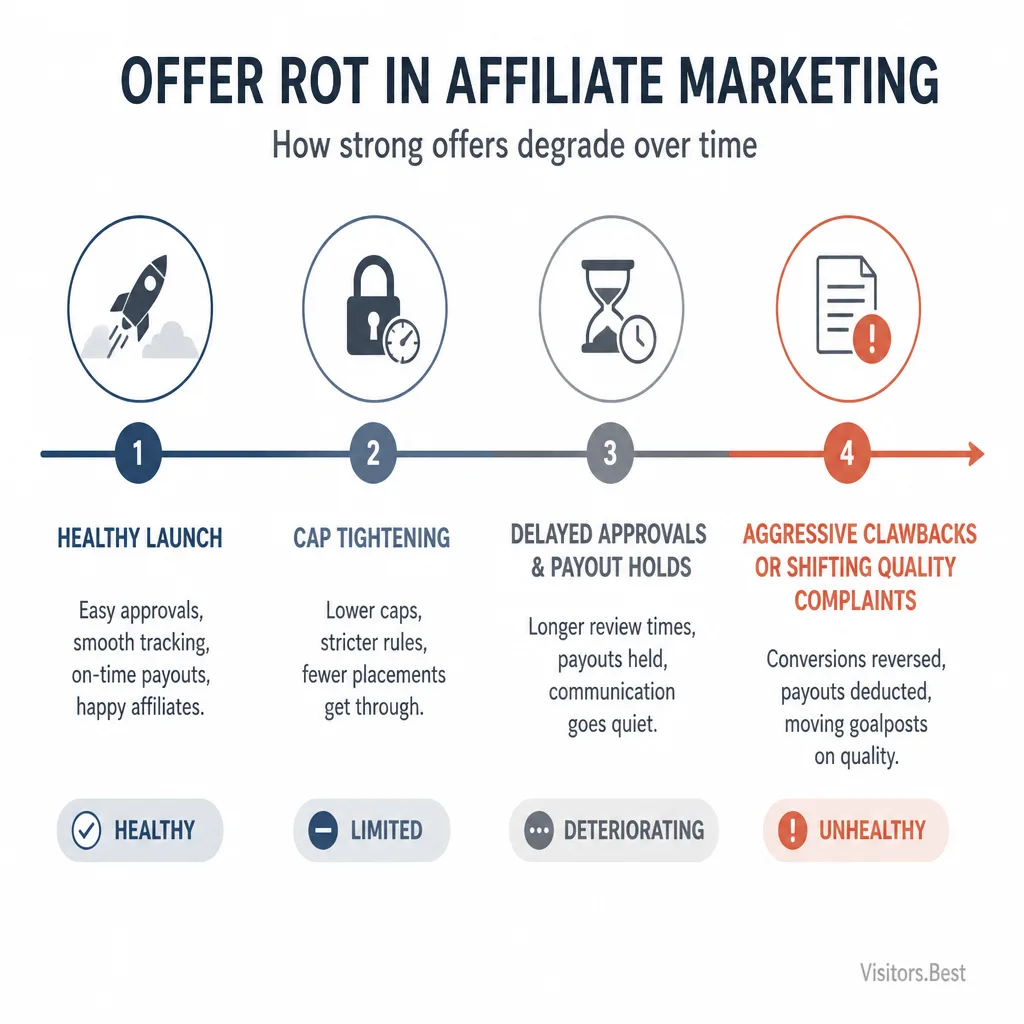
“Offer rot” is a useful term for a familiar pattern: an offer that looks healthy at first and then becomes harder to profit from as conditions quietly deteriorate.
It is not a formal industry metric. It is operator shorthand for decay.
Sudden cap changes and shrinking acceptance windows
Caps matter for more than volume.
If a promising offer suddenly drops from open volume to tight daily caps, or if acceptance windows narrow without explanation, something changed. Maybe the advertiser is overloaded. Maybe lead quality is slipping. Maybe downstream economics got worse.
The point is not to panic. The point is to notice.
Cap pressure is often an early sign that scale will be harder than the initial test suggested.
Aggressive clawbacks and retroactive quality complaints
Some reversals are normal. Aggressive retroactive clawbacks are different.
If an offer starts approving well and later reverses a large share of conversions with broad quality complaints, you have a forecasting problem even if the traffic itself is decent.
This is where verbal reassurance from a manager becomes worthless. You need definitions, evidence, and written terms.
Delayed approvals, payout holds, and moving goalposts
Hold periods such as Net-7, Net-15, or Net-30 can be manageable. But if approvals keep slipping, payouts get delayed, or quality criteria change after launch, the offer becomes harder to trust.
The hidden cost is not just cash-flow delay. It is decision fog.
You cannot optimize efficiently when the revenue signal arrives late and keeps changing shape.
Manager behavior that signals instability before the data does
Sometimes the earliest warning sign is not in the dashboard.
It is a manager who avoids precise answers, keeps saying “traffic quality is under review,” resists putting terms in writing, or responds quickly before launch and slowly after volume starts.
That does not prove the offer is bad. It does suggest the operation may not stay clean under pressure.
A 30-minute due-diligence checklist for affiliate offers
This does not need to become a research project. You can do a useful first-pass review in half an hour.
Check the advertiser, not just the network listing
Visit the advertiser site. Look at the brand, the offer page, contact information, public reputation, and whether the business looks real and maintained.
A polished network listing can hide a weak advertiser.
Review the funnel as if you were the customer
Open the flow on mobile and desktop.
Check:
- page speed
- headline clarity
- trust elements
- form length
- qualification friction
- message match with your planned ad angle
If you would hesitate to complete the form yourself, your traffic may hesitate too.
Verify restrictions, caps, and payout terms in writing
Before launch, confirm these by email, platform message, or the offer terms page:
- allowed traffic sources
- GEO and device restrictions
- cap rules
- payout model
- hold period
- approval criteria
- reversal policy
- reporting delay
- duplicate filtering rules
Memory is not evidence. Chat hype is not either.
Ask for recent performance context, not cherry-picked screenshots
A useful performance example includes:
- date range
- GEO
- traffic source
- device mix
- conversion stage shown
- approximate volume
A screenshot without context is marketing material.
Run a small risk score before launch
Use a simple 1-to-5 score across these factors:
- advertiser transparency
- traffic-rule clarity
- approval confidence
- funnel quality
- attribution reliability
- payment terms
- cap stability
If the offer scores badly on three or more, it may still work. But it probably does not deserve aggressive paid testing from a limited budget.
How to choose between a high payout and a clean operation
This is usually the real decision.
When the higher payout is still worth it
A messier, higher-payout offer can make sense when:
- your traffic is cheap
- you know the vertical well
- the advertiser has clear written criteria
- attribution is trustworthy
- you can tolerate volatility
- cash flow is not tight
Experienced operators sometimes accept more approval friction because the upside is large enough. That is a rational choice when the risks are understood, not ignored.
When a lower payout produces better real margin
For many buyers, especially smaller ones, cleaner wins.
A lower-payout offer often beats a flashy one when:
- approvals are faster and more stable
- hold periods are shorter
- restrictions are clearer
- the funnel fits your traffic better
- reporting arrives fast enough to optimize
- reversals are lower or easier to understand
A campaign you can read clearly is easier to improve.
Why durable offers compound faster than flashy ones
Durable offers shorten the distance between test and confidence.
You learn faster. You waste less spend. You spend less time arguing over rejected conversions, fixing broken postbacks, or rebuilding campaigns around sudden rule changes.
That is why the strongest offer is usually not the loudest one.
It is the one that still behaves well after the easy traffic is gone.
Conclusion
If you remember one thing, make it this: access is not the edge. Judgment is.
Good affiliate offers can come from networks, direct programs, partner ecosystems, or private referrals. But the source matters less than the operating quality behind the listing. Before you buy traffic, look past the payout and ask harder questions about approvals, attribution, restrictions, funnel quality, and advertiser behavior.
The offer that scales cleanly will usually beat the one that only looks exciting in a screenshot.
FAQ
Where do high-converting affiliate offers usually come from in 2026?
Most come from four places: affiliate networks, direct advertiser programs, partner marketplaces, and private referrals through managers or brokers. Networks are fastest for access, direct programs can offer better control, marketplaces are often cleaner in SaaS and B2B, and private referrals can surface hidden offers but need the most verification.
Are affiliate networks still the best place to find offers?
They are often the fastest place to start, but not automatically the best place to scale. A network gives access, not proof of offer quality. You still need to vet approval behavior, traffic restrictions, attribution reliability, cap stability, and advertiser responsiveness.
What matters more than a high affiliate payout?
Predictable approvals, clean attribution, clear traffic-source rules, reasonable hold periods, and a funnel that converts the traffic you actually plan to send. A lower payout can produce better real margin if fewer conversions are reversed or rejected.
How useful is EPC when evaluating an affiliate offer?
EPC is a helpful signal, but a weak decision-maker on its own. It can reflect a different GEO, device mix, traffic source, season, or approval stage than your campaign. Treat it as directional context, not as a forecast.
What should I ask before sending paid traffic to an affiliate offer?
Confirm allowed traffic sources, GEO and device restrictions, cap rules, approval criteria, reversal policy, hold period, attribution setup, conversion lag, and whether duplicates are filtered. Get the important terms in writing, not just over chat.
What is offer rot in affiliate marketing?
Offer rot is a practical term for an offer that looks good initially but degrades over time. Common signs include sudden cap cuts, slower approvals, rising clawbacks, tighter quality complaints, changing traffic rules, and weaker manager communication.
How can I tell if an affiliate offer is risky before launch?
Look for vague answers on traffic rules, inconsistent approval explanations, poor landing page quality, unclear attribution, long hold periods, and cherry-picked performance screenshots without context. If the manager will not clarify the basics, the risk is already visible.
Is it better to work directly with advertisers?
Sometimes. Direct relationships can improve transparency, communication, and flexibility. But they also increase your diligence burden. They make the most sense when you already understand the traffic model and want more control over terms, caps, or tracking.
How long should affiliate offer due diligence take?
You can run a useful first-pass check in about 30 minutes. Review the advertiser, inspect the funnel, verify restrictions and payout terms, ask for recent performance context, and score the offer for transparency, approval confidence, and tracking clarity.
Why do some affiliate offers work at low spend but fail at scale?
Because scale exposes what small tests can hide: approval friction, attribution gaps, cap limits, duplicate filtering, compliance issues, and weaker funnel performance on broader traffic. Early wins are not always false, but they are often incomplete.
[^1]: Policies and enforcement can change. Check current platform and regulatory guidance before launching paid campaigns.