How Much Website Traffic Can $100 Buy in 2026? Realistic Ranges by Channel
If you are working with a very small paid acquisition budget, the obvious question is usually the least helpful one: How many clicks can I get for $100? It sounds practical, but it often leads to poor channel choices.
A hundred dollars might buy 10 to 25 high-intent clicks from Google Search ads, 40 to 120 clicks from Meta Ads, 60 to 200 visits from TikTok Ads, or several hundred low-cost display clicks. But those numbers matter only if the traffic is actually relevant.
That is the real issue in 2026: traffic volume varies sharply by channel, and lower CPC often comes with weaker intent, noisier visits, or heavier creative demands. So the better comparison is not cost per click. It is cost per qualified visit.
How much website traffic can $100 buy in 2026?
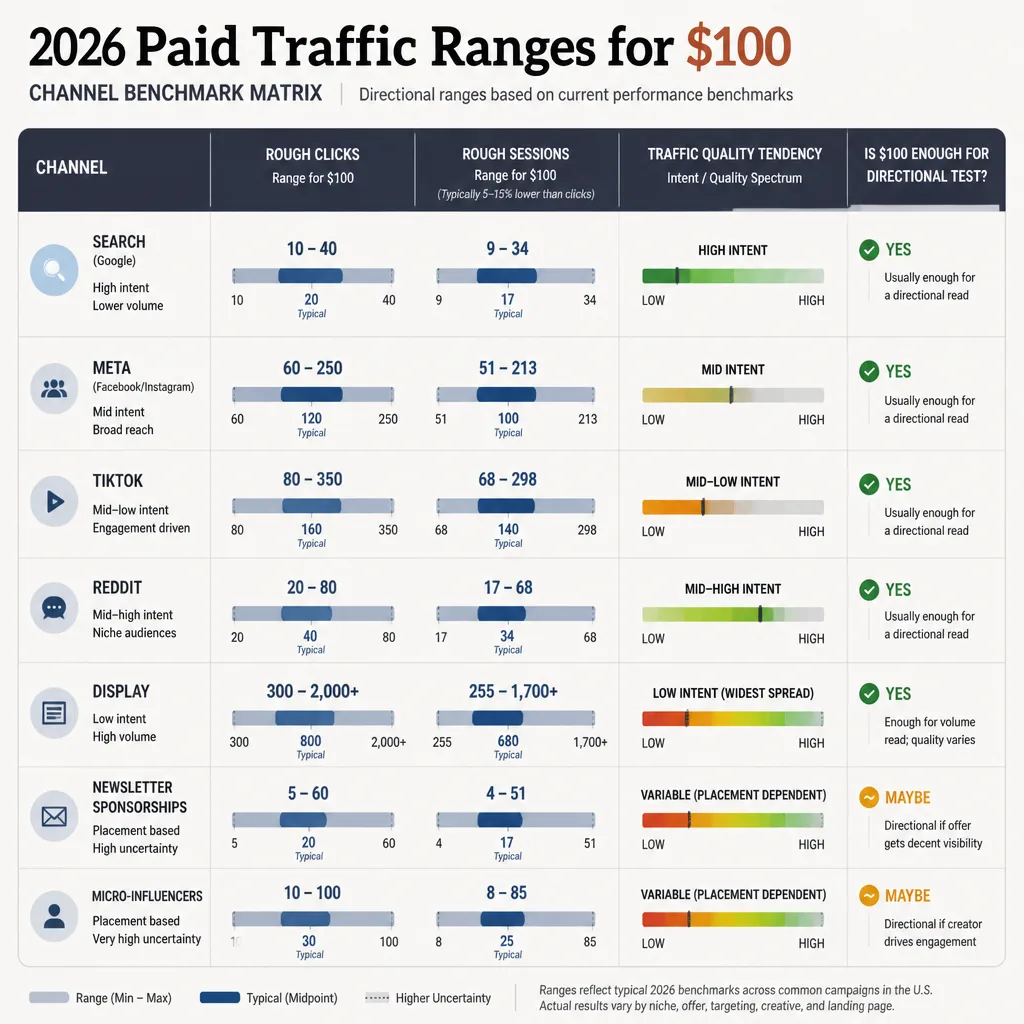
Here is the short answer. These are directional planning ranges, not forecasts. Actual results can vary widely based on country, niche, campaign objective, ad quality, landing page, and tracking setup.
| Channel | Typical buying model | Rough clicks for $100 | Rough sessions for $100 | Traffic quality tendency | Is $100 enough for a directional test? |
|---|---|---|---|---|---|
| Google Search | CPC | 10–25 | 8–22 | Usually highest intent | Often yes |
| Meta (Facebook/Instagram) | CPC/CPM | 40–120 | 35–105 | Mixed intent | Usually yes |
| TikTok | CPC/CPM | 60–200 | 50–170 | Lower intent, creative-sensitive | Sometimes |
| CPC/CPM | 25–90 | 20–75 | Can be highly relevant in niche communities | Often yes | |
| Display networks | CPC/CPM | 100–500+ | 70–350 | Widest quality spread | Only with tight controls |
| Newsletter sponsorships | Flat fee / placement | 10–80 clicks equivalent | 8–70 sessions | Depends heavily on list trust and fit | Sometimes not |
| Micro-influencers | Flat fee / deliverable | 20–150 clicks equivalent | 15–120 sessions | Depends heavily on fit and trust | Sometimes not |
One measurement note: ad platforms report clicks, while analytics tools like GA4 report sessions. Sessions are usually lower because of accidental taps, page-load failures, consent settings, ad blockers, duplicate clicks, and attribution mismatches.[^1]
The core mistake: clicks and useful visits are not the same thing
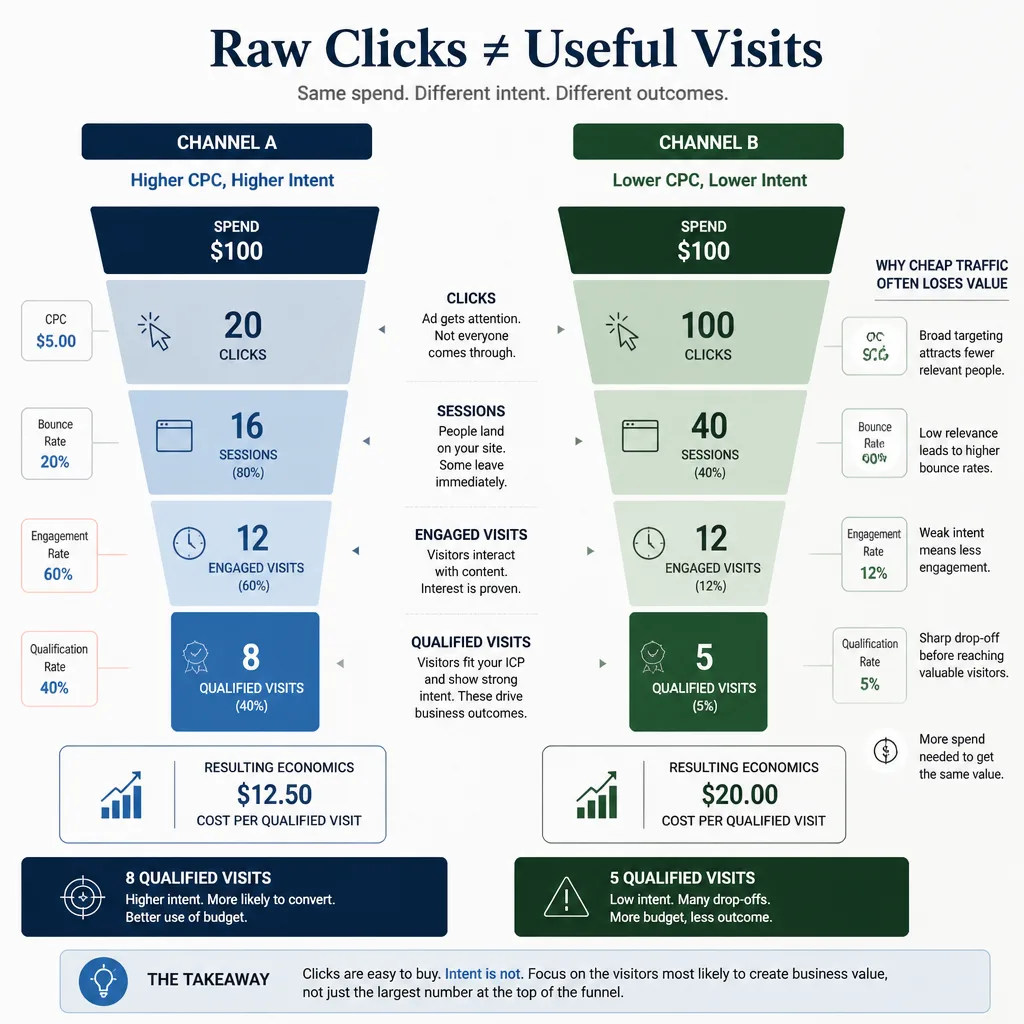
The biggest small-budget mistake is treating all clicks as if they were equal.
A search click from someone looking for “best payroll software for small business” is not the same as a TikTok click from someone who tapped because the video caught their attention. Both count as one click. They do not carry the same intent.
Why a cheap click can still be expensive
Cheap traffic often looks efficient until you check what those visitors actually do.
Suppose Channel A gives you 20 clicks at $5 each. Channel B gives you 100 clicks at $1 each. On the surface, Channel B looks far better.
But if 40% of Channel A’s visitors are genuinely relevant and only 5% of Channel B’s are, Channel A produced 8 qualified visits while Channel B produced 5. The lower CPC led to the worse business outcome.
This is why display and some paid social campaigns can look strong in platform dashboards but weak on site. The platform optimized for clicks. Your business needs relevance.
A better metric: cost per qualified visit
With a $100 test, you often will not get enough conversions to judge CAC or ROAS with much confidence. That is especially true in B2B, high-ticket ecommerce, or any offer with a longer consideration cycle.
A more useful interim metric is:
Cost per qualified visit = Spend / (Sessions × qualified session rate)
If you only have click data:
Cost per qualified visit = Spend / (Clicks × qualification rate)
A “qualified visit” should be defined by your business, not by a generic benchmark. It might mean a visitor who:
- stays longer than 30 or 60 seconds
- views pricing, product, or service pages
- matches your target geography
- adds to cart
- starts signup
- reaches a lead-quality threshold
That definition matters more than any average CPC headline.
Realistic 2026 ranges by channel
Google Search: fewer clicks, higher intent
With Google Ads Search campaigns, $100 often buys roughly 10 to 25 clicks and about 8 to 22 sessions in many commercial markets. In expensive verticals, it can be less. In lower-competition geographies or long-tail niches, it can be more.
Search costs more because you are paying for declared intent. Someone searched for something specific. That usually makes the traffic more commercially useful than social or display traffic.[^2]
The catch is that $100 disappears fast in competitive categories like legal, insurance, finance, and B2B software. In those markets, $100 may tell you whether your targeting and landing page make sense, but it is rarely enough to judge ROI fairly.
Where this range breaks down: low-volume niches, very broad keywords, or poor keyword match discipline.
Meta ads: broader reach, mixed intent
On Meta Ads, $100 often buys 40 to 120 clicks and roughly 35 to 105 sessions.
The upside is reach. The harder part is quality. Meta traffic is interruption-based. You are not capturing demand the way search does. You are trying to create interest while people are doing something else.
That makes creative and objective selection especially important. A campaign optimized for link clicks can produce very different traffic from one optimized for landing page views or conversions.[^3] A curiosity-heavy ad may lower CPC while hurting qualification. A clearer ad may cost more per click while sending better traffic.
Meta is often a strong first channel for audience testing or broad top-to-mid funnel reach. It is less ideal when you need immediate buying intent.
TikTok ads: cheap traffic, heavy creative dependence
TikTok Ads can sometimes deliver 60 to 200 clicks or visits for $100, with sessions often landing around 50 to 170.
This is one of the most variable channels on the list. Strong, native-feeling creative can drive very low costs. Weak creative can burn through budget with almost no useful signal.
TikTok traffic can also make weak offers look better than they are. If the ad is entertaining but the landing page does not carry the same relevance or energy, you may get clicks without real commercial traction.
Where it works best: visually clear offers, strong hooks, impulse-friendly products, and teams that can iterate creative quickly.
Reddit ads: niche relevance if the targeting is right
Reddit Ads usually land somewhere between broader social and search in terms of quality. A realistic $100 range is often 25 to 90 clicks and 20 to 75 sessions.
Reddit is less forgiving than Meta. Generic ad copy tends to fail. Precise audience-message fit can work surprisingly well, especially when the offer matches a clearly defined subreddit interest.
This is one of the few channels where a smaller traffic sample can still be useful, because the right community can produce highly relevant visits. The wrong one can reject the campaign almost immediately.
Display networks: the cheapest clicks and the biggest quality spread
Display often wins the raw click contest. Through channels such as the Google Display Network, $100 may buy 100 to 500 or more clicks, with sessions perhaps 70 to 350.
It is also the channel where benchmark misuse causes the most confusion.
Display inventory quality varies widely. Some clicks are accidental. Some come from weak interest. Some come from placements that were never likely to send commercially meaningful traffic. Cheap CPC here is not proof of good economics.
Display tends to make the most sense for retargeting, inexpensive awareness, or tightly controlled placements. It is usually a poor choice for a founder who just wants “traffic” and assumes traffic alone means progress.
Newsletter sponsorships: audience access, not guaranteed clicks
Newsletter sponsorships do not behave like ad auctions. You are usually paying a flat fee for placement inside someone else’s audience.
With $100, you might get into a small niche newsletter, a remnant placement, or a short sponsor mention. The result might be 10 to 80 clicks and roughly 8 to 70 sessions, but uncertainty is much higher here.
What matters most is list trust, open-rate quality, CTA placement, audience-offer fit, and whether the recommendation feels native rather than bolted on. A tiny but trusted niche list can outperform a much larger weak one.
This is why false precision is dangerous in newsletter buying. It is less about market CPC and more about borrowed trust.
Micro-influencers: fit and trust matter more than media math
Micro-influencer campaigns are similar. You are not buying interchangeable media units. You are buying access to trust, attention, and creator context.
A $100 micro-influencer deal might produce 20 to 150 clicks and 15 to 120 sessions. Or almost none. Results vary heavily by niche, creator credibility, story or post format, link placement, and CTA quality.
An influencer with 8,000 highly aligned followers can outperform one with 80,000 loosely related followers. That is not unusual. It is how creator marketing usually works.
For small budgets, this channel works best when audience fit is already clear and the creator can present the offer naturally.
What changes the result most
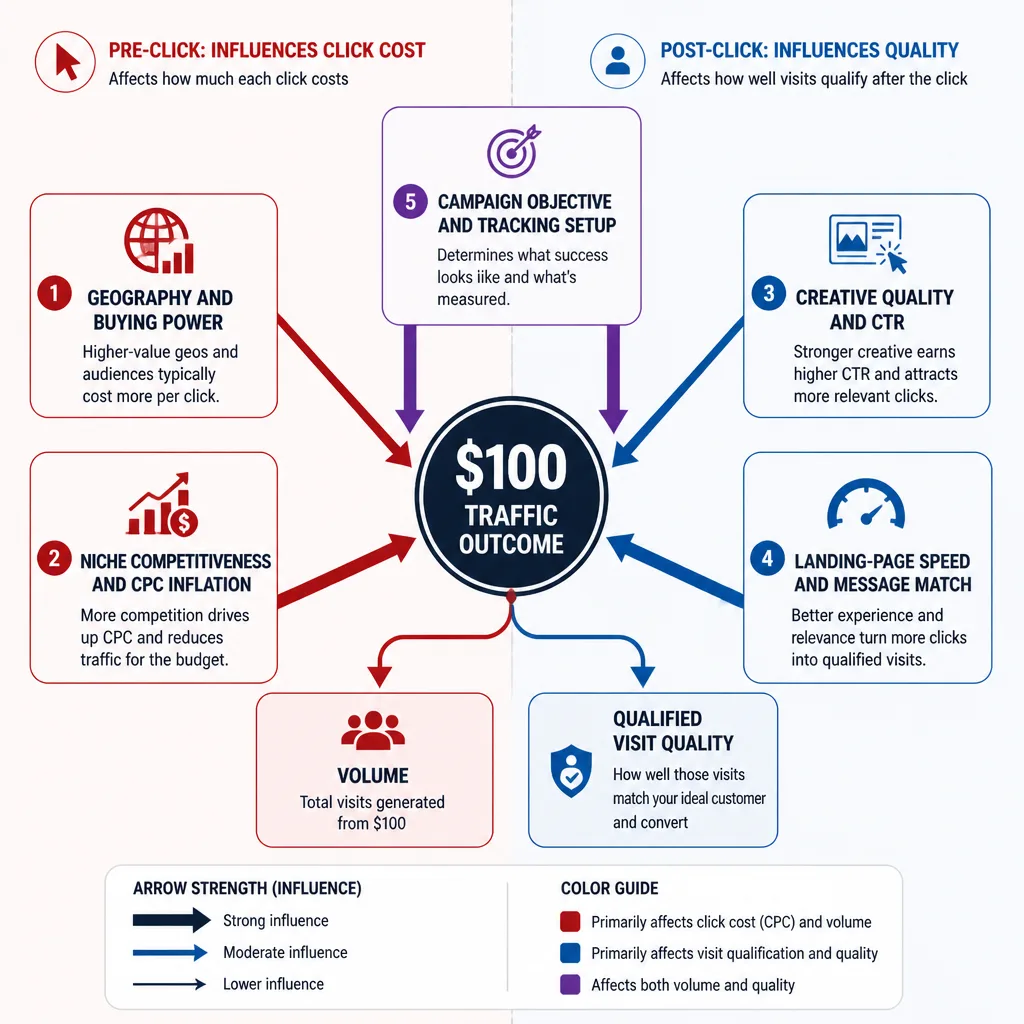
Benchmarks help you avoid fantasy. They do not explain your outcome on their own.
Geography and buying power
Tier 1 English-speaking markets often have higher auction pressure and higher CPCs. They can still be worth more because the buyers may be worth more. Cheaper traffic from lower-cost geographies is not automatically better if your business cannot monetize it.
Niche competitiveness and CPC inflation
This matters most in search. If you are in software, legal, finance, or other high-value lead categories, keyword competition can overwhelm small-budget efficiency gains.
That is why two businesses in the same country can see very different outcomes from the same $100.
Creative quality and click-through rate
On Meta and TikTok especially, creative affects both cost and traffic quality. Better creative does not just win more clicks. It helps the right people self-select.
Misleading hooks can lower CPC and still make the campaign worse.
Landing-page speed, message match, and conversion friction
A weak landing page can distort channel comparisons. If your ad promises one thing and the page delivers another, qualified traffic can look unqualified.
Even technical issues matter. If you lose 10% to 20% of paid clicks before they become measurable sessions, your test can look worse than it really is.[^4]
Campaign objective, optimization, and tracking setup
A platform optimized for clicks behaves very differently from one optimized for landing page views or conversions. This is documented in official platform guidance and matters more than many small advertisers realize.[^3]
Tracking matters too. Weak UTM setup, consent mode, or analytics configuration can make traffic quality hard to read.
A simple calculator for cost per qualified visit
Formula
Use this before you spend:
CPQV = Spend / (Expected sessions × expected qualified session rate)
Or, if you only know click estimates:
CPQV = Spend / (Expected clicks × expected qualification rate)
Worked example across two channels
Imagine two possible $100 tests:
- Google Search: 18 sessions, 35% qualified
- Meta: 80 sessions, 8% qualified
Now calculate:
- Search CPQV = 100 / (18 × 0.35) = $15.87
- Meta CPQV = 100 / (80 × 0.08) = $15.63
That is the useful insight. The channels are basically tied on qualified-visit cost even though one produced far more traffic.
Change Meta’s qualification rate from 8% to 5%, and its CPQV rises to $25. Same cheap traffic. Much worse economics.
How to use it before you spend
Do not aim for precision. Aim for a planning model.
Estimate three cases:
- conservative
- expected
- optimistic
Then ask one practical question: If this channel performs near the middle of the range, is the likely qualified visit cost acceptable for my business?
That question is far more useful than chasing the highest click count.
When $100 is enough to test a channel—and when it isn't
Channels where $100 can produce directional signal
Search, Meta, Reddit, and sometimes TikTok can often give enough data to judge:
- click-to-session continuity
- audience relevance
- landing-page engagement
- message match
- early intent signals like pricing views or add-to-cart starts
That is enough for a directional test.
Channels where $100 is mostly a learning budget
In expensive search verticals, creator-led campaigns, newsletter sponsorships, and highly creative social formats, $100 may be too little for a fair performance verdict.
In those cases, treat the budget as payment for learning:
- Which message gets attention?
- Which audience responds?
- Does the landing page hold interest?
- Does the offer fit the channel at all?
What to look for besides conversions
On tiny budgets, conversions are often too sparse to judge with confidence. Watch:
- click-to-session retention
- engaged session rate
- pricing or product page views
- signup starts
- add-to-cart rate
- geo and device quality
- bounce patterns by source
Many good channels look bad early simply because the budget was too small to produce stable conversion data.
How to choose the right channel for your first $100
If you need intent now
Start with Google Search. You will usually get fewer clicks, but they are often easier to interpret and more commercially relevant.
If you need cheaper top-of-funnel traffic
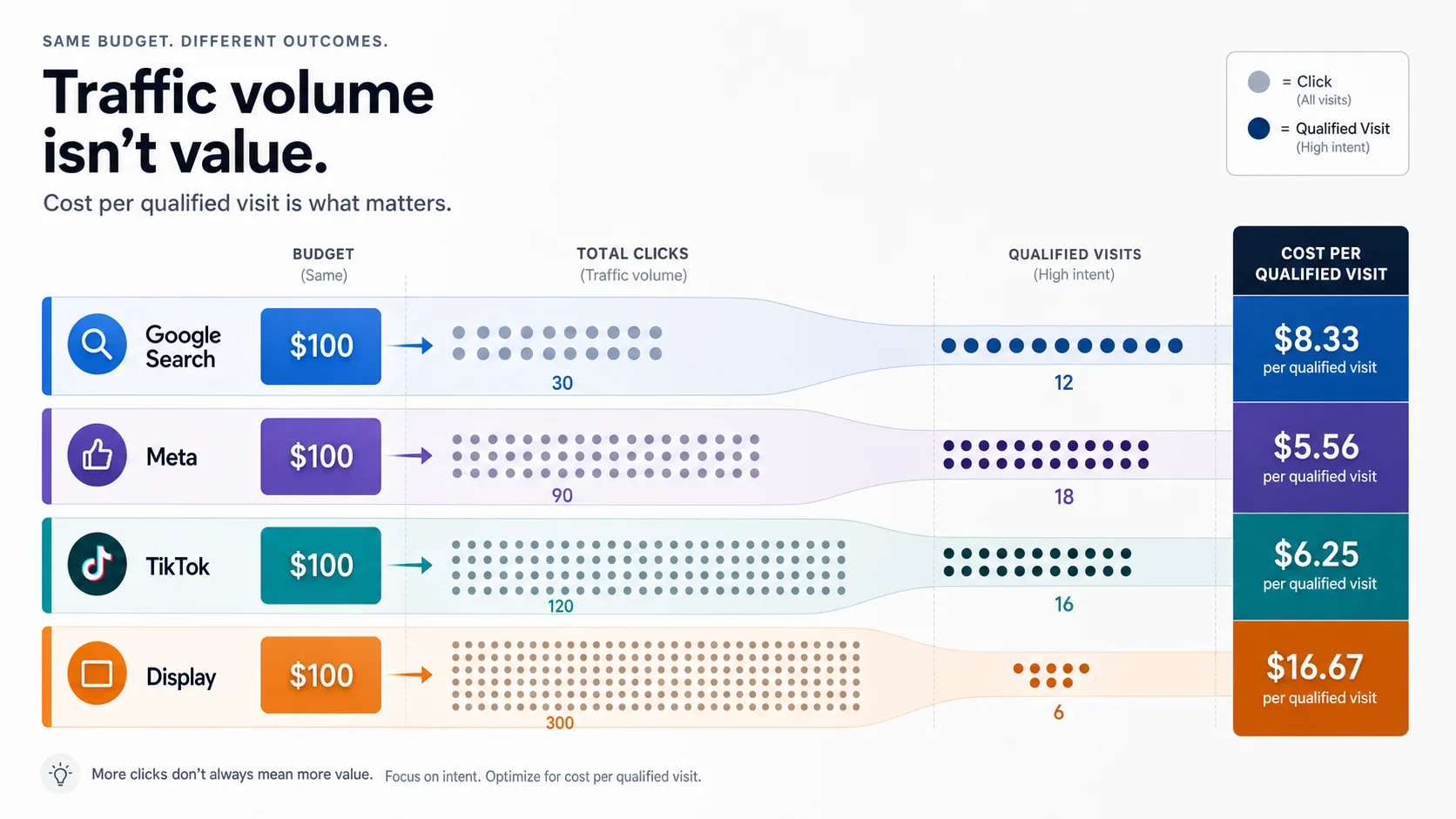
Meta is usually the better first stop. TikTok can be cheaper, but only if you can produce platform-native creative. Without that, low CPCs can become a trap.
If you have a niche audience
Try Reddit, a niche newsletter, or a tightly matched micro-influencer. These channels can outperform broader platforms when audience fit is unusually strong.
If you already have strong creative or creator relationships
Lean into TikTok or micro-influencers. Those channels reward asset quality and trust more than generic media-buying tactics.
One more practical rule: in most cases, do not split your first $100 across several channels. Thin data is hard to interpret. One cleaner test usually teaches more than three noisy ones.
Conclusion
A hundred dollars can buy very different amounts of website traffic in 2026. It might buy a handful of high-intent search visits, a decent batch of Meta clicks, a cheap wave of TikTok traffic, or a large pile of low-quality display visits.
That is why “most clicks for $100” is usually the wrong goal.
The better question is: which channel gives you the lowest cost per qualified visit for your offer, audience, and landing page? Start there. Define what a qualified visit means for your business, run one focused test, and judge the channel on relevance before you judge it on volume.
FAQ
How much website traffic can $100 buy in 2026?
It depends on the channel, market, and offer. Directionally, $100 may buy around 10 to 25 Google Search clicks, 40 to 120 Meta clicks, 60 to 200 TikTok visits, a smaller but potentially more relevant Reddit sample, or several hundred lower-intent display clicks. Newsletter sponsorships and micro-influencer campaigns vary more because pricing is often based on placement or audience access rather than auction CPC alone.
Which channel gives the most traffic for $100?
Display networks and some social placements often produce the most raw clicks for $100, but that does not automatically make them the best value. Low-cost traffic can be less qualified, less engaged, or less likely to convert. The better comparison is cost per qualified visit, not click volume alone.
Why are clicks and sessions different?
Ad platforms report clicks, but analytics tools usually report sessions. Sessions are often lower because of page-load failures, accidental taps, ad blockers, consent settings, duplicate clicks, and tracking mismatches. That gap is normal, which is why traffic estimates should account for both clicks and sessions.
What is a qualified visit?
A qualified visit is a session from someone who appears genuinely relevant to your offer. In practice, that might mean they stay beyond a time threshold, view a product or pricing page, match your target geography, start signup, add to cart, or meet a lead-quality rule.
How do I calculate cost per qualified visit?
A simple formula is: Cost per qualified visit = Spend / (Sessions × qualified session rate). If you only have click data, use: Spend / (Clicks × qualification rate). This helps you compare channels more fairly when a small budget does not generate enough conversions to judge CAC or ROAS with confidence.
Is $100 enough to test a paid traffic channel?
Often, yes for a directional test. Usually, no for proving profitability. It can show whether a channel brings relevant visitors, whether the message matches the audience, and whether the landing page holds attention. In expensive search verticals or creative-heavy channels, $100 is often more useful as a learning budget.
What affects how much traffic $100 can buy the most?
The biggest variables are geography, niche competitiveness, campaign objective, creative quality, landing-page speed and message match, and tracking setup. In practice, these factors can change results more than benchmark averages do.
Are cheaper CPCs always better?
No. A lower CPC can still produce worse economics if the traffic is weak. If one channel brings far more clicks but only a fraction of the relevant visits, it may be more expensive where it counts. Cheap traffic is only valuable when the audience and intent are a real fit.
How should I choose the right channel for my first $100?
Choose based on intent strength, setup burden, and the assets you already have. Google Search is usually best when you need explicit demand capture. Meta is often better for broader audience testing. TikTok works best when you already have strong native-feeling creative. Reddit can work well for niche audiences. Newsletters and micro-influencers are stronger when trust and fit are already clear.
Should I split $100 across multiple channels?
Usually not. Splitting a tiny budget across too many channels makes the data hard to interpret. In most cases, putting the full $100 into one channel gives you a clearer signal. The exception is when you are running very small exploratory tests to compare audience response rather than performance.