How Affiliates Can Optimize for Qualified Leads Without Access to the Advertiser CRM
If you run lead-gen offers as an affiliate, you already know the frustration: you can see clicks and submits, but you often get paid on something further downstream—accepted leads, approved leads, or eventual lead quality—that you cannot see directly.
That blind spot creates a predictable optimization problem. Ad platforms optimize for the event you give them. If the only reliable event is a raw form submit, they will find more of it. The trouble is that more submits do not always mean more revenue. In many verticals, they can mean the opposite.
The answer is not to pretend proxies are as good as CRM truth. They are not. But a well-chosen proxy can still outperform a shallow conversion event if it reflects real intent, cleaner data, and stronger contactability. Google’s lead-gen documentation makes the broader point clearly: deeper lead-stage signals improve optimization when you can send them back.[^1][^2] Affiliates usually cannot, so the next best move is to build observable stand-ins that correlate closely enough with value to guide bidding and funnel decisions.
Why affiliates need proxy signals
The blind spot: form submits are visible, accepted leads are not
Advertisers and in-house teams can often upload offline conversion data back into ad platforms. That is what Google Ads’ qualified lead and converted lead workflows are built for: optimizing toward deeper funnel stages informed by CRM or internal systems.[^1][^2]
Affiliates usually do not get that luxury. You may receive delayed scrub data, limited network feedback, or only blended payout results at the sub-ID level. That leaves a gap between what the platform can optimize for and what actually makes you money.
Why raw conversion rate can hurt lead quality
A raw submit is easy to produce. That is useful for volume and terrible for signal quality.
If your traffic source learns that a short form submit is the rewarded event, it can find users who complete forms impulsively, inaccurately, or with little buying intent. On paper, CPA improves. In reality, EPC may flatten or fall.
This shows up often in insurance, finance, home services, education, and legal. The lead is real enough to reach the thank-you page, but not real enough to answer the phone, confirm details, book an appointment, or survive the advertiser’s filters.
The key idea: deeper is not automatically better
A deeper event is useful only if it predicts commercial value.
That is where many campaigns go wrong. A quiz-step completion, 45-second dwell time, or button click later in the funnel can still be weak if it is cheap to trigger and easy to spoof. The best proxy is not the deepest event. It is the one that stays aligned with payout reality.
What makes a proxy worth optimizing for
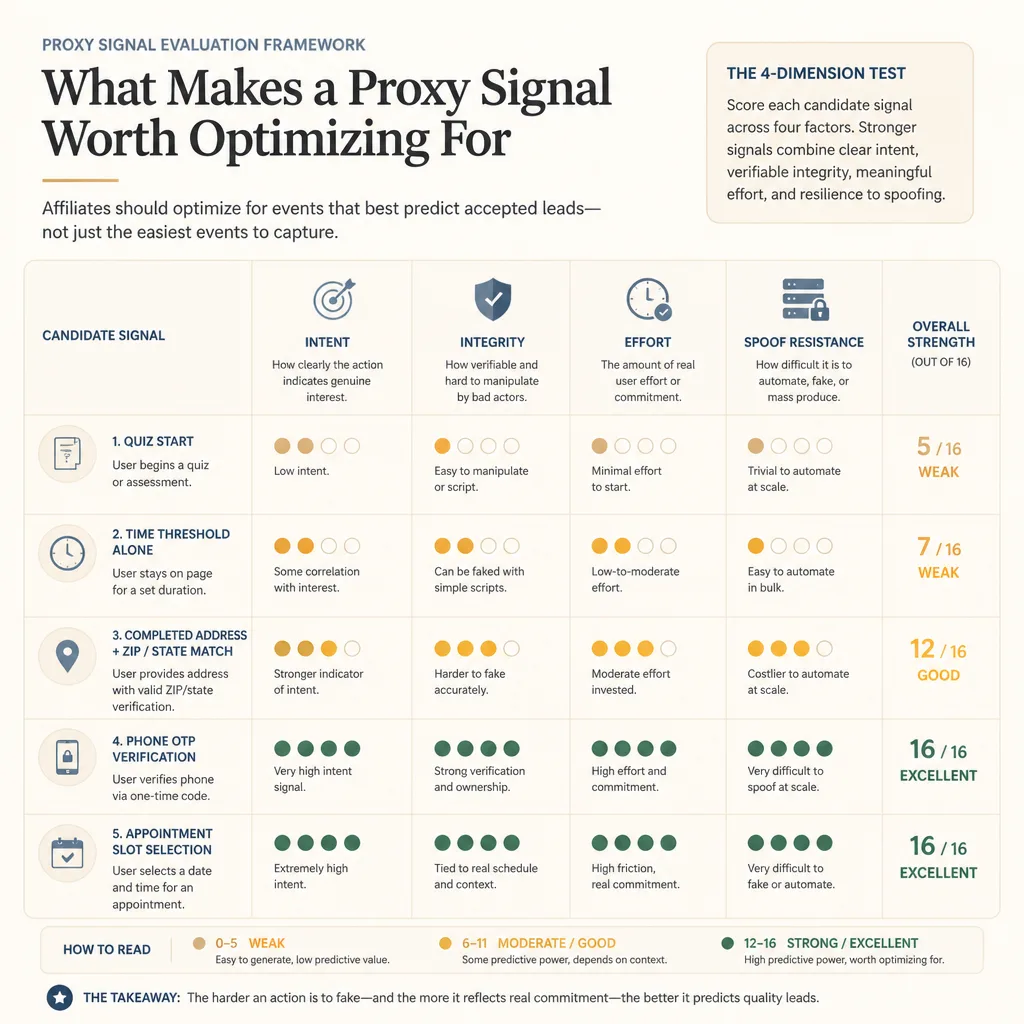
A simple way to evaluate candidate signals is:
Intent × Integrity × Effort × Spoof Resistance
If a signal scores well across all four, it is usually a better optimization target than a basic submit.
Behavioral intent
Some actions suggest genuine purchase or service intent. Selecting an appointment slot, starting a document upload, or requesting a callback usually means more than starting a quiz.
The difference is simple: these actions imply the visitor expects real follow-up.
Data integrity
A good lead usually has to be contactable and plausible. That makes verification events powerful. Twilio’s Verify documentation states that its API confirms a claimed device, phone number, or email address is actually in the user’s possession.[^3] That is much stronger than checking whether a phone field merely looks valid.
The same logic applies to address completeness, ZIP/state consistency, and coherent field combinations. None of those prove lead quality, but they are better than accepting any syntactically valid input.
Commitment cost
Useful proxies usually require a little effort.
Not friction for its own sake. Real effort. Entering and confirming an OTP, selecting a real appointment time, or completing a multi-step quote flow with consistent details creates a small commitment cost that filters casual or accidental submissions.
Non-triviality
Easy-to-trigger events lose value quickly.
Scroll depth, field focus, quiz start, or a generic CTA click can still be useful as diagnostic metrics. They are usually poor primary optimization targets because traffic sources can generate them at scale with very little underlying intent.
Proxy signals that usually beat simple submits
There is no universal ranking across every vertical. Confidence is highest for server-confirmed or possession-based signals and much lower for generic engagement metrics.
Verification signals
Phone OTP completion is one of the strongest common candidates because it confirms the user can receive and enter a code tied to the claimed phone number.[^3][^4]
Email confirmation can also work well, especially when ongoing contact matters.
A plain “valid phone number” check is far weaker than successful OTP verification. One checks formatting. The other checks possession.
Completion-quality signals
These are not glamorous, but they often matter:
- complete address rather than partial address
- ZIP and state match
- consistency between city, state, ZIP, and service area
- name and contact data that pass basic coherence checks
- server-validated confirmation-page arrival
This is where many affiliates leave money on the table. A lead with complete, internally consistent contact data is often more commercially plausible than one that simply clicked Submit.
Engagement signals
Engagement can help, but only when tied to meaningful task completion.
Time on page by itself is noisy. A visitor can idle, multitask, or leave a tab open. A stronger version looks more like this:
- 90+ seconds and quote step 3 completed
- pricing section viewed and plan selection made
- multi-step quiz completed with all required answers
The event should represent progress through a real task, not passive presence.
Commercial-intent signals
These are often underrated:
- appointment scheduling clicks
- calendar slot selection
- call initiation tied to connected-call or duration thresholds
- document-upload starts or completions
- callback request confirmation
A click-to-call event alone is weak. A connected call above a minimum duration is much stronger.
Composite signals
Often, two medium-strength signals beat one impressive-looking single event.
Examples:
- verified phone plus completed address
- appointment slot selected plus valid ZIP or service-area match
- OTP success plus server-confirmed post-submit completion
This logic mirrors how risk systems work more broadly. Stripe Radar, for example, evaluates many signals together rather than relying on one isolated datapoint.[^5] Affiliate lead quality is not the same as payment fraud, but the principle transfers well: composite evidence is usually more trustworthy than a single binary event.
How to design proxy events without making them easy to game
Do not reward friction for its own sake
Longer forms do not automatically improve quality.
If you add fields that do not improve intent, verifiability, or consistency, you may just reduce valid volume. Extra friction earns its place only when it filters more junk than it suppresses legitimate leads.
Use thresholds tied to real behavior
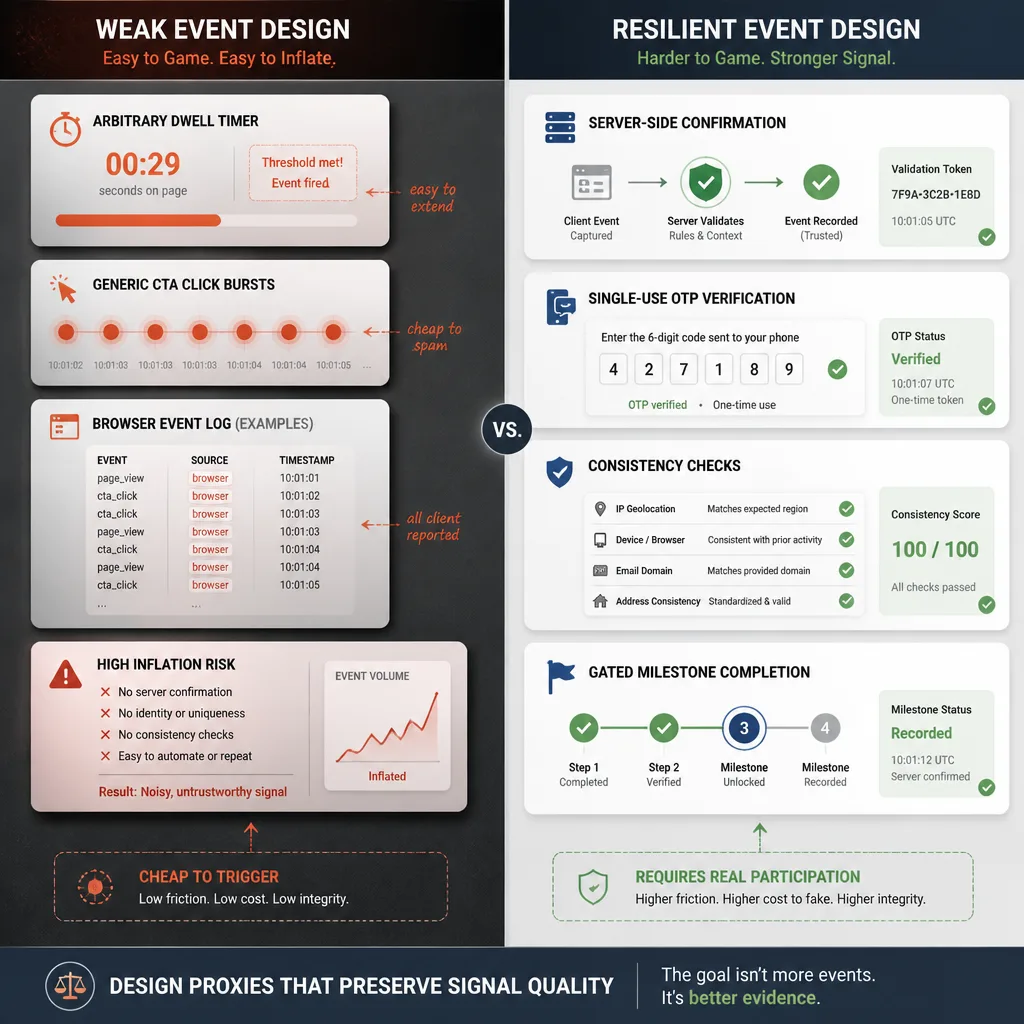
A 60-second timer is arbitrary.
A better rule is to fire the event only when the user completes a meaningful step and meets the minimum time normally required for that step. The threshold should describe behavior, not decorate it.
Gate events behind meaningful completion
If an event can fire before the user has done anything costly or verifiable, it is probably too weak.
That is why server-confirmed milestones matter. Cloudflare’s Turnstile documentation is clear that client-side completion alone is not enough; server-side validation is required because tokens can be forged, replayed, or expire.[^6][^7] The same principle applies to affiliate funnels: browser-only events feel trustworthy until traffic adapts.
Prefer verifiable inputs over cosmetic engagement
If you must choose between “watched 50% of explainer video” and “successfully verified phone number,” choose the event that proves something operationally useful.
Platforms do not care whether your event feels sophisticated. They care whether it can be optimized toward. If it is cheap to fake, the algorithm will find cheap ways to produce it.
Make spoofing expensive
Good proxy rules are hard to trigger at scale without real user participation.
Single-use or expiring validations, server-side checks, and event definitions that require consistent data all increase spoof resistance.[^6] That does not make the event perfect. It makes it harder to manufacture.
How to test whether a proxy correlates with accepted leads
You do not need perfect truth to run a useful validation loop. You need the best downstream signal you already have.
Start with the truth you do have
That might be:
- EPC by traffic source
- payout per click
- payout per session
- sub-ID revenue
- keyword-level returns
- placement or creative-level payout
- occasional approved-lead feedback
The goal is not to prove causation. It is to see whether the proxy is directionally aligned with revenue.
Compare segments, not just totals
This is one of the easiest mistakes to avoid.
If your overall proxy rate rises from 18% to 26%, that tells you very little on its own. What matters is whether segments with higher proxy density also produce higher EPC or better payout efficiency.
For example, if Source A shows a 34% verified-phone rate and Source B shows 12%, Source A should usually outperform on revenue efficiency if the proxy means anything. If it does not, the signal may be noise.
Look for directional consistency
Without CRM data, false precision is a trap.
You are looking for repeated patterns across source, creative, keyword, audience, or landing-page segments. If the relationship holds often enough to improve decisions, the proxy is useful. If it only looks good in one blended dashboard, be skeptical.
Use holdouts when possible
A simple test design beats a tidy narrative.
Keep one campaign, audience slice, or landing-page variant optimized to raw submit while another uses the proxy. Run long enough to compare payout density or EPC over a meaningful window. Even an imperfect holdout is better than inferring success from a single trend line.
Avoid optimizing into a lie
This is the failure mode that matters most.
What it looks like
Your proxy rate rises. Platform CPA improves. The dashboard looks cleaner.
But downstream value stays flat or drops.
That is what it means to optimize into a lie: the stand-in metric becomes detached from the business outcome it was supposed to represent.
How proxies get detached
Usually in one of three ways:
- the event was too shallow from the start
- the traffic source learned to trigger it cheaply
- funnel changes altered what the event actually means
A time-on-quiz threshold is a good example. At first it may loosely signal thoughtful completion. Later, a traffic source may send slower but still low-intent users, or the page design may force more dwell time without improving quality.
Warning signs
Watch for:
- sudden jumps in proxy rate after a source or landing-page change
- isolated spikes from one placement, audience, or creative
- lower EPC despite stronger event rates
- more proxy completions but unchanged payout per session
When those patterns appear, tighten the rule, demote the metric to diagnostic status, or replace it.
A practical framework affiliates can use
Step 1: list all observable behaviors
Map both pre-submit and post-submit actions:
- field completions
- consistency checks
- OTP success
- step progression
- scheduling events
- call connection signals
- confirmation-page arrivals
- upload starts
You want the full menu before deciding what matters.
Step 2: score each signal
Use a simple 1–5 score for:
- intent
- integrity
- effort
- spoof resistance
A quiz start might score 2, 1, 1, 1.
A verified phone plus completed address might score 4, 5, 4, 4.
This is not science. It is a forcing function for better judgment.
Step 3: choose one primary proxy and one secondary proxy
Usually, that is cleaner than running multiple live definitions.
For example:
- Primary: verified phone + completed address
- Secondary diagnostic: step-3 quote completion
The primary drives optimization. The secondary helps explain funnel behavior without becoming the target.
Step 4: optimize carefully, then revalidate
If submit rate drops 20% but EPC rises 35%, that may be a win. If proxy rate rises 40% and EPC falls 10%, it probably is not.
Volume-first marketers are not always wrong. In some payout models, advertisers can absorb quality variance. But if your economics are sensitive to scrub rate, approval rate, or source throttling, cleaner volume usually matters more than gross volume.
Step 5: revisit proxies whenever conditions change
Revalidate when:
- the offer changes
- the form changes
- traffic mix shifts
- new sources are added
- fraud pressure rises
- approval criteria tighten
Proxy usefulness is conditional. Treat it like a model with drift, not a permanent truth.
Where this approach works best — and where it breaks
This method fits best in verticals where the gap between submit and accepted value is large: insurance, finance, legal, home services, and education are common examples.
It is less useful when reliable downstream feedback already exists. If the advertiser or platform can return qualified-lead or sales data quickly, that usually beats any inferred stand-in.[^1][^2]
It also weakens when payout feedback is too sparse or delayed to validate directionally. If you cannot compare proxy density against any meaningful revenue signal, you are operating mostly on theory. Sometimes that is still better than optimizing to raw submit rate, but confidence should stay modest.
Conclusion
Affiliates do not need CRM access to improve lead quality, but they do need to stop confusing visible events with valuable ones.
The best proxy is usually not the one deepest in the funnel or easiest to scale in a dashboard. It is the one that combines real intent, cleaner data, meaningful effort, and resistance to spoofing—then keeps correlating with EPC or payout as traffic conditions change.
That last part is the whole game. Proxies are hypotheses, not truth. Treat them that way, and you can build a much better optimization loop than raw form submits allow. Ignore that distinction, and the platform may optimize beautifully toward an event that makes you poorer.
FAQ
What is a proxy signal in affiliate lead generation?
A proxy signal is an observable action or validation event in your funnel that stands in for downstream lead quality when you cannot see accepted leads, approvals, or CRM outcomes directly. Good proxies suggest stronger intent, cleaner data, or higher contactability than a simple form submit.
Which proxy signals usually correlate better than raw form submits?
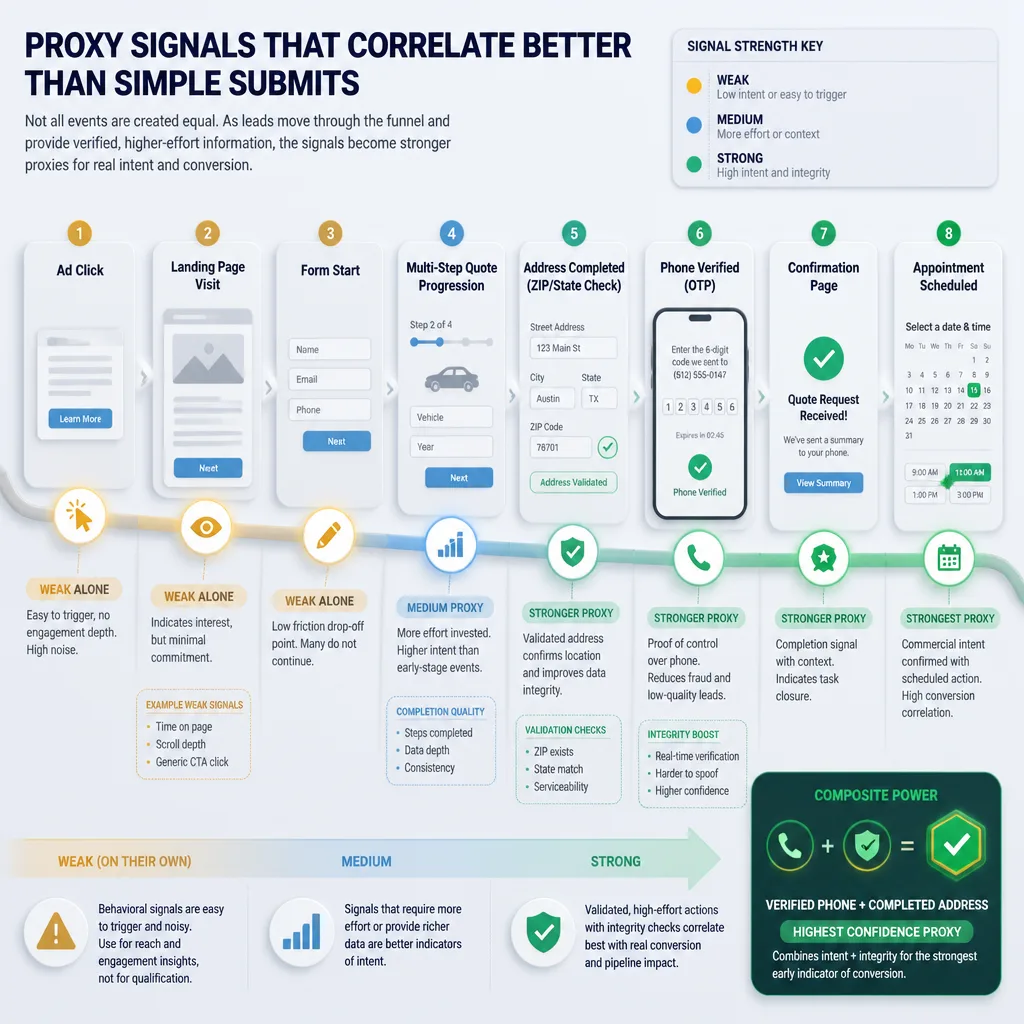
The strongest candidates are usually harder-to-fake events such as OTP phone verification, email confirmation, completed address data with consistency checks, appointment selection, connected-call indicators, and composite events like verified phone plus completed address. The exact strength varies by vertical and traffic source.
Why isn’t a deeper funnel event automatically a good optimization target?
Because depth alone does not prove commercial value. A deeper event can still be easy to trigger, low intent, or vulnerable to gaming. A useful proxy should reflect real intent, verifiability, effort, and spoof resistance rather than simply happening later.
Is time on page a reliable proxy for qualified leads?
Usually not on its own. Raw dwell time is noisy and easy to manipulate. It becomes more useful only when tied to meaningful task completion, such as finishing key quote steps, reviewing pricing options, or reaching a validated post-submit milestone.
Should affiliates optimize for more than one proxy event at the same time?
Usually it is cleaner to use one primary optimization proxy and one secondary diagnostic proxy. Too many active proxy definitions can muddy platform learning, complicate analysis, and make it harder to spot when a traffic source is adapting to a weak signal.
How can you validate a proxy without access to advertiser CRM data?
Use the downstream truth you do have, such as EPC, payout per click, payout per session, sub-ID revenue, keyword-level returns, placement performance, or occasional approved-lead feedback. If segments with higher proxy rates also tend to produce better payout efficiency, the proxy may be directionally useful.
What does it mean to optimize into a lie?
It means your chosen proxy metric improves in dashboards, but accepted lead quality, payouts, or EPC do not improve with it. This usually happens when the event is too shallow, too easy to fake, or becomes detached from the business outcome you actually care about.
How do you tell when a proxy is being gamed?
Watch for sudden jumps in proxy rate after a traffic-source or landing-page change, especially if EPC, payout density, or approval feedback stays flat or declines. Isolated spikes from one source, audience, creative, or placement are another common warning sign.
Are composite proxy events better than single events?
Often, yes. Combining an intent signal with an integrity signal, such as appointment selection plus ZIP match or verified phone plus completed address, usually creates a stronger optimization target than a single shallow event. Still, composite proxies should be revalidated against payout outcomes rather than assumed to be better.
When should proxy signals be revalidated?
Revalidate whenever the offer changes, the traffic mix shifts, the funnel is redesigned, the form structure changes, fraud pressure increases, or advertiser approval criteria tighten. Proxy usefulness is conditional, not permanent.