Direct Deals vs Affiliate Networks: When to Go Direct, How to Negotiate, and What to Put in Writing
Most affiliates hear about direct deals as if they sit behind a hidden door in the market: better payouts, better caps, better treatment. Sometimes that is true.
But going direct is not a shortcut. It is a transfer of responsibility.
A network absorbs a lot of friction you may barely notice until it is gone: payment collection, basic dispute handling, offer distribution, some compliance policing, and a layer of tracking standardization. A direct advertiser relationship can improve margins and give you more control. It can also expose every weak point in your operation.
That is the real question. Not whether direct looks better on paper, but whether the extra margin is worth the added operational risk.
Direct deals are a trade: more upside, more responsibility
The simplest way to think about a direct deal is this: you are not just changing where the offer comes from. You are changing who handles coordination.
With a public network offer, standardization is the benefit. Terms may be less flexible, but onboarding is easier, reporting is centralized, and payment risk is partly buffered by the network.
With a direct deal, you may get more leverage. You also inherit more ambiguity.
That ambiguity tends to show up in places affiliates often underestimate at first:
- who decides when reporting does not match
- how duplicate leads are handled
- how long approvals can sit before becoming payable
- what happens if tracking breaks on a high-spend day
- whether late payment quietly becomes normal after volume ramps
A mature operation can manage that. A newer team, or one still testing, usually should not.
When going direct usually makes sense
You already send meaningful, consistent volume
Advertisers do not care that you want a direct deal. They care whether you bring reliable economics.
That usually means you already have a traffic source and offer combination that converts with some consistency. Not one good week. Not one lucky creative. Something stable enough that the advertiser can model it.
A realistic example: you have been sending a finance CPL offer through a network for two months, lead quality is stable, and approvals are strong. At that point, a direct conversation becomes credible. You are no longer pitching potential. You are presenting performance.
The network is adding friction you can now remove
Sometimes the problem is not payout. It is speed.
Offer approvals may take too long. Caps may be too rigid. Creative updates may arrive after your winning angle has cooled off. The public landing page may be too generic for the traffic you are sending.
That is where direct can win even without a dramatic payout increase. Faster changes can be worth more than a few extra dollars on paper.
You need terms the public offer cannot support
This is where many serious affiliates get the most value.
You may need:
- higher or more flexible caps
- a private landing page
- faster lead-quality feedback
- tiered CPA based on volume or approval rate
- a hybrid deal with CPA plus rev-share
- custom routing by geo, device, or traffic source
A network offer has to work for many publishers. A direct deal can be shaped around how your traffic actually performs.
The advertiser has the team and systems to support direct partners
This gets ignored too often.
A direct advertiser is only as good as its operations. If they do not have responsive partner management, reliable tracking, clear qualification logic, and a finance process that does not drift, the payout advantage can disappear quickly.
Before moving direct, look for signs of operational readiness. Do they have a dedicated partner manager? Can they explain attribution and approvals clearly? Are they already running on a known tracking stack such as Everflow, TUNE, or CAKE? None of that guarantees a good relationship, but it is usually better than improvising over email.
When networks are still the better option
You are still testing and need flexibility
If you are still validating angles, traffic quality, or audience fit, networks are usually the better environment.
Testing works better with less setup overhead. You want fast launch, simple reporting, and the option to swap offers without rebuilding the relationship each time.
Direct becomes more attractive once you already know the offer works.
The advertiser is unproven or operationally slow
A direct advertiser can look polished in a sales call and still be weak behind the scenes.
If response times are slow before launch, they usually do not improve after launch. If approval logic is vague, expect disputes later. If legal or finance processes are fuzzy, treat that as real risk, not admin detail.
Payment protection matters more than payout lift
This is one of the strongest reasons to stay with networks.
A higher direct payout is not automatically better if payment terms are longer, hold periods are vague, or the advertiser tends to dispute quality after volume lands. Networks are not perfect protection, but they often absorb more collection risk than a direct relationship does.
You need consolidated tracking, support, and dispute buffering
Networks are operationally efficient: one login, one payment flow, one support structure, one familiar dispute layer.
That matters if you run multiple offers, move traffic quickly, or do not want a separate reconciliation process for every advertiser.
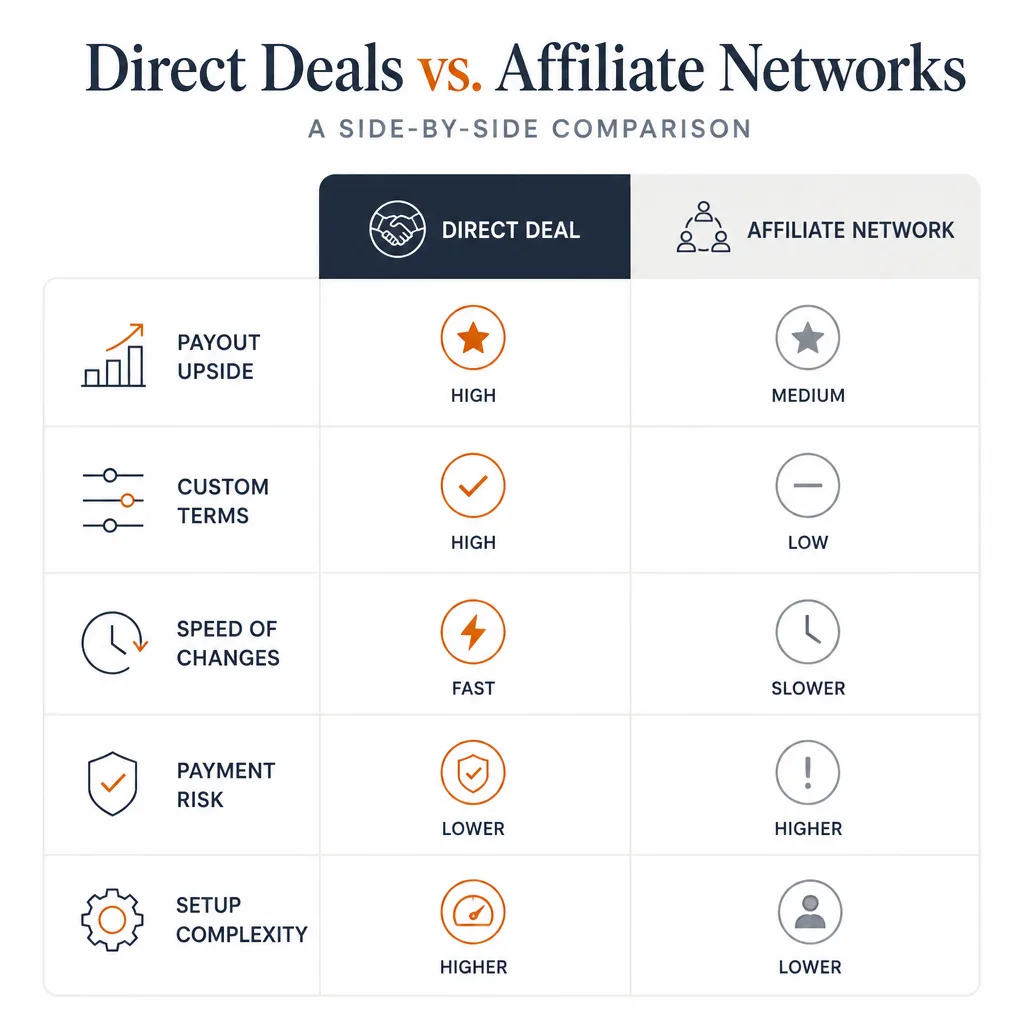
| Factor | Direct Deal | Affiliate Network |
|---|---|---|
| Payout upside | Often higher, if terms hold | More standardized |
| Custom caps and landing pages | Usually better | Usually limited |
| Speed of changes | Can be faster | Depends on network process |
| Payment risk | Higher | Often lower |
| Tracking disputes | Mostly yours to manage | Partly buffered |
| Setup complexity | Higher | Lower |
| Best fit | Proven volume, clear leverage | Testing, flexibility, lower risk |
What direct can improve, and what it can quietly make worse
Typical upside
The obvious upside is payout. Sometimes that alone justifies the conversation.
But the less obvious upside is often more valuable:
- faster approval feedback
- custom landing pages matched to your traffic
- better cap management
- quicker creative refreshes
- direct access to the advertiser team when quality shifts
A direct relationship can tighten the feedback loop. That matters because better feedback usually improves media buying decisions faster than generic reporting does.
Typical downside
Direct relationships usually fail in boring ways, not dramatic ones.
An affiliate gets a higher direct CPL, moves volume, then discovers the advertiser approves leads on a 30-day lag under a loosely defined quality standard. Reporting starts to drift. Some leads are rejected as duplicates, but dedupe rules were never defined. Payment lands late because finance “needs reconciliation.”
The headline payout looked better. The actual economics did not.
That is why a higher direct rate can still be a worse deal than a lower network rate.
What to bring before asking for a direct deal
Performance proof
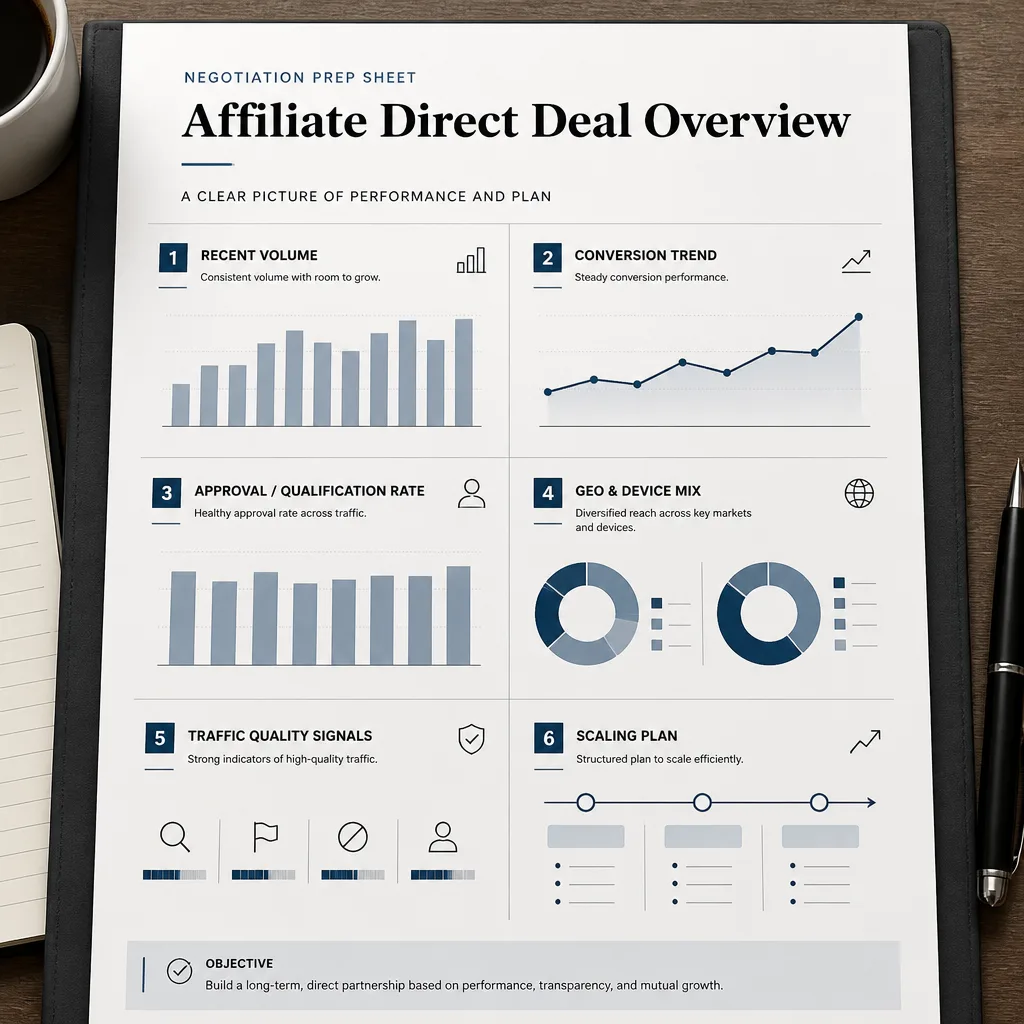
Do not approach direct as a favor request. Approach it as a commercial case.
Bring:
- recent conversion volume
- conversion trend over time
- approval or qualification rate
- geo and device mix
- source breakdown, at an appropriate level
- seasonality or volume constraints
- a clear note on current scale and realistic upside
The goal is simple: make it easy for the advertiser to understand what you already do well.
Quality signals beyond volume
Volume gets attention. Quality earns trust.
Useful signals include compliance history, refund or chargeback context when relevant, clean traffic-source explanations, and evidence that your traffic quality is stable rather than opportunistic.
An advertiser is more likely to negotiate if they believe your performance will hold after terms improve.
A traffic plan they can evaluate quickly
This matters more than many affiliates expect.
Do not just say, “I can scale.” Say what scaling depends on.
For example: if the advertiser can offer a private landing page, faster approval feedback, and a higher cap for one geo, you can shift more budget into the campaign over the next two weeks.
That is a business case, not a vague promise.
How to negotiate without sounding like you just want a higher payout
Lead with economics, quality, and scalability
Weak negotiation sounds like this: “Can you beat the network payout?”
Strong negotiation sounds like this: “We are already sending converting volume in this geo. Approval quality is stable. If we can improve economics and reduce approval friction, we can justify increasing spend.”
That framing changes the conversation. You are not asking for generosity. You are discussing a better operating model for both sides.
Ask for the right structure
Do not default to a flat payout ask if another structure fits better.
Common options include:
- Flat CPA/CPL: useful when conversion quality is already understood
- Tiered CPA: useful when more volume or better approvals should unlock better terms
- Hybrid payout: part CPA, part rev-share; useful when trust exists and downstream value is meaningful
- Pure rev-share: potentially strong upside, but riskier if you lack visibility into downstream revenue
- Cap increases: sometimes more valuable than a payout bump
- Private terms: custom landing pages, approvals, or routing logic
If trust is still limited, hybrid and rev-share deals need more caution. The less visibility you have into downstream monetization, the more careful you should be.
Negotiate for speed, not just money
A common mistake is treating payout as the only lever.
For many affiliates, the real gain comes from faster:
- creative approvals
- landing page edits
- quality feedback
- cap changes
- issue escalation
Speed compounds. Slow communication kills scaling.
Start with a pilot if trust is not established
You do not need to move everything at once.
A pilot is usually the smarter first step. Route a limited share of traffic direct, define the metrics, confirm reporting behavior, and see how the advertiser performs under real conditions.
That reduces risk without giving up the upside.
What to put in writing before traffic goes live
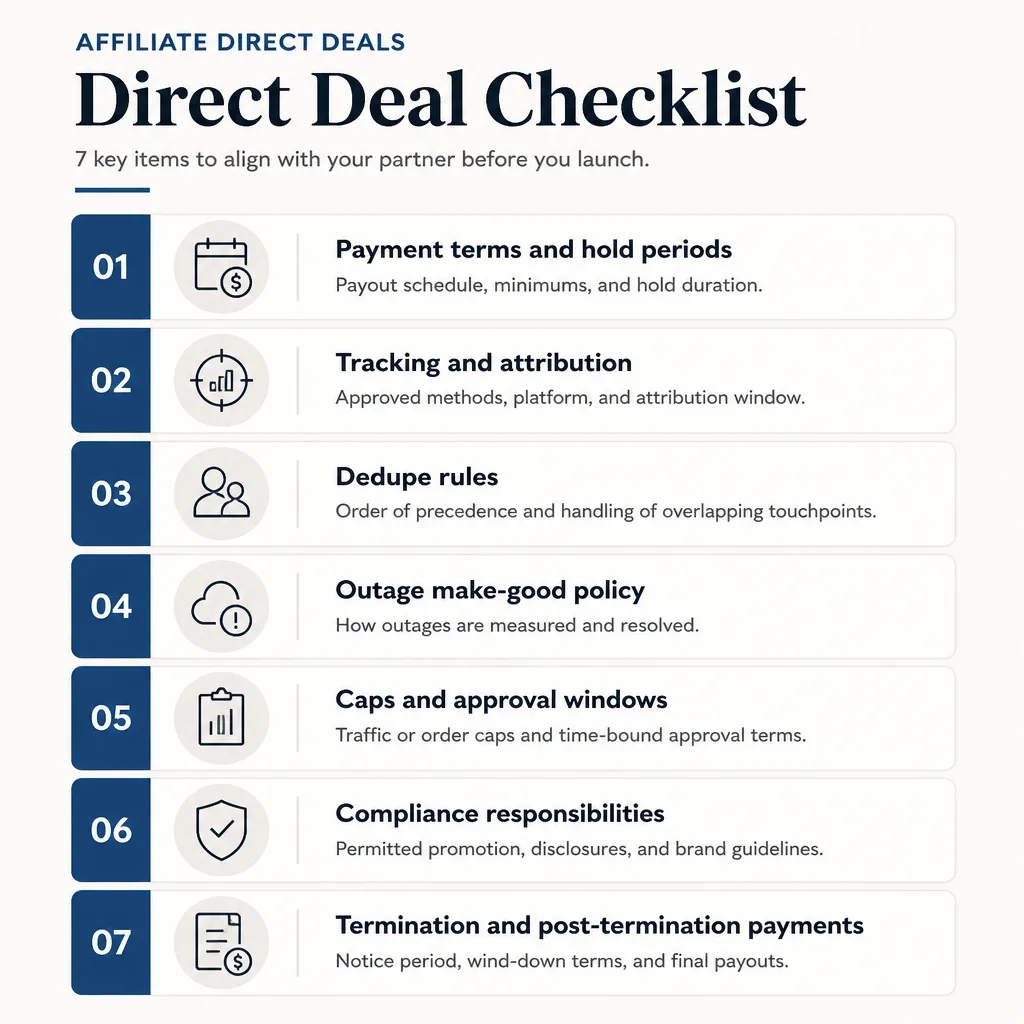
This is the part many affiliates rush through. It is also where a lot of preventable damage starts.
Payment terms and hold periods
Define:
- payment schedule and net terms
- invoice process
- minimum payout threshold, if any
- hold periods
- reversal and clawback conditions
If quality-based rejections are possible, the quality standard needs to be specific enough to audit.
Tracking method, attribution model, and reconciliation process
Agree on the mechanics before launch.
Specify the tracking setup, whether through server-to-server postbacks, a third-party tracker such as Voluum, RedTrack, or the advertiser’s own platform, and define how conversions are recorded.
Also define the attribution model and window. If both sides measure differently, disagreement is not the exception. It is the default.
Dedupe rules and source-of-truth logic
This is one of the most important non-obvious points.
If the advertiser buys traffic from multiple affiliates, internal teams, or other channels, ask:
- how duplicate leads or sales are identified
- which system decides final credit
- what data fields are used for matching
- who bears the loss if duplicate logic is too aggressive
You want a written source of truth. Otherwise, disputes become subjective.
Make-good policy for outages or broken tracking
Tracking breaks. Pixels fail. Landing pages misfire. Postbacks go silent.
Do not wait for the first outage to decide what happens next.
A sensible make-good policy should cover:
- how an outage is identified
- who must notify whom
- what logs or evidence will be used
- how affected conversions will be estimated or reconciled
- when compensation will be applied
Caps, approval windows, and creative turnaround expectations
If the campaign has caps, define how they are communicated and updated.
If the offer requires approval or qualification review, define the review window. An open-ended approval period is not neutral. It shifts cash-flow risk onto you.
Also set expectations for creative and landing-page turnaround. “We’ll get to it soon” is not a process.
Compliance responsibilities and traffic restrictions
Spell out allowed and prohibited traffic sources, brand-bidding rules, creative restrictions, disclosure requirements, and any geo-specific compliance rules.
Do not rely on assumptions here. Compliance disputes often appear only after performance becomes meaningful.
Termination, pause rights, and post-termination payment handling
You need to know:
- who can pause traffic and how
- how quickly cap changes must be communicated
- what happens to conversions generated before termination
- when final reconciliation happens
- whether approved but unpaid conversions survive the relationship
If this is not written down, the weaker party usually loses.
A simple rule: test direct only when the extra margin outweighs the extra risk
There is no status bonus for going direct.
Sometimes direct is clearly the better move. You have proven volume, the advertiser is operationally solid, the network is adding friction, and the relationship can improve both economics and speed.
Sometimes the smarter move is staying with the network, or keeping the network live while testing a direct pilot on part of the volume.
That is usually the right mindset: not “move everything direct,” but “earn the right to move direct.”
If the advertiser can improve margin, responsiveness, and control enough to justify the added work around tracking, reconciliation, payment follow-up, and compliance, test it. Start small. Put the important terms in writing. Expand only after the relationship performs well under real load.
A direct deal is not a secret. It is a business development skill backed by process discipline.
FAQ
When does a direct affiliate deal make more sense than a network offer?
Usually when you already send consistent, converting volume, need custom terms the network cannot support, and have enough process discipline to manage tracking, reconciliation, payment follow-up, and compliance yourself.
Are direct affiliate deals always more profitable than affiliate networks?
No. A higher headline payout can be offset by slower payment terms, more rejected leads, weak attribution rules, tracking disputes, or poor advertiser operations. The better deal is the one with stronger net economics after those risks are counted.
What proof should I bring when asking an advertiser for a direct deal?
Bring recent volume, conversion trends, approval or qualification rates, geography and device breakdowns, compliance history, traffic-source details, and a clear scaling plan. Advertisers respond better to evidence of quality and reliability than to vague requests for higher payouts.
What terms should be negotiated before traffic goes live?
At minimum: payout structure, payment schedule, hold periods, clawback rules, tracking method, attribution model, dedupe rules, source-of-truth logic, outage make-good policy, caps, approval windows, traffic restrictions, and post-termination payment handling.
What is the biggest risk in direct affiliate deals?
Payment and measurement risk usually matter most. Networks often absorb some collection, reporting, and dispute friction. Going direct can improve control, but it also means carrying more of the operational and financial risk yourself.
Should I move all traffic direct once an offer is working?
Not necessarily. A limited pilot is often safer. Test direct with a portion of volume first, confirm reporting and payment behavior, then expand only if the extra margin and responsiveness hold up under real operating conditions.
Can I negotiate more than just a higher payout?
Yes. In many cases, the bigger gains come from better caps, faster approvals, custom landing pages, creative turnaround, hybrid CPA plus rev-share structures, or clearer feedback loops on lead quality.
What happens if advertiser and affiliate reporting do not match?
That should be defined before launch. Both sides should agree on attribution rules, reconciliation cadence, dedupe logic, and which platform or dataset acts as the source of truth when numbers differ.