Meta Ads Lead Quality in 2026: How to Stop “Fake Leads” Without Killing Volume
A low cost per lead can hide a bad acquisition system.
That is the trap in many Meta lead gen campaigns. Meta is very good at generating easy submissions. What it does not do automatically is detect that many of those leads were accidental, unreachable, outside your service area, or never serious to begin with.
Most “fake lead” problems are not actually one problem. Some are bots. Many are not. More often, the issue is a mix of low-friction form behavior, weak qualification, poor validation, and optimization signals that reward volume rather than sales usefulness. If you want better lead quality without crushing volume, the fix is usually layered, not dramatic.
Meta lead quality problems usually start with the system, not just the audience
Blaming the audience is tempting because it feels concrete: broad targeting, cheap placements, careless clicks. Sometimes that is part of the story. But most lead quality issues start earlier, with the signal chain you built.
Why “fake leads” are often a mix of bots, accidental submissions, incentive seekers, and low-intent users
Treating every bad lead as fraud leads to bad decisions.
A junk lead might be:
- a real person who completed a prefilled form with almost no effort
- someone curious about price but not ready to buy
- a duplicate from retargeting or repeat submission
- a prospect outside your geography or budget range
- a lead with invalid contact details
- actual bot or fraudulent activity
Those are different problems, and they need different fixes.
A home services advertiser, for example, might see 80 leads in a week and assume Meta is sending garbage traffic. Then sales reviews the records and finds the bigger issue: many leads are real people, but half are outside the service area and another chunk never intended to book an estimate. That is not bot fraud. It is a qualification problem.
What Meta is actually optimizing for when your form is too easy to complete
Meta’s delivery system optimizes for the event it can see clearly and at usable volume. If your optimization event is a raw lead submission, Meta will learn from people who submit forms, not from people who later become qualified pipeline.[^1]
That distinction matters.
Meta Instant Forms are designed to reduce friction, often by using prefilled profile data. That is why they work well for volume. It is also why they can produce a lot of low-commitment conversions.
Why low friction can improve CPL while quietly hurting sales outcomes
Low friction is not bad by itself. It becomes a problem when ease replaces intent.
A form that takes five seconds to complete can improve reported efficiency while reducing commercial usefulness. You pay less per lead, the dashboard looks healthier, and the sales team gets worse inputs.
The real unit of analysis is not form completion. It is qualified lead yield.
The four main reasons Meta lead ads produce junk leads
Frictionless instant forms make submission too easy
This is the most common cause.
If the ad promise is broad and the form is prefilled, users can submit with barely any thought. That is great for volume. It is not great for intent clarity.
Meta offers higher-intent form settings with an added review step before submission, specifically to increase commitment.[^2] That extra step will usually reduce total submissions. Sometimes that is exactly the point.
Weak optimization signals teach Meta to find more of the wrong people
If you optimize to leads and never send back qualified outcomes, Meta has limited visibility into what “good” means for your business.[^3]
So the system keeps finding users who behave like converters at the form level. Cheap leads tend to produce more cheap leads.
This is why broad targeting often gets blamed for what is really a signal problem. Broad targeting can widen the pool, yes. But weak optimization data is usually the deeper issue.
Broad targeting and audience expansion can widen intent too far
Broad targeting is not automatically wrong. In some accounts, broad targeting paired with strong downstream signals performs very well.
But when the form is easy and the optimization event is shallow, broader delivery can amplify low-intent behavior. That is where products like Advantage+ audience need to be judged carefully, not by CPL, but by downstream quality.
If valid contact rate and meeting rate collapse as delivery broadens, the system may be finding cheap submitters instead of real prospects.
Lead handling gaps in CRM and follow-up make quality look worse than it is
Some “bad leads” are not bad traffic. They are mishandled leads.
Common examples:
- invalid phone numbers passing straight into the CRM
- duplicates counted as new leads
- no filtering for geography or existing customers
- long delays before the first call or SMS
- inconsistent sales qualification
A clinic or appointment-based business might think Meta is sending trash because answer rates are low. Then it discovers reps are calling hours later, making one attempt, and never sending a confirmation text. That is not a targeting problem. It is an operations problem wearing a media-buying costume.
Fix lead quality with layers, not one big change
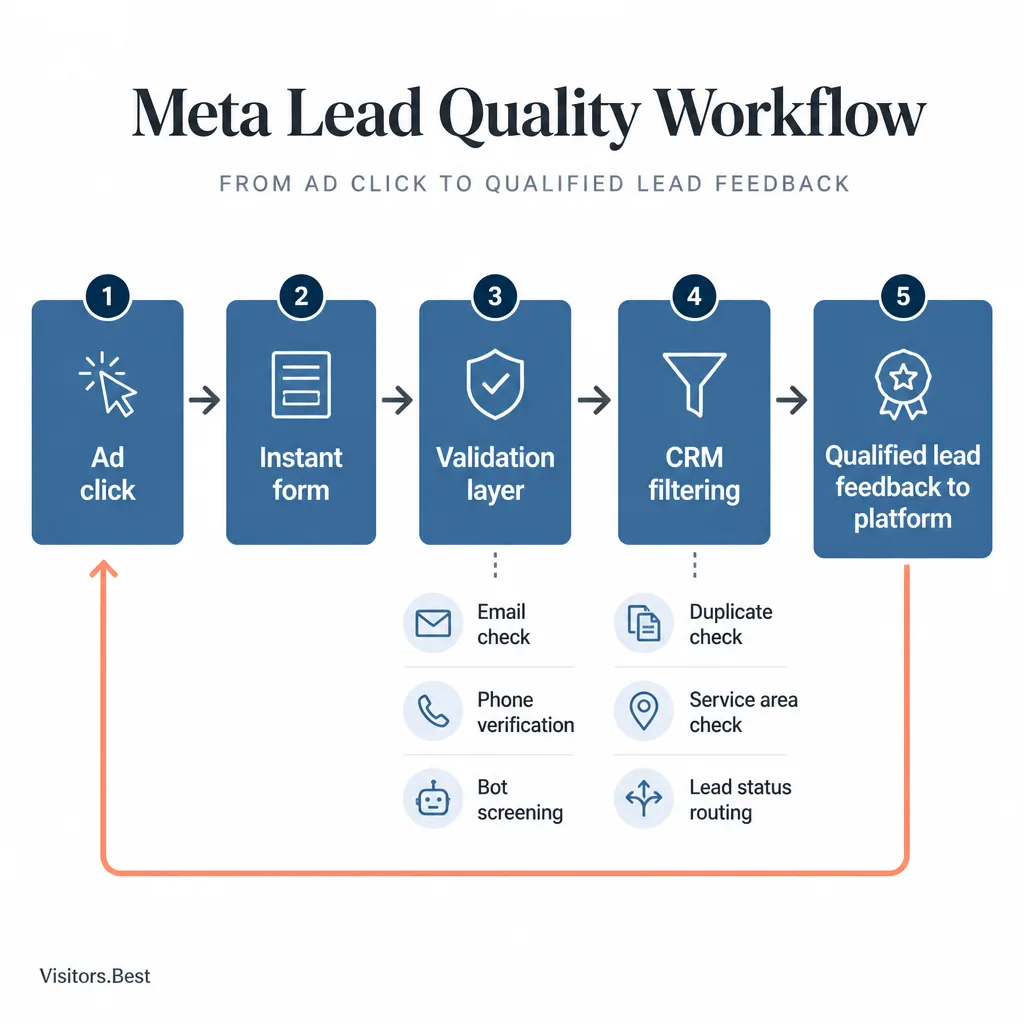
The best fixes improve signal quality at multiple points: form, validation, CRM, and feedback.
Start with higher-intent form design: review step, stronger copy, realistic expectations
This is usually the first test because it is simple and high leverage.
Start by tightening three things:
- Form intent setting: Use the higher-intent version of Meta’s Instant Form when low-intent submissions are a clear problem.[^2]
- Ad-to-form consistency: If the ad promises “Free quote in 60 seconds,” do not expect strong buyer intent. Set expectations honestly.
- Review step and confirmation language: Remind people what happens next. “Our team will call to confirm service area and schedule” is stronger than vague copy.
A practical home services example: adding a review step and explicitly stating “available only in listed counties” may reduce form volume by 20% while improving booked estimate rate enough to raise overall efficiency.
Use conditional questions to filter without bloating the form
More questions are not better. Better questions are better.
Use gating questions that screen for actual fit:
- service area
- company size
- timeline
- budget range
- type of need
For a B2B demo campaign, asking every prospect six qualification questions can kill completion. A better approach is to ask one or two high-signal questions first. If someone selects “just researching” or “team size: 1,” that can trigger extra filtering or route them into lighter nurture instead of immediate sales follow-up.
The goal is not to make everyone work harder. It is to identify who deserves the next step.
Add verification where it matters: email checks, SMS confirmation, or one-time codes
Native lead forms are convenient, but they give you less control than a landing page stack.
Verification options depend on your flow, but common ones include:
- email format and deliverability checks
- phone number validation before routing
- SMS confirmation
- one-time passcodes through tools like Twilio Verify
- post-submit confirmation steps
Not every business needs OTP verification. For high-consideration offers, though, a small confirmation step can quickly separate reachable demand from junk.
Use bot filtering and fraud controls outside the form when native protections are limited
If fraud is a serious concern, the cleaner setup is often a landing page rather than a native form.
A landing page gives you access to:
- CAPTCHA or alternative bot checks
- hidden field traps
- device or IP-based fraud scoring
- richer validation logic
- behavioral screening before submit
That does not mean landing pages are always better. They usually reduce completion rate, especially on mobile. But if your bottleneck is quality rather than volume, the extra control may be worth the tradeoff.
Tighten CRM validation rules so junk never becomes a lead by default
This is one of the least glamorous and most valuable fixes.
Useful CRM rules include:
- reject impossible phone numbers
- normalize and validate email format
- flag duplicates by email and phone
- mark out-of-area submissions automatically
- separate unverified submissions from sales-ready leads
- route existing customers differently from new prospects
A simple example: if a lead arrives with a phone number like 1111111111 or the wrong digit count for your market, it should not enter reporting as a standard lead. It should be flagged before it poisons both funnel metrics and event feedback.
The highest-leverage fix is sending qualified lead signals back to Meta
This is where lead quality stops being a cleanup exercise and becomes a learning system.
Why platform optimization improves only when you feed it downstream quality data
Meta can optimize only on the signals it receives and can match back to users. If you never tell the platform which leads became qualified, contacted, booked, or revenue-generating, it remains heavily dependent on top-of-funnel conversion behavior.[^3][^4]
That is why Conversions API and CRM-fed offline events matter. They let you push downstream outcomes back into the ad system.
What counts as a qualified lead event
The best qualified lead event is objective, consistent, and not too delayed.
Examples:
- valid phone and email confirmed
- sales contacted and confirmed fit
- inside service area and budget range
- appointment requested or booked
- demo accepted after screening
If your sales team’s definition changes by rep, the signal becomes noisy. Meta cannot learn well from moving targets.
How to think about volume thresholds and delayed feedback
There is no universal magic number for every account. The principle is simpler: optimize as low in the funnel as you can without starving the system of usable signal.
If qualified leads are too sparse or delayed by weeks, optimize to raw leads for now, but improve validation and measure qualified outcomes externally. If you have enough timely qualified events, move the optimization lower.
When this works well and when your data is too noisy to trust
Qualified-lead optimization works best when:
- qualification criteria are stable
- CRM identifiers are clean and well formatted
- event matching is strong
- feedback is sent back quickly enough to matter
It works poorly when:
- reps qualify inconsistently
- duplicates are common
- match quality is low
- sales cycles are long and messy
- event volume is tiny
Measurement quality comes before optimization quality.
What to test first if you want better quality without collapsing volume
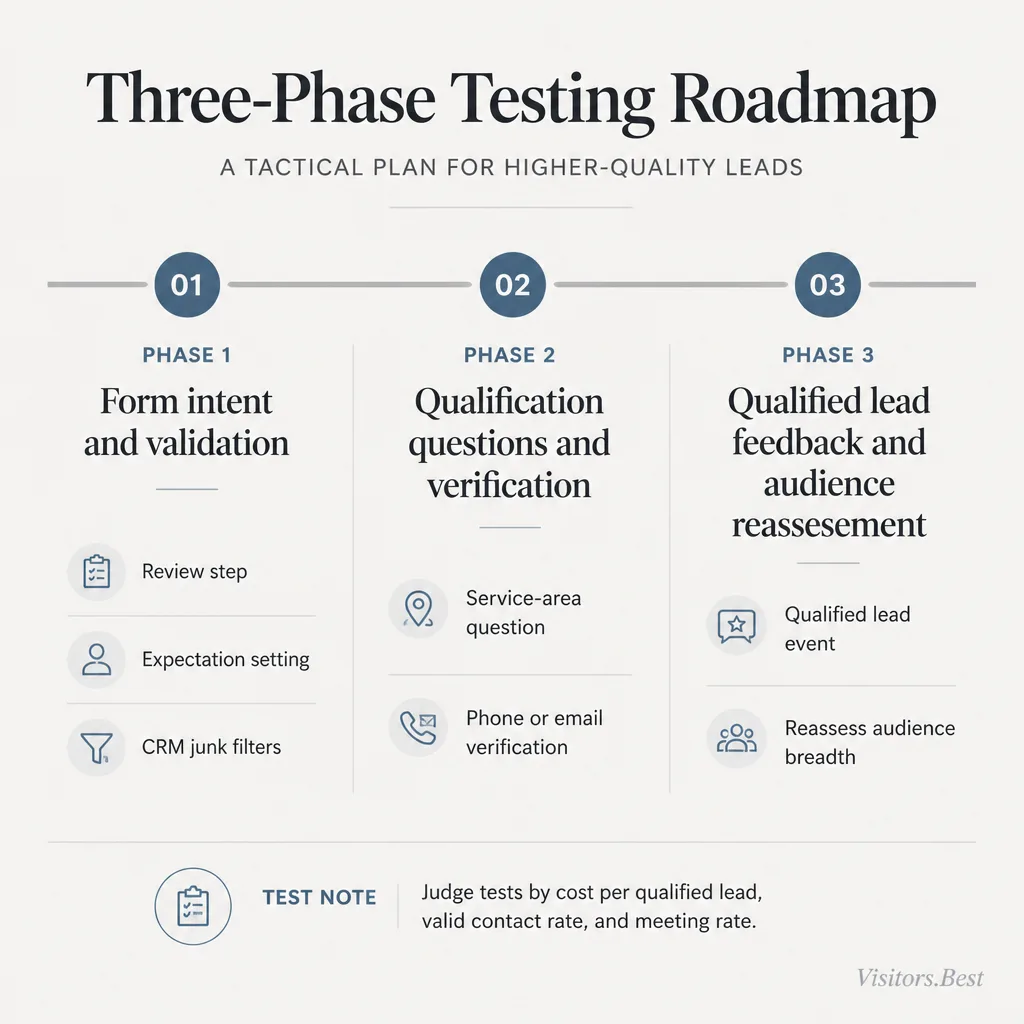
Most accounts should not start by rebuilding targeting. Start with intent and validation.
Phase 1: change form intent and validation before touching targeting
First test:
- higher-intent form setting
- tighter ad-to-form messaging
- clearer expectations
- basic field validation
- obvious CRM junk filters
This isolates the cheapest fixes first.
Phase 2: test qualification questions and verification layers
Next, test one or two meaningful qualification questions.
Then, if needed, add:
- email verification
- phone validation
- SMS confirmation
- stronger post-submit confirmation
Do not add five new layers at once. If volume drops, you need to know why.
Phase 3: feed qualified outcomes back into Meta and reassess audience breadth
Once the intake process is cleaner, send qualified events back through your CRM integration, offline event workflow, or Conversions API setup.[^4]
Only after that should you reassess broad targeting, exclusions, or audience expansion. Otherwise, you risk blaming targeting for a broken feedback loop.
How long to wait before calling a test
Do not judge by days alone. Judge by downstream sample size.
You need enough data to compare:
- valid contact rate
- qualified lead rate
- meeting rate
- cost per qualified lead
If your account generates 20 leads a day, a week may be enough for an initial read. If you generate 20 leads a week, you will need longer. The right test window is the one that accumulates enough quality signals to matter.
The metrics that matter more than cost per lead
CPL is not useless. It is just incomplete.
Cost per qualified lead
This is the anchor metric for most advertisers. If CPL rises 25% but cost per qualified lead falls 15%, the campaign improved.
Valid contact rate
Can you actually reach the person?
This catches invalid phone numbers, fake emails, and dead submissions early.
Sales contact rate
How many leads were actually contacted by sales?
This separates traffic quality from follow-up quality.
Meeting or appointment rate
For service businesses, clinics, consultative sales, and B2B demos, this is often where lead quality becomes obvious.
Opportunity or close-rate signals when sales cycles are longer
If your cycle is long, you may not be able to optimize directly to revenue yet. Fine. Track opportunity creation or other mid-funnel indicators instead.
The ladder is simple:
lead → valid contact → contacted → qualified → meeting → opportunity → close
The higher you can measure reliably, the less likely you are to fool yourself.
Where added friction helps and where it backfires
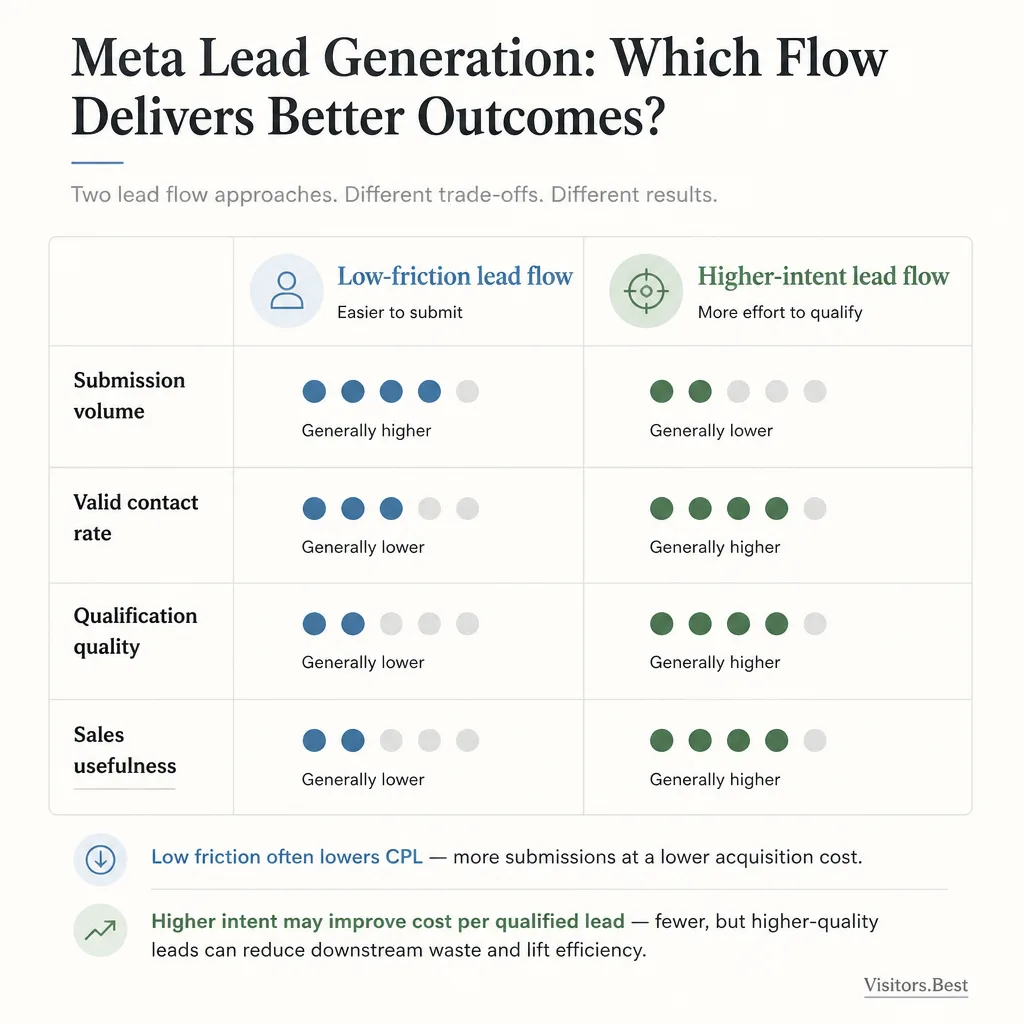
When friction improves signal quality
Added friction helps when it asks for a real act of commitment tied to buying intent.
Good friction usually does one of three things:
- confirms fit
- confirms reachability
- confirms seriousness
A review step, service-area question, or SMS confirmation can improve signal quality because each one reveals something useful.
When friction cuts off legitimate demand
Bad friction is annoyance disguised as qualification.
Examples:
- too many irrelevant questions
- long forms sales never uses
- identity checks for low-consideration offers
- clunky landing pages on mobile
- verification steps that break technically
This kind of friction does not improve intent. It just reduces completion.
How to decide whether to keep the extra step
Keep the friction if it improves business economics, not if it merely makes the form look cleaner.
That usually means one of these outcomes:
- cost per qualified lead falls
- valid contact rate rises materially
- meeting rate improves enough to offset lower volume
- sales team recovery rate improves
If form submissions drop but qualified lead volume stays flat or rises, the friction did its job.
A practical decision rule for 2026
If volume is high but quality is poor, tighten intent first
Use higher-intent forms, better expectation-setting, and a small number of meaningful qualification steps.
If quality is mixed but recoverable, improve validation and follow-up
Fix CRM hygiene, phone and email validation, duplicate handling, routing, and speed-to-lead before overhauling the campaign.
If Meta cannot learn from real outcomes, fix measurement before blaming targeting
If you are not sending qualified outcomes back, the platform is mostly learning from raw submissions. That is not a Meta flaw so much as a signal design problem.
Conclusion
Most Meta “fake lead” issues are really signal-chain issues.
The platform is doing what you asked: finding people likely to submit a form. If that form is easy, qualification is weak, the CRM accepts junk, and no downstream outcomes are sent back, cheap leads are exactly what the system will produce.
The fix is not one trick. It is a sequence. Raise intent a little. Validate contact data. Filter junk operationally. Measure quality where it actually shows up. Then feed qualified outcomes back into Meta so the system can learn what a good lead looks like for your business.
Cheap volume is easy to buy. Useful demand takes better signals.
FAQ
Why are Meta lead ads generating fake or low-quality leads?
Usually because the system is optimized for easy form submissions, not downstream sales quality. Poor leads can come from accidental submissions, low-intent users, invalid contact details, duplicates, weak qualification, and sometimes bot-like activity.
Do higher-intent Meta Instant Forms improve lead quality?
They often help by adding a review step and a bit more commitment before submission. That can reduce accidental or casual leads, but it may also lower total form volume. The real test is cost per qualified lead, not raw CPL.
Will adding more form questions fix low-quality Meta leads?
Not by itself. Extra questions only help when they screen for actual fit, such as service area, timeline, budget, or need. Irrelevant questions can reduce conversions without improving sales outcomes.
Should I use a Meta lead form or send traffic to a landing page?
It depends on the tradeoff you need. Meta lead forms usually produce more volume with less friction, while landing pages give you more control over validation, qualification, anti-spam measures, and messaging. If quality is the real bottleneck, that extra control can be worth it.
Can Meta optimize for qualified leads instead of raw leads?
Yes. In many setups, you can send downstream events back through CRM integrations, Conversions API, or offline event workflows. The catch is that your qualified lead definition must be consistent, timely enough, and based on enough volume for the signal to be useful.
What metrics matter more than cost per lead for Meta lead generation?
Track cost per qualified lead first, then valid contact rate, sales contact rate, meeting or appointment rate, and later opportunity or close-rate metrics if your attribution is clean enough. CPL alone can make a weak campaign look healthy.
Are fake leads on Meta always bots?
No. Many bad leads are low-intent human submissions created by frictionless forms and shallow optimization signals. Treating everything as bot traffic usually leads to the wrong fix.
What should I test first to improve Meta Ads lead quality?
Start with form intent and basic validation before changing targeting. Then test qualification questions and verification layers. After that, improve CRM filtering and send qualified lead events back to Meta. Change one layer at a time so you can see what actually moved quality.