Most “make money online” funnels do not fail at the checkout button. They fail earlier, when the story changes.
You get clicks. You get opt-ins. Maybe email opens are decent. But sales stay weak, so the default conclusion is simple: the offer must be bad.
Sometimes that is true. More often, it is a lazy diagnosis.
In MMO, conversion problems usually come from a mismatch between the promise that earned the click, the lead’s awareness level, and the follow-up that moves them toward the offer. A broad “easy side income” hook can produce cheap leads and still hurt sales. A decent offer can look broken when cold beginner traffic hits a buyer-stage pitch too early.
This article is a diagnostic checklist, not a collection of generic CRO advice. The goal is to help you find the first point where trust or expectation breaks, run a few fast tests, and decide whether to optimize, change the angle, swap the traffic source, or move on.
Why MMO leads fail to convert even when the funnel looks healthy
A healthy top of funnel can hide a weak business model.
That happens a lot in MMO because broad promises attract curiosity. “Work from home.” “Beginner side hustle.” “Simple online income.” Hooks like these can lift click-through and opt-in rates, but they often pull in people who like the idea more than the work behind it.
The usual mistake: blaming the offer too early
The sale is the visible failure point, so it gets blamed first.
But if the ad promised simplicity and the offer requires a real learning curve, the offer never got a fair shot. The lead was wrong before they ever saw the sales page.
The same thing happens when someone searching “what is affiliate marketing?” gets pushed straight into a hard sell for an advanced coaching offer. The copy may be fine. The sequence may be fine. The timing is wrong.
The real issue: mismatch between promise, audience temperature, and follow-up
Think of conversion as a chain:
traffic source → click promise → pre-lander → opt-in → first email → offer click → sales page → sale
The funnel usually breaks at the first stage where expectations shift.
A lead who clicked out of curiosity behaves differently from a lead who clicked because they were already comparing options. Those are not the same asset. Many MMO funnels pay for the first and expect the economics of the second.
Start with the leak: diagnose the funnel stage before changing anything
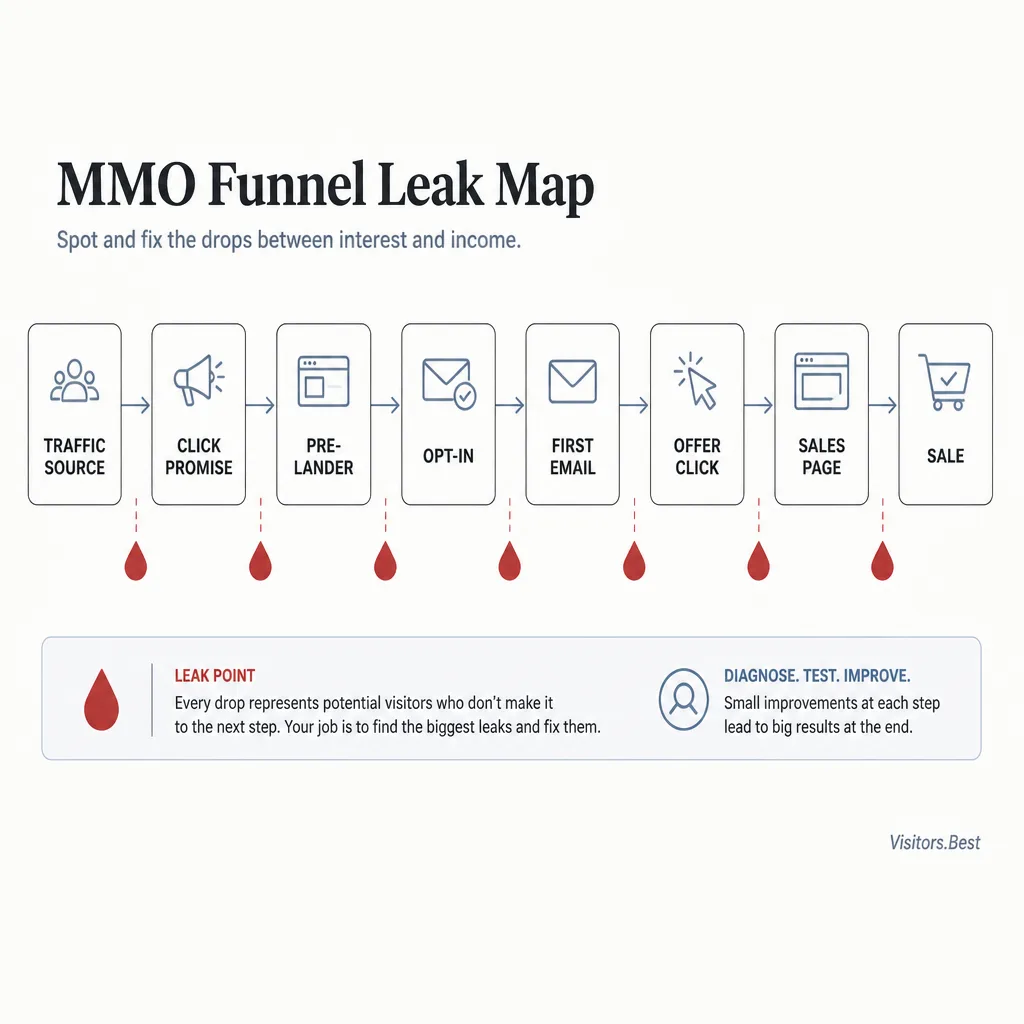
Before you rewrite emails or replace the offer, isolate the stage where intent drops.
Ad or SEO snippet: does the click come from curiosity or buyer intent?
Start with the entry point.
If CTR is strong but everything downstream is soft, your hook may be too broad. An ad that says “Discover a simple way to make money online” will usually attract more curiosity than “How beginners are using local lead gen to get their first client.” The second will get fewer clicks, but those clicks are easier to monetize.
For SEO, check query intent. Traffic from “best side hustles for beginners” is not at the same awareness level as traffic from “best affiliate tracking software” or “how to choose an email autoresponder for affiliate funnels.”
Pre-lander: does it frame the offer or just chase the opt-in?
A good pre-lander narrows the audience. A bad one inflates the lead count.
If the page exists only to tease a secret, promise a free trick, or push the email form as fast as possible, you may be collecting names instead of building sales readiness.
A better bridge page does three things:
- explains what the offer actually is
- sets the effort or commitment level honestly
- gives the lead a reason to continue if they are a fit
If the offer is a webinar about building a service business, say that. Do not frame it like a shortcut to instant passive income.
Opt-in page: are you collecting leads or attracting freebie seekers?
A high opt-in rate can be a warning sign.
In MMO, broad lead magnets and vague “free training” hooks often pull in people who want tips, not change. If opt-in rate is high but first-email engagement is poor, that usually points to low commitment or weak qualification upstream.
Ask a blunt question: would a reasonable person know what they are signing up for?
If the answer is no, the opt-in page is probably lying by omission.
First email: does it continue the conversation the click started?
Your first email should feel like the next sentence, not a new script.
If the lead clicked for “beginner-friendly ways to start online” and the first email immediately pitches a high-ticket mentorship or a complicated business model, the drop-off should not surprise you. The funnel changed tone before trust had time to form.
Timing matters too. There is no universal rule, but delayed follow-up often wastes the highest-intent window. If someone opts in and hears from you much later, you are restarting a conversation they may already have forgotten.
Offer click: are leads curious enough to click but not ready to buy?
This is one of the most common patterns in MMO: people click through, but sales stay flat.
That can mean several things:
- they were curious, not committed
- the price expectation was wrong
- the offer feels more complex than promised
- the proof is weak
- the ask came too early
Do not treat offer clicks as proof of strong intent. In this niche, curiosity often survives longer than trust.
Sales page: is the handoff aligned with what the lead expected?
Affiliates often cannot change the merchant page, but they can control the handoff.
If your bridge copy frames the opportunity as simple, fast, and beginner-friendly, while the sales page sells a long-term system that requires tools, learning, and patience, the friction is built in. The problem may not be the sales page alone. It may be the story you told before the lead got there.
Conversion: what the final no-sale pattern usually tells you
Even simple data can be useful.
A rough symptom map:
| Symptom | Likely cause | First test |
|---|---|---|
| High opt-ins, low opens | weak lead commitment, broad promise, low-intent source | narrow the headline promise |
| High opens, low clicks | hook-to-offer mismatch, weak CTA clarity, wrong awareness level | rewrite the first email for continuity |
| High clicks, no sales | poor handoff, weak proof, wrong price expectation, offer mismatch | add expectation-setting before the offer |
| Good engagement across stages, weak sales everywhere | offer problem or merchant-page problem | test a different offer with the same audience |
These are clues, not verdicts. One symptom can have more than one cause.
The 5 mismatch patterns that kill conversions
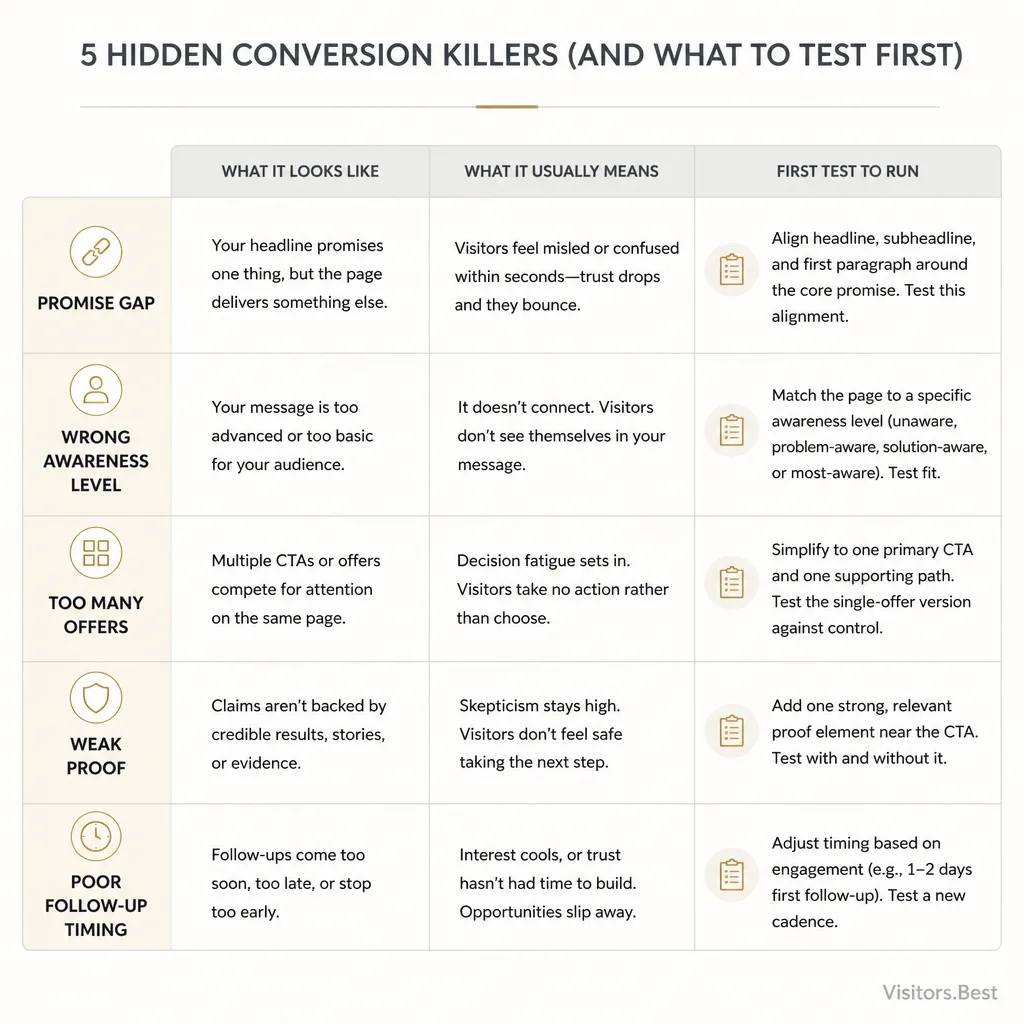
Promise gap: the lead came for one thing and met another
This is the biggest one.
A lead clicks an ad about “easy side income from home” and lands in a webinar for building an agency, wholesaling leads, or launching a serious affiliate system. Those are not the same proposition. Even if the offer is good, the promise gap creates distrust.
Wrong awareness level: beginners are seeing a buyer-stage pitch too soon
Someone searching broad MMO terms is often still trying to understand the category.
They may need context, examples, and proof before they are ready for urgency-driven copy. If your funnel assumes they already believe in the model and only need a push, you are selling too far ahead of their awareness.
Too many offers: attention gets diluted before trust forms
Early-stage traffic does not need options. It needs a clear next step.
If your emails rotate three different offers, plus a software recommendation, plus a YouTube channel, plus a bonus page, you are not nurturing. You are fragmenting attention. Optionality feels helpful to the marketer. To the lead, it usually feels noisy.
Weak proof: claims appear larger than the evidence
MMO is a skepticism-heavy niche for good reason.
If the claims are big and the proof is thin, people disengage quietly. That is especially true when the funnel uses income language but does not explain effort, constraints, or who the method is actually for. Strong proof does not need to be flashy. It needs to be credible, specific, and proportional.
Poor follow-up timing: the sequence misses the moment of intent
More emails do not automatically fix weak conversion.
Sometimes the first message arrives too late. Sometimes the spacing is odd. Sometimes the strongest angle is buried in email four when intent was highest on day one. Timing problems are easy to miss because the funnel still works mechanically. It just misses the moment.
A 48-hour triage plan: quick tests that can reveal the problem fast
These are diagnostic tests, not guaranteed lifts.
Swap the headline to narrow the promise
Take a broad hook and make it more specific.
Instead of “Start making money online from home,” test “A beginner-friendly local lead gen model that starts with one client.” Volume may drop. That is fine. You are testing whether better qualification improves downstream behavior.
Add an expectation-setting paragraph before the opt-in or first CTA
This is one of the simplest fixes.
Add two or three sentences that explain:
- what the offer really involves
- who it is for
- what it is not
Example:
This training is for people willing to learn a real client-acquisition model. It is not a push-button income trick, and it makes more sense for beginners who want to build a skill than for people looking for instant results.
That paragraph may lower opt-ins and improve sales efficiency at the same time.
Reduce the path to one primary CTA
If the page or email asks the lead to do five things, your data gets harder to interpret.
Strip it down. One next step. One offer. One action. This does not just improve focus. It makes diagnosis cleaner.
Add one segmentation question to sort intent
You do not need a CRM for this.
Add a simple question after opt-in or in the welcome flow:
- Just exploring
- Want to start in the next 30 days
- Already tried another MMO model
That one answer can change how you write the next email and how seriously you treat the lead.
Use resend logic for non-openers or non-clickers with a tighter angle
If the first email underperformed, resend it with a more precise subject line or a more realistic angle.
This helps separate inbox attention problems from message-fit problems. If the resend also fails, the issue is probably deeper than subject line optimization.
What a qualified MMO lead actually looks like
Why opt-in volume is a weak definition of quality
A lead is not qualified because they filled out a form.
In MMO, that standard is especially weak because broad hooks can generate a lot of low-commitment signups. Volume feels good. Revenue cares about intent.
Behavior signals that matter more than list size
Better signals include:
- the source and query context
- time spent on the bridge page
- first-email open
- first-email click
- reply behavior
- repeat site visits
- returning to the offer after the first click
- segmentation answers that indicate urgency or experience
A lead who opens, clicks, revisits, and replies is worth more than ten people who grabbed a free checklist and disappeared.
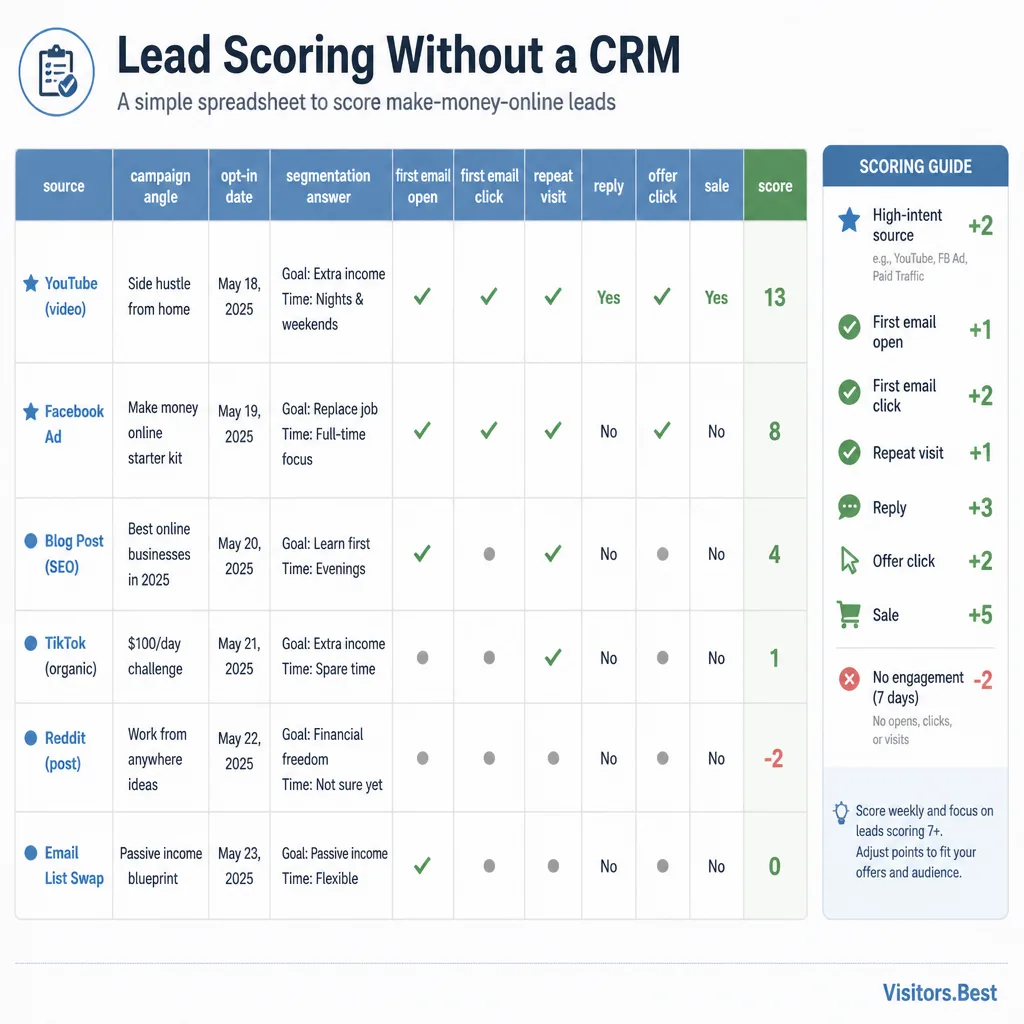
A simple lead scoring model you can run in a spreadsheet
Keep it simple.
Create columns for:
- source
- campaign angle
- opt-in date
- segmentation answer
- first-email open
- first-email click
- repeat visit
- reply
- offer click
- sale
Then assign rough points:
- +2 for a high-intent source or specific angle
- +1 for first-email open
- +2 for first-email click
- +2 for repeat offer visit
- +3 for reply or question
- -1 for a broad giveaway-only angle
- -2 for no engagement after opt-in
This is not predictive science. It is pattern recognition.
If leads with 4+ points convert far better than the average list, you have learned something important: qualification is your bottleneck, not just copy.
When to stop optimizing and change something bigger
At some point, more tweaking becomes expensive avoidance.
Signs the traffic source is mismatched
Change the source when low intent shows up early and repeatedly:
- strong clicks, weak opens
- broad placements or vague search intent
- the same low-quality behavior across multiple angles
- recurring freebie-seeker patterns
If the source keeps delivering curiosity without commitment, no amount of email polishing will turn it into buyer intent.
Signs the angle is attracting the wrong lead
Change the angle when engagement exists but expectations are clearly off.
A common signal: a narrower, more honest promise lowers opt-in rate but improves clicks, sales-page visits, or EPC. That usually means the original hook was attracting too many of the wrong people.
Signs the offer is the real problem
Sometimes the offer really is the problem.
If qualified leads engage with the bridge, open emails, click through, and still do not convert across multiple angles or segments, the final proposition may be weak. That could mean poor proof, weak economics, bad merchant-page alignment, or an offer that simply does not fit the audience.
How to decide between traffic change, angle change, and offer change
Use a simple rule:
- Behavior breaks early: change traffic
- Behavior is decent early but expectations feel wrong: change angle
- Behavior stays strong until the sale and then dies: change offer
Do not keep optimizing a bad match because the top-line metrics look busy.
Use the checklist to find the mismatch before you buy more traffic
Most conversion leaks in MMO are not mysterious. They are just misdiagnosed.
Fix the stage that breaks trust first
If the click promise is too broad, fix that before rewriting the entire email sequence. If the bridge page hides the real commitment level, fix that before blaming the merchant. If the first email changes the story, repair the handoff before adding five more follow-ups.
Optimize only what the data and behavior actually support
A funnel does not deserve more traffic because it gets opt-ins.
It deserves more traffic when the people entering it behave like qualified leads and the offer has a realistic chance to convert. That is the standard that matters.
Conclusion
When MMO leads do not convert, the visible failure usually happens late in the funnel. The real failure usually does not.
Most of the time, the leak starts where the promise, the lead’s awareness level, and the follow-up stop matching. That is why endless copy tweaks often disappoint. They are being applied too far downstream.
Find the first stage where expectations break. Fix that stage first. Then decide whether the next move is better qualification, a better angle, a different traffic source, or a different offer.
In this niche, a smaller list that knows what it is signing up for will often outperform a much larger list built on curiosity.
FAQ
Why do MMO leads fail to convert even when opt-in rates look good?
Because opt-in rate measures willingness to raise a hand, not willingness to buy. In MMO funnels, broad promises, freebie hooks, and curiosity-driven angles can inflate lead volume while lowering buyer intent. A funnel can look healthy at the top and still be weak where trust, expectations, and offer fit actually matter.
How can I tell whether the problem is the traffic source or the offer?
Look for where behavior breaks. If clicks and opt-ins are high but engagement collapses early, the source or angle may be attracting low-intent traffic. If leads engage with emails, click through, and still do not buy across multiple angles, the offer or sales-page handoff is more likely the issue.
What is the most common mismatch in MMO funnels?
Usually, it is the promise gap. A lead clicks because the ad or SEO snippet suggests something easy, fast, or beginner-friendly, then lands in a funnel that asks for more time, money, or sophistication than expected. That mismatch often kills conversion before the sales page gets a fair chance.
What quick tests can I run to improve MMO lead conversion?
Start with small diagnostic tests: narrow the headline promise, add an expectation-setting paragraph before the opt-in, reduce the funnel to one primary CTA, ask one segmentation question, and resend to non-openers or non-clickers with a tighter angle. These tests help reveal whether the problem is qualification, messaging, or timing.
How do I define a qualified MMO lead without a CRM?
Define quality by behavior, not form fills. Track simple signals in a spreadsheet such as source, campaign angle, opt-in timing, first email open, first click, segmentation answer, repeat visit, and offer interaction. Leads showing multiple positive intent signals are usually more valuable than a large list of low-commitment opt-ins.
When should I stop optimizing and change the angle, traffic source, or offer?
Stop tweaking when the same weakness repeats after a few focused tests. Change the traffic source when low intent shows up early and consistently. Change the angle when leads engage but expectations are clearly wrong. Change the offer when qualified leads reach the sales step with good engagement and still fail to convert.