Most make-money-online lead magnets fail for a simple reason: they are built to win the opt-in, not attract the right subscriber.
That sounds obvious, but it changes almost everything. A free ebook called “10 Ways to Make Money Online” may collect plenty of email addresses. It may also fill your list with people who like the idea of the topic but have no budget, no asset, no workflow, and no intention to act this month.
The better question is not, “What will get the most downloads?” It is, “What will reveal buyer intent early?” In MMO niches, the strongest lead magnets usually help the reader do one concrete thing next. They ask for a decision, some effort, or existing context. That is exactly why they often convert better later.
Best Lead Magnets for Make Money Online Niches: 12 Offers That Attract Buyers, Not Freebie Hunters
This is not a roundup of random freebies. It is a shortlist of lead magnet formats that tend to qualify subscribers better when your goal is tripwire sales, booked calls, high-intent affiliate clicks, or first purchases within a short window.
The thesis is simple: curiosity magnets say, “Tell me more.” Buyer magnets say, “Help me do the next thing.”
Why Most MMO Lead Magnets Fail to Produce Buyers
The real problem is not list size. It is buyer quality.
A lead magnet can be useful and still attract low-intent leads.
That is the mistake many MMO marketers make. They judge success by opt-in rate or cost per lead, then wonder why the list does not buy. But the highest-converting opt-in page is often not attached to the highest-converting funnel. Behavioral tracking and segmentation systems from platforms like HubSpot, ActiveCampaign, and Customer.io all point in the same direction: what people do after subscribing matters more than the fact that they subscribed at all.[^1][^2][^3]
Why generic ebooks, vague checklists, and broad mini-courses attract curiosity more than intent
Generic educational assets are easy to say yes to because they ask very little from the prospect.
A broad ebook promises possibility. A mini-course promises inspiration. A vague checklist feels harmless. None of those formats tells you whether the subscriber has traffic, a budget, a landing page, an offer, clients, or a real business problem to solve.
That is why they often attract aspiration rather than implementation.
There are exceptions. Broad educational magnets can work if you run a longer trust-building funnel or monetize later through segmentation and retargeting. But if your goal is faster monetization and better buyer quality, low-friction freebies usually create more noise than signal.
The Buyer-Signal Test: How to Judge a Lead Magnet Before You Build It

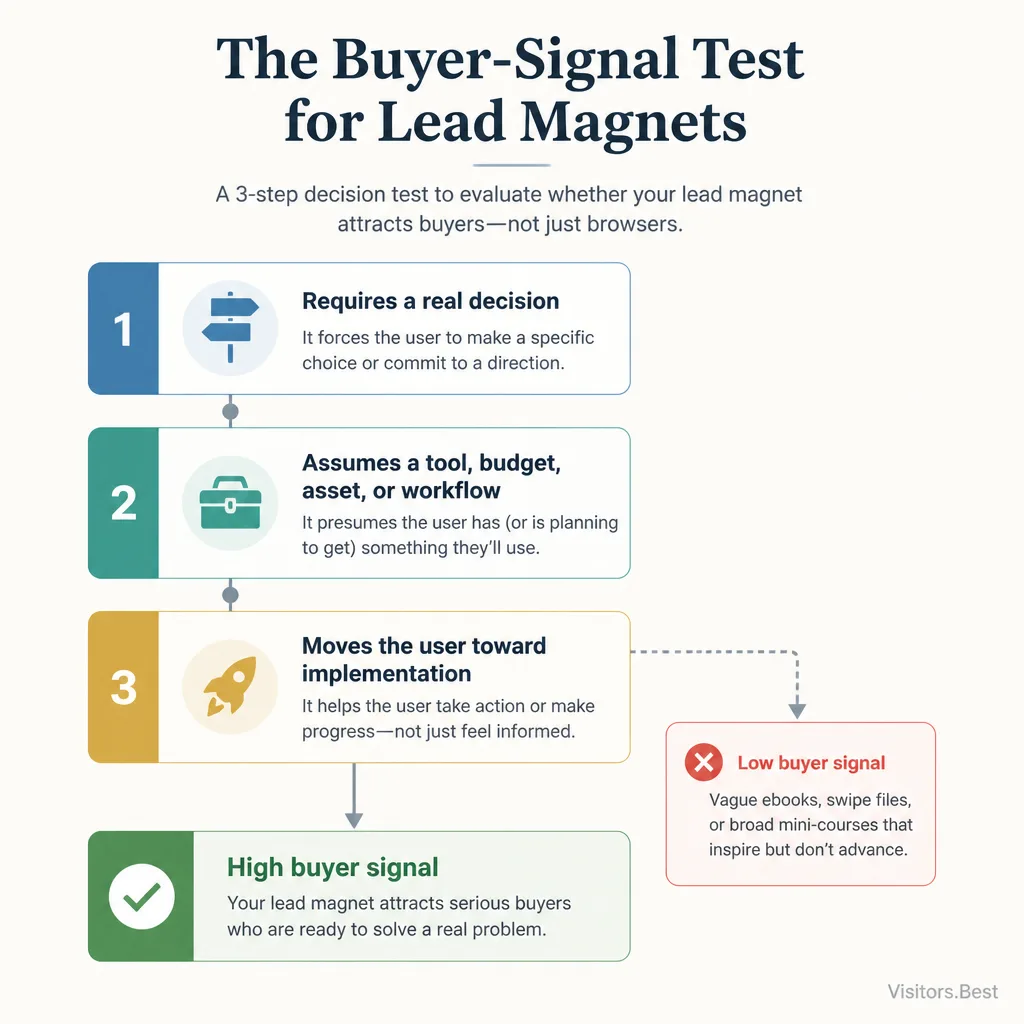
A useful lead magnet is not automatically a good one. In MMO, the best magnets pass a simple buyer-signal test.
Does it require a real decision?
If the asset forces the reader to think about pricing, margin, ad spend, offer structure, keyword choice, or client packaging, that is a strong sign.
People close to buying are usually willing to make decisions. Freebie hunters prefer content they can consume without committing to anything.
Does it assume the reader already has a tool, budget, asset, or workflow?
A landing page teardown template assumes the reader already has a page.
An ad budget planner assumes they are willing to spend, or at least model spend.
A KPI dashboard assumes they are running campaigns worth tracking.
That built-in assumption filters out a lot of low-readiness leads. Good.
Does it move the prospect toward implementation rather than inspiration?
This is where calculators, planners, scorecards, templates, and dashboards usually beat broad PDFs.
They are not glamorous. They are useful. More importantly, they create participation. That participation is often the first real qualification event.
A simple rule: the best MMO magnets help people do the next useful thing
Not everything. Just the next thing.
That is what makes the paid offer easier to position. The magnet creates clarity. The paid product, audit, service, or training deepens the process.
The 12 Best Lead Magnet Formats for MMO Audiences
1. Niche profit calculator
A niche profit calculator helps a prospect model revenue using inputs like traffic, conversion rate, EPC, product price, or margin.
Why it signals intent: it forces engagement with real business assumptions.
Best fit: affiliate SEO, niche publishers, digital product sellers.
Best next offer: niche validation workbook, affiliate funnel template, SEO training.
Watch out for: if it is too broad, it becomes entertainment. “Website profit calculator” is weak. “Affiliate review site breakeven calculator” is better.
2. Ad budget planner
This is a spreadsheet or planning sheet that helps the user map testing spend, CAC targets, and campaign scenarios.
Why it signals intent: budget planning sits close to action.
Best fit: paid traffic, media buying, lead-gen funnels.
Best next offer: campaign template pack, paid audit, media buying SOP.
Watch out for: this repels total beginners. In this case, that is often a feature.
3. Landing page teardown template
A structured worksheet that helps users review hooks, trust elements, CTA clarity, objection handling, and offer-message match.
Why it signals intent: the lead already has a page and wants better conversion, not just theory.
Best fit: affiliate funnels, digital products, service offers.
Best next offer: paid teardown, CRO service, funnel template bundle.
Watch out for: avoid generic CRO checklists. Tie it to revenue leaks.
4. Keyword pack for a specific monetization angle
A keyword pack works best when it is tightly scoped, such as buyer-intent keywords for hosting affiliates or comparison keywords for email software affiliates.
Why it signals intent: the user is choosing a traffic and monetization path.
Best fit: affiliate SEO, content sites.
Best next offer: content brief bundle, topical authority course, SEO tool recommendation.
Watch out for: broad keyword dumps attract collectors, not builders.
5. Outreach script pack
This can include cold email scripts, link outreach templates, partnership messages, or client acquisition sequences.
Why it signals intent: reaching out to real people is operational behavior.
Best fit: freelancers, agencies, link builders, partnership-driven creators.
Best next offer: outreach training, CRM template, deliverability setup, consulting.
Watch out for: commodity swipe bundles are weak. Annotations make them better.
6. Offer validation scorecard
A scorecard helps a prospect assess whether an offer has enough pain, audience fit, proof, pricing logic, and distribution potential.
Why it signals intent: they are actively testing whether something can sell.
Best fit: coaches, creators, info-product sellers, freelancers.
Best next offer: validation workshop, offer messaging template, strategy session.
Watch out for: keep it specific. “Business idea checklist” is too loose.
7. Funnel audit checklist tied to revenue leaks
A diagnostic asset focused on leaks between opt-in, email sequence, tripwire, checkout, and upsell.
Why it signals intent: they already have a funnel and believe money is leaking out of it.
Best fit: affiliate marketers, email marketers, digital product sellers.
Best next offer: paid audit, email sequence pack, optimization service.
Watch out for: generic audit PDFs are everywhere. Diagnosis beats documentation.
8. Simple tracking dashboard or KPI sheet
A lightweight sheet for tracking activation, clicks, tripwire take rate, revenue per lead, or first-purchase rate.
Why it signals intent: people who care about measurement are usually closer to buying or optimizing.
Best fit: marketers already running traffic or email campaigns.
Best next offer: analytics setup, reporting pack, performance consulting.
Watch out for: too complex and nobody uses it. Too simple and it feels disposable.
9. Pricing or package calculator for freelancers
A calculator that helps service providers price retainers, projects, or performance-based packages.
Why it signals intent: pricing is a commercial decision, not casual interest.
Best fit: copywriters, media buyers, funnel builders, SEO freelancers.
Best next offer: proposal templates, sales scripts, premium packaging support.
Watch out for: strong for service niches, weak for broad MMO audiences.
10. Swipe file with annotated examples
The important word here is annotated.
A plain swipe file attracts collectors. An annotated swipe file explains why a subject line, advertorial intro, CTA block, or checkout page works.
Why it signals intent: the prospect wants to adapt working assets, not just admire them.
Best fit: copywriting, affiliate funnels, email marketing, digital products.
Best next offer: copy breakdowns, prompt packs, page templates, done-for-you services.
Watch out for: without commentary, it becomes a commodity.
11. 7-day implementation sprint
A short guided sprint that produces a tangible output: a live opt-in page, first outreach batch, first offer draft, or campaign setup.
Why it signals intent: the user commits to execution.
Best fit: creators, freelancers, newer marketers with some urgency.
Best next offer: cohort program, accountability layer, template bundle, deeper course.
Watch out for: if it turns into motivation content, it loses value fast.
12. Tool stack blueprint by business model
This is not a software list. It is a constrained setup guide, such as a lean stack for a one-person affiliate email funnel or a low-cost stack for selling a mini-course.
Why it signals intent: tool selection usually happens near implementation.
Best fit: digital products, affiliate email funnels, small service businesses.
Best next offer: affiliate tools, setup service, automation templates, consulting.
Watch out for: these age faster than scorecards or planners, so they need updates.[^4][^5]
Which Lead Magnet Fits Which MMO Sub-Niche
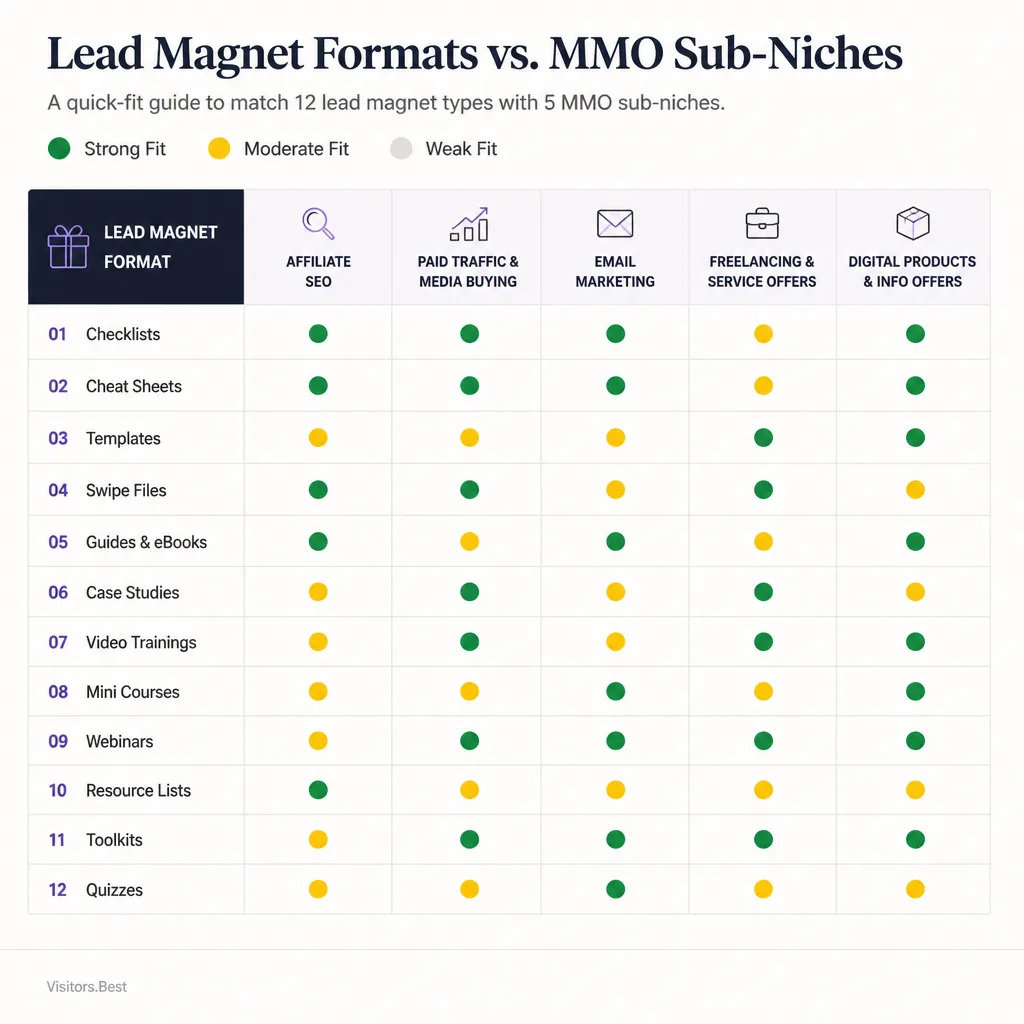
Affiliate SEO
Best choices: niche profit calculators, buyer-intent keyword packs, funnel leak audits, annotated swipe files.
These work because affiliate SEO is not just about traffic. It is about monetization structure. The lead is usually deciding what to rank for, what to promote, and how to convert the click.
Paid traffic and media buying
Best choices: ad budget planners, landing page teardown templates, KPI dashboards, funnel audit checklists.
This audience already thinks in numbers. A practical planner or dashboard feels more relevant than another “how to run ads” PDF.
Email marketing
Best choices: KPI dashboards, annotated email swipe files, funnel audits, implementation sprints.
Email marketers respond well to assets that sharpen sequence performance and monetization timing.
Freelancing and service offers
Best choices: pricing calculators, outreach scripts, offer validation scorecards, teardown templates.
These magnets work because they sit close to client acquisition and offer packaging.
Digital products and info offers
Best choices: offer validation scorecards, 7-day sprints, tool stack blueprints, funnel audits.
Product creators usually need help deciding what to sell, how to launch it, and how to avoid funnel friction.
How to Connect Each Lead Magnet to a Tripwire or Core Offer
Match the opt-in to the next paid decision
The best transition feels obvious in hindsight.
If someone downloads an ad budget planner, they should not land in a generic newsletter sequence. They should see the next paid step: maybe a campaign planning template, setup workshop, or audit.
If someone uses a landing page teardown worksheet, the natural follow-up is a paid teardown, template pack, or conversion consultation.
The rule is simple: the paid offer should continue the exact problem the lead magnet surfaced.
Examples of strong magnet-to-offer transitions
- Profit calculator → niche selection framework or funnel template
- Keyword pack → content brief bundle or SEO course
- Outreach scripts → cold outreach training or CRM setup
- Offer validation scorecard → workshop or strategy call
- KPI dashboard → analytics setup or optimization service
Where marketers create friction by offering the wrong next step
The biggest mistake is mismatch.
A lead magnet qualifies the prospect for one conversation, then the funnel tries to sell something else. That creates drop-off because the subscriber did not raise their hand for that problem.
The wrong next step does not just reduce conversion. It also makes your list data less trustworthy.
What to Avoid If You Want Buyers, Not Browsers
Generic ebooks
Easy to download. Easy to ignore.
Broad “free training” promises
They often attract topic interest, not problem urgency.
Mass-market templates with no specific use case
If the template could apply to anyone, it tells you very little about the downloader.
Lead magnets disconnected from the paid offer
This is the quiet funnel killer. List growth looks fine. Revenue does not.
Specificity will usually reduce opt-ins. That is not failure. It is filtering.
How to Measure Lead Magnet Quality in the First 14 Days
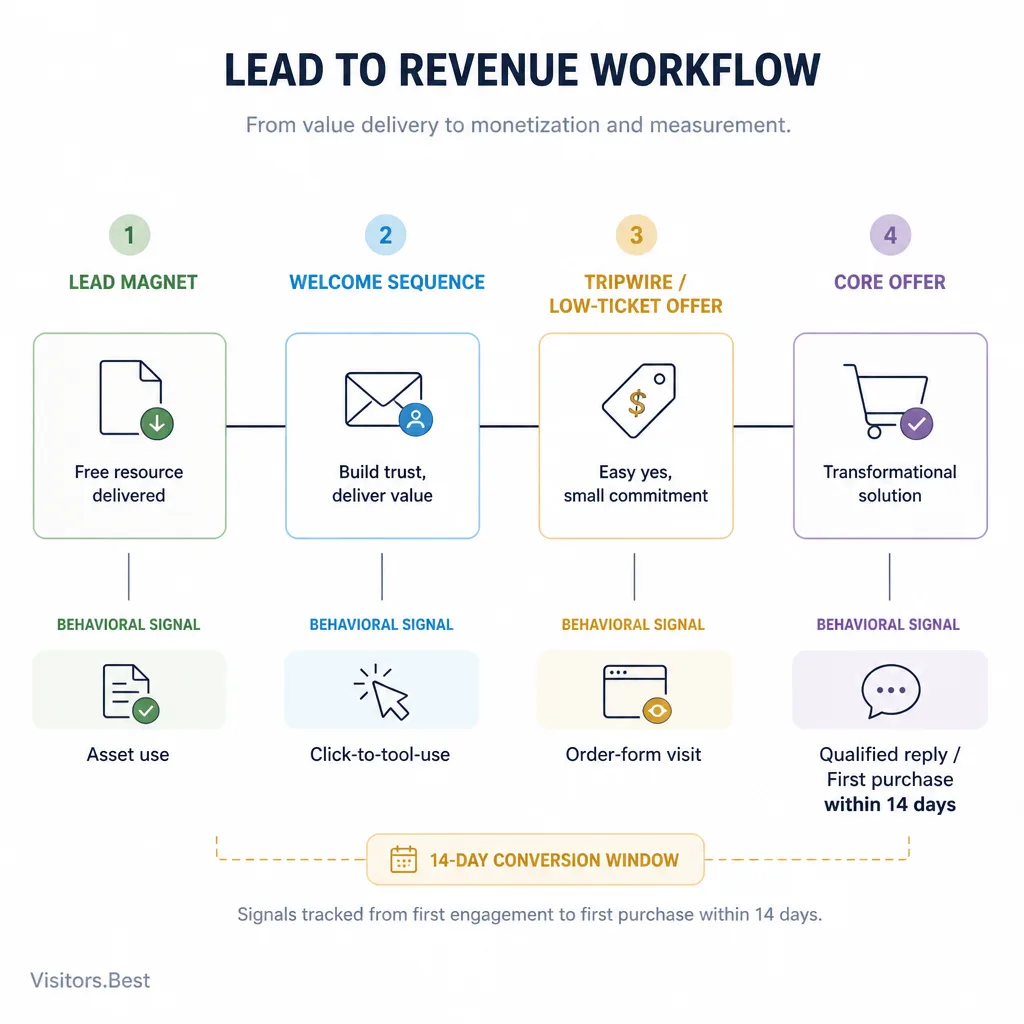
A 14-day window is not a universal rule, but it is a useful operating range for many MMO funnels because the path to affiliate clicks, tripwire purchases, and low-ticket conversions is often short.
Lead-to-MQL criteria
In this context, a marketing-qualified lead is not someone who merely opted in. It is someone who showed behavior that suggests commercial readiness.
That might include:
- asset use or completion
- repeat clicks from the welcome sequence
- tripwire checkout visits
- replies describing a real problem
- booked calls
- first purchase within 14 days
Behavior-based qualification models are standard in modern lifecycle systems and are generally stronger than raw list-growth metrics alone.[^1][^2]
Behavioral signals worth tracking
Track what reveals intent, not just attention:
- click-to-tool-use rate
- asset completion rate
- order-form visit rate
- tripwire take rate
- qualified reply rate
- unsubscribe rate after the first sequence
- revenue per lead within 14 days
Why opt-in rate and CPL are incomplete metrics
Opt-in rate tells you how persuasive the page was.
CPL tells you how cheaply you bought the email.
Neither tells you whether the subscriber is worth having.
A narrower magnet may produce fewer leads and still win on revenue per subscriber, tripwire conversion, or sales-call quality. That is especially true when traffic is warm, such as search traffic with clear problem intent.
A practical 14-day conversion window
For most MMO funnels, review each lead magnet after 14 days and ask:
- Did they use the asset?
- Did they click into the next decision?
- Did they buy the tripwire?
- Did they book a call or reply with context?
- What was revenue per lead, not just cost per lead?
One caution: lead magnet format is not the only variable. Traffic source quality, offer-message match, and brand trust all affect downstream conversion. A better magnet helps. It does not work alone.
Conclusion
The best MMO lead magnets do not try to impress everyone. They are specific enough to repel casual browsers and useful enough to attract people ready to act.
That is the shift.
If your current freebies produce subscribers but not buyers, do not ask how to make them broader. Ask how to move them closer to a real decision. A calculator, planner, scorecard, teardown, or dashboard may pull fewer opt-ins than a glossy ebook. It may also build a far more valuable list.
In this part of marketing, lower volume often means better signal.
FAQ
What makes a lead magnet work better in the make money online niche?
The strongest MMO lead magnets help the subscriber take a concrete next step, not just consume information. Assets like calculators, planners, scorecards, and teardown templates tend to qualify better because they reveal intent, effort, or existing business context.
Why do generic ebooks and free mini-courses often attract low-quality leads?
They are easy to download and easy to ignore. In many MMO funnels, broad educational freebies attract curiosity-driven subscribers who like the idea of making money online but are not close to acting, buying, or implementing.
Which lead magnets are best for affiliate marketing offers?
For affiliate SEO and affiliate funnels, strong options usually include niche profit calculators, buyer-intent keyword packs, funnel audit checklists, and annotated swipe files. These formats connect more naturally to monetization decisions than broad beginner guides.
How do I connect a lead magnet to a tripwire offer?
The next paid offer should feel like the logical continuation of the problem the lead magnet exposed. For example, a budget planner can lead into a paid campaign template, a teardown worksheet can lead into a paid audit, and a keyword pack can lead into a content brief bundle or SEO training.
What should I measure besides opt-in rate?
Look beyond cost per lead and track early downstream signals such as asset usage, click-to-tool-use rate, tripwire take rate, order-form visits, reply rate, booked calls, and first purchase within a defined conversion window such as 14 days.
Is a low-friction lead magnet always a bad idea?
No. Low-friction magnets can still work when your goal is list growth at scale and you have strong segmentation, retargeting, and follow-up systems. But if your priority is buyer quality and faster monetization, narrower, execution-focused magnets are often the better filter.