Platform dashboards still show conversions. That is the trap.
In affiliate lead gen, the bigger problem in 2026 is not that tracking disappeared. It is that the data left behind often looks complete enough to trust while staying incomplete enough to mislead. GA4 says one thing, Meta says another, your network says a third, and the CRM eventually tells a more expensive story.[^1][^2]
That changes the goal. For most teams, perfect attribution is no longer realistic. The practical target is a measurement system reliable enough to guide budget decisions with fewer false winners and fewer premature cuts.
Server-side tracking matters now because platform numbers are no longer a reliable source of truth
What changed: browser privacy, iOS restrictions, shorter cookie life, and weaker client-side signals
A lot of affiliate lead gen tracking still depends on browser-side events: page views, form submits, pixel fires, cookies, redirect parameters, and cross-domain handoffs.
That chain is now fragile.
Browser privacy protections, consent choices, script blocking, app tracking restrictions, and shorter-lived client-side identifiers all reduce the amount of data that survives from click to conversion.[^1][^3] In lead gen, the problem gets worse because the funnel is rarely simple. A user might go from ad to prelander to form to a booking tool to a CRM to an approval queue. Every handoff is another chance for source data to disappear.
The real problem is not just missing data. It is bad optimization decisions.
Missing data is annoying. Distorted feedback is expensive.
A campaign can look efficient inside an ad platform because it reports a low CPL. But if those leads turn into qualified opportunities at half the rate of another source, the cheap CPL was never the metric that mattered.
That is why optimizing from platform numbers alone has become less reliable in affiliate lead gen. Platform dashboards still have value. They just are not the scoreboard.
What breaks in affiliate lead gen measurement, and what still works
Where GA4 and browser pixels undercount or misattribute leads
Google Analytics 4 is useful for traffic analysis, event flows, and broad performance patterns. It is much weaker as a final ROI ledger when lead quality and revenue are confirmed later in a CRM or partner workflow.[^2]
Typical failure points include:
- redirect chains dropping query parameters
- hidden form fields not preserving source IDs
- cross-domain journeys breaking session stitching
- call or booking events happening off-site
- consent states preventing event collection
- revenue arriving days or weeks after the lead
None of that makes GA4 useless. It means GA4 belongs in the analysis layer, not at the top of your financial truth stack.
Why ad platforms are useful but dangerous as the main scoreboard
Ad platforms still matter for bidding and optimization, especially when you feed them conversion data through APIs or offline uploads.[^4][^5] But each platform uses its own attribution windows, modeled behavior, and reporting logic.
That is why cross-platform totals often exceed reality. Each system is grading itself.
A practical rule: use platform conversions as optimization inputs, not as proof of business performance.
What still works: first-party data capture, server events, click IDs, CRM stages, and network postbacks
What still holds up best is simpler and less glamorous than most tracking sales pages suggest:
- capture identifiers on landing
- store them somewhere durable
- pass them through the funnel
- map them to CRM stages
- return outcomes to networks and platforms where useful
Do that well and you can recover enough signal to make better decisions, even without perfect attribution.
The minimal measurement stack for 2026
A first-party tracking domain
A first-party tracking domain usually means collecting data through a subdomain you control instead of relying entirely on third-party browser calls. That can improve continuity and data control, assuming the setup is clean and consent logic is respected.[^1]
It is not magic. Bad DNS, sloppy tagging, or weak field mapping can break a first-party setup just as easily as a client-side one.
GTM server-side as a practical middle layer
Google Tag Manager server-side is best understood as middleware.[^1]
It can receive events, enrich them, transform them, and forward them to destinations such as GA4 or ad platforms. That makes the flow more resilient than a browser-only setup, but it also adds hosting, QA, and monitoring overhead.
For many affiliate teams, this is the practical middle ground: more control than pixel-only tracking without the burden of full data engineering.
Conversion APIs and offline conversion uploads where available
Where platforms support them, use server-side event forwarding or offline feedback:
These do not restore full attribution. They simply help platforms receive cleaner conversion signals than the browser alone can provide.
Capturing and storing unique click IDs at the moment of click or landing
This is the part that matters most.
You can build an elegant server container and still fail if you do not preserve the identifier chain. Depending on your stack, that may be:
- affiliate network click ID
- tracker click ID
gclidfbclid- your own visit ID
- UTMs plus a generated session or lead key
The label matters less than the discipline. Capture it on landing. Persist it. Attach it to the lead record.
How click IDs and postbacks keep affiliate attribution usable
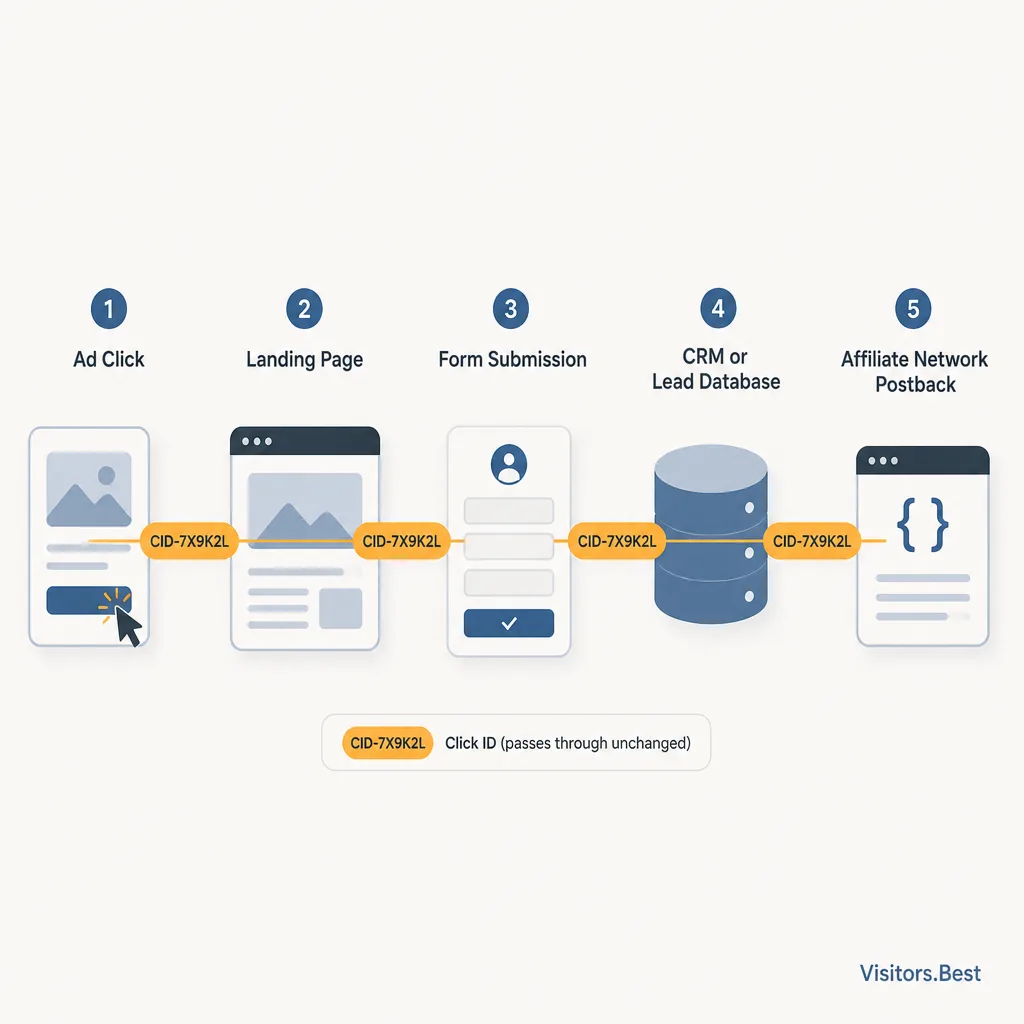
Passing click IDs through landing pages and forms
On landing, read the incoming parameters and write them into first-party storage where permitted. Then pass them into hidden form fields, quiz steps, booking links, or call tracking flows.
A common mistake is assuming the identifier made it into the form because it appeared in the URL on page one. That is not the same thing.
Storing IDs in your CRM or lead database
If the click ID is not saved in your CRM, it does not really exist for revenue analysis.
Store original source fields separately from “last touch” or overwritten campaign fields. Otherwise, your team will eventually lose the most reliable attribution data during deduplication or lead updates.
Sending conversion feedback back to networks with postback URLs
Postbacks are still one of the most dependable tools in affiliate measurement because they rely less on the browser at conversion time.
A postback URL typically sends event status and value back to the network or tracker using the original click ID. That lets the network connect the conversion to the recorded click even when browser-side tracking is incomplete.
Common implementation mistakes that quietly break attribution
This is where many setups fail:
- redirects dropping parameters
- forms not preserving hidden fields
- CRM deduplication overwriting original source
- timestamps using different time zones
- qualified leads not carrying the original click ID
- postback event names not matching network expectations
- payout values mapped to the wrong field
- consent states not passed into event forwarding
Server-side tracking does not fix sloppy plumbing. It just makes sloppy plumbing more expensive.
Build a source-of-truth sheet that reflects the business, not the ad platforms
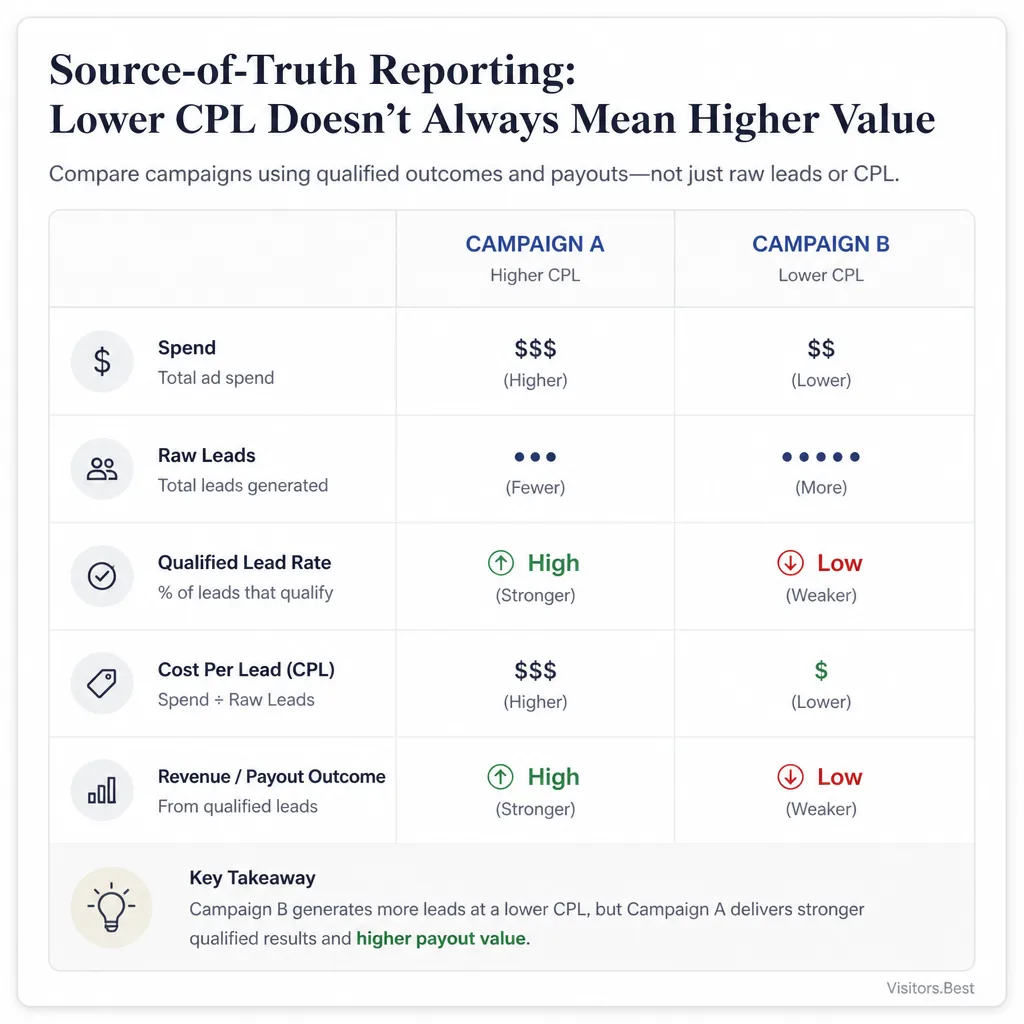
The five columns that matter: spend, leads, qualified leads, revenue, and lag
At minimum, build reporting by source and cohort date with these five fields:
- spend
- raw leads
- qualified leads
- revenue or payout
- lag
That can live in a spreadsheet at small scale or in a warehouse later. The structure matters more than the software.
Why qualified leads usually matter more than raw leads
Here is a realistic example.
Campaign A shows a $22 CPL in-platform. Campaign B shows $31. If you stop there, A wins.
But in the CRM, only 18% of A’s leads become qualified, versus 37% for B. Suddenly the more expensive campaign is cheaper where it counts.
This is a common mistake in affiliate lead gen: scaling the source that produces the most trackable forms instead of the one that produces the most usable pipeline.
How to handle delayed revenue and payout windows without fooling yourself
Lag distorts judgment.
A source can look weak after three days and strong after three weeks. That does not mean you should excuse bad traffic forever. It means your review window has to match the business.
Use cohort reporting by click date or lead date. Then compare metrics after a defined maturation window. If qualification takes 10 to 14 days, same-week optimization based on final payout is usually noise.
In practice, many teams use a near-term metric like cost per qualified lead for optimization, then validate later against approved sale rate or realized payout.
Use holdout tests to catch false winners
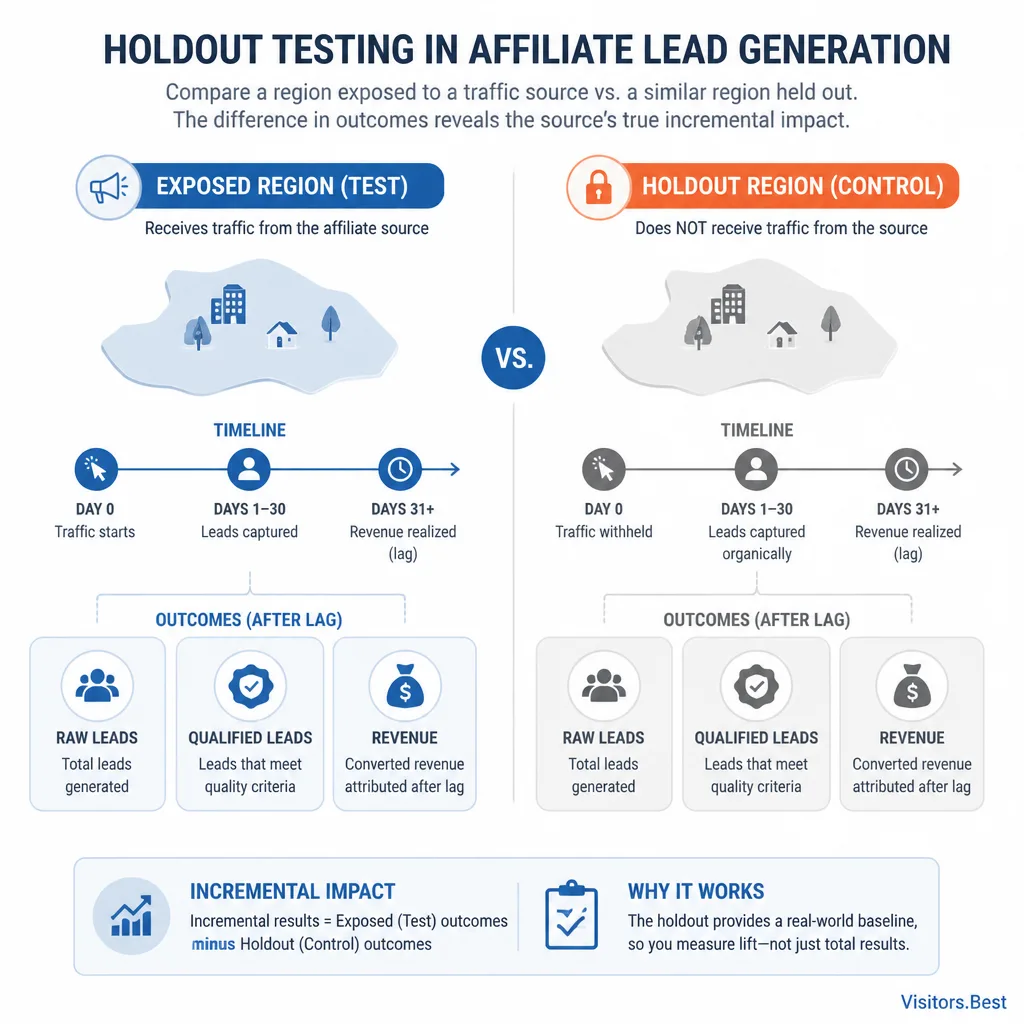
Why attribution-based optimization can over-credit the wrong source
Attribution tells you what was tracked. It does not reliably tell you what was incremental.
A source may claim conversions because it touched users near the end, because another channel created the demand first, or because modeled reporting filled the gaps. That is how false winners survive.
Simple holdout options: geo splits, time-based holdouts, audience exclusions
You do not need a perfect experiment to learn something useful.
Reasonable options include:
- geo splits between comparable regions
- time-based pauses on one source while others stay stable
- audience exclusions for a matched segment
- suppressing a retargeting or affiliate source in a controlled slice
None of these are flawless. They are still often more useful than another attribution dashboard.
What to measure during a holdout and how long to run it
Measure business outcomes, not just tracked conversions:
- raw leads
- qualified leads
- approval rate
- payout or revenue
- blended CAC or CPL across the system
Run the test long enough for lag to mature. If approvals take two weeks, a five-day holdout is mostly theater.
When server-side tracking is worth the complexity, and when it is not
Good fit: high spend, meaningful lead qualification variance, long sales cycles, multi-source buying
Server-side tracking usually makes sense when:
- spend is high enough that measurement errors affect budget allocation
- lead quality varies a lot by source
- qualification or payout is delayed
- you buy across multiple channels and networks
- someone on the team can own QA and maintenance
Poor fit: low volume, simple funnels, weak downstream data, no ability to maintain the setup
It is a poor fit when:
- volume is too low to learn much from better attribution
- the funnel is simple and short
- the CRM data is weak or incomplete
- no one can maintain tags, mappings, and postbacks
The hidden cost is not setup. It is maintenance.
A practical decision rule for small teams
If fixing identifier capture and CRM-stage reporting would already change your budget decisions, do that first.
Only add server-side infrastructure after the basics are stable.
Tool options for different levels of complexity
Lean stack: spreadsheet + CRM + network postbacks
Best for smaller teams.
Use a spreadsheet or basic BI layer, store click IDs and UTMs in the CRM, and send conversion status back via network postbacks. If calls matter, a tool like CallRail can help connect source data to phone outcomes.
Mid-tier stack: GTM server-side + first-party domain + webhook automation
This is often the practical middle ground.
Use a first-party tracking domain, GTM server-side, CRM identifier storage, and automation via tools like Zapier or Make to push downstream events where needed.
Advanced stack: warehouse, BI layer, and offline conversion feedback loops
For larger teams, add reconciliation in BigQuery, Snowflake, or similar tools, then visualize in Looker Studio or another BI platform.
This becomes worthwhile when you need cohort analysis across spend, leads, qualification, and payout at scale.
What to do next if your tracking is messy today
Start by fixing identifier capture
Before touching server containers, make sure click IDs and UTMs survive from landing to lead creation.
Then connect lead stages to traffic source data
Map lead, qualified lead, sale, and payout stages back to the original identifier in your CRM or database.
Then improve optimization with server events and testing
Once the identifier chain works, add server-side forwarding, offline conversion feedback, and holdout testing where the economics justify it.
Conclusion
Cookie loss did not make affiliate lead gen measurement impossible. It made lazy measurement expensive.
The teams adapting best are not chasing perfect attribution. They are building a stack that does three things well: preserves identifiers, ties lead quality to spend, and checks attribution against real-world tests when the stakes are high.
If your reporting is messy, resist the urge to start with the fanciest tool. Start with the chain of evidence. When you can reliably connect click to lead, lead to qualified stage, and qualified stage to revenue, the rest of the stack finally has something worth measuring.
FAQ
What is server-side tracking in affiliate lead generation?
Server-side tracking moves part of data collection and event forwarding from the browser to a server endpoint you control. In affiliate lead gen, teams usually use it to recover more signal, preserve identifiers more reliably, and send conversion data to analytics tools, ad platforms, or affiliate networks with less dependence on browser-side pixels.
Can server-side tracking fully restore attribution after cookie loss?
No. It can improve data continuity and reduce some client-side loss, but it does not recreate perfect attribution. Browser restrictions, consent limits, cross-device behavior, app environments, and delayed offline outcomes still create gaps. The practical goal is better decision-making, not perfect tracking.
Why do GA4, ad platforms, and my CRM show different conversion numbers?
They measure different parts of the journey using different attribution windows, identity rules, and event definitions. GA4 is often strongest for traffic and event analysis, ad platforms are designed for optimization inside their own systems, and the CRM usually reflects the lead and revenue stages that matter most to the business. Differences are normal. The problem starts when one dashboard is treated as the whole truth.
What is the minimal tracking stack for affiliate lead gen in 2026?
A practical minimum usually includes four pieces: first-party identifier capture on landing, storage of click IDs and UTMs in the form or CRM, postbacks to affiliate networks using the original click ID, and a reporting layer that ties spend to leads, qualified leads, and revenue or payout. GTM server-side and conversion APIs become more useful once spend and complexity increase.
Do I need GTM server-side to improve affiliate tracking?
Not always. If your main problem is that click IDs are not being captured, passed through forms, or stored in the CRM, GTM server-side will not fix it by itself. It becomes more valuable when you need a controllable middle layer for forwarding events to GA4, ad platforms, and other destinations with better resilience.
Why are click IDs so important for affiliate attribution?
Because the identifier chain is what connects the original click to the eventual lead, qualified lead, or sale. Whether the ID comes from an affiliate network, ad platform, tracker, or your own system, it has to be captured on landing, preserved across the funnel, stored downstream, and returned in postbacks or conversion feedback. If that chain breaks, attribution usually becomes guesswork.
What should be in a source-of-truth report for affiliate lead gen?
At minimum: spend, raw leads, qualified leads, revenue or payout, and conversion lag. Those metrics should ideally be grouped by traffic source and cohort date. That structure is usually more useful than relying on platform conversion totals alone because it shows lead quality and delayed value, not just immediate volume.
When is server-side tracking worth the complexity?
Usually when spend is high enough that attribution errors change budget decisions, when lead quality varies significantly by source, when conversion lag is meaningful, and when someone can maintain the setup. It is less compelling for low-volume funnels, short sales cycles, weak CRM data, or teams with no owner for ongoing QA and governance.
How do postback URLs help affiliate marketers measure ROI?
Postback URLs send conversion status and value back to an affiliate network or tracker using the original click ID. Because they rely less on browser-side conversion tracking at the moment of action, they are often more dependable for closing the loop between click, lead, qualification, and payout.
Why should lead gen teams run holdout tests if they already have attribution reporting?
Because attributed conversions and incremental value are not the same thing. A source can look strong in tracked reporting while adding little real business impact. Holdout tests such as geo splits, time-based pauses, or audience exclusions help check whether a channel is actually creating qualified leads or revenue rather than simply claiming them.